
If you wake up most mornings with a tight jaw, you already know the feeling well. A dull heaviness in the muscles. Teeth that ache slightly when you first open your mouth. A jaw that feels like it needs loosening before the day can really start.
For many people who grind or clench at night, jaw muscle tension is a consistent morning companion. A night guard protects your teeth from the grinding pressure — but the muscles doing the work still carry the load. That tension needs somewhere to go.
Targeted jaw exercises are one of the most accessible tools for managing that residual muscle tightness. No equipment, under ten minutes, done anywhere. More importantly, they address the muscular side of the equation that a night guard alone doesn't cover.
This guide walks through 8 exercises specifically useful for people managing jaw tension from grinding, clenching, or general TMJ muscle tightness.
Why Jaw Exercises Matter for Grinders and Clenchers
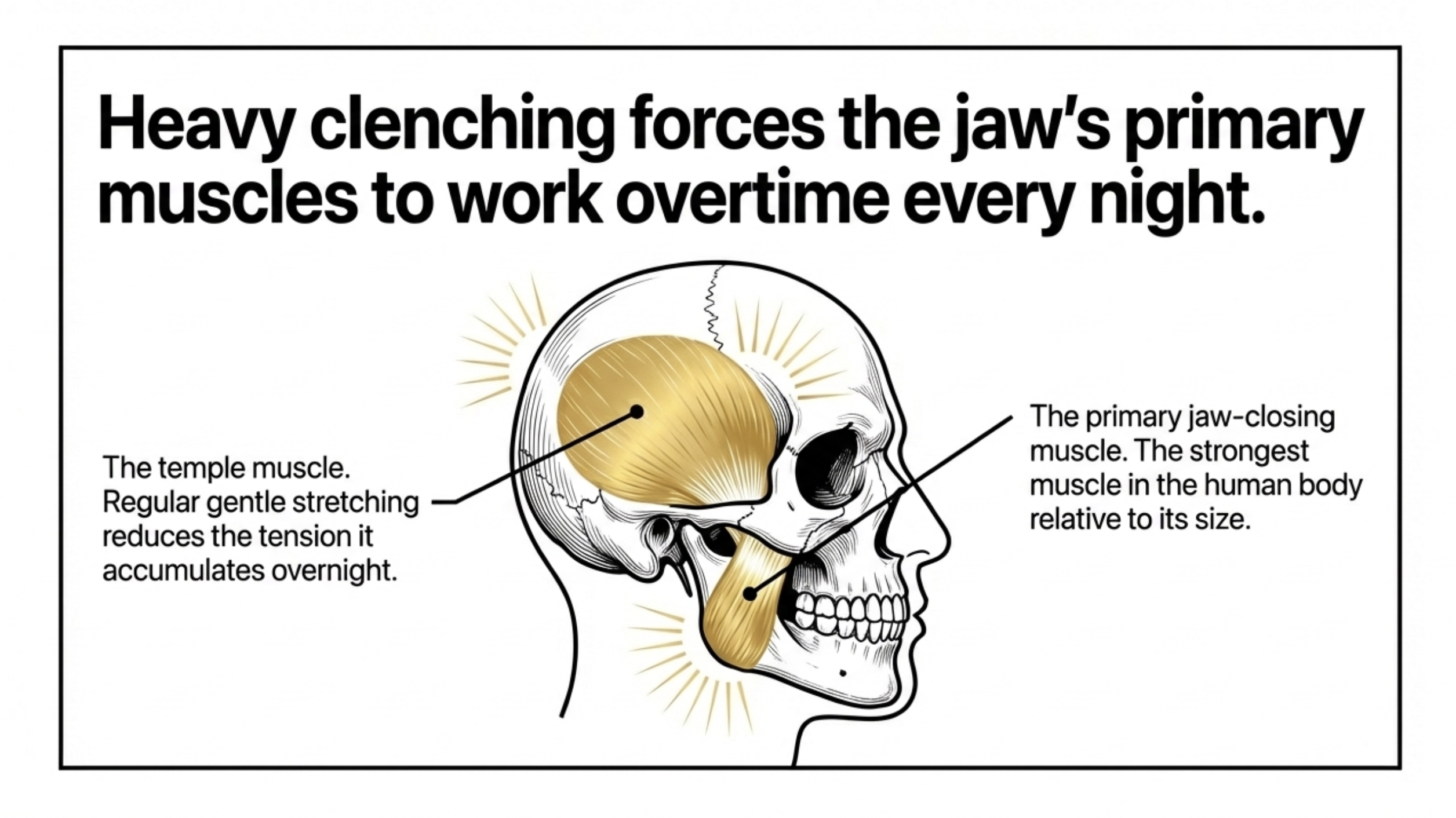
The masseter — the primary jaw-closing muscle — is the strongest muscle in the human body relative to its size. In people who grind or clench heavily, it works overtime every night. By morning, it can be tight, fatigued, and carrying significant residual tension.
Jaw exercises serve several purposes:
- Reduce residual muscle tension accumulated during nighttime grinding episodes
- Maintain or improve range of motion — heavy clenching can gradually reduce comfortable jaw opening
- Reinforce a relaxed jaw resting position — teeth slightly apart, lips gently closed, tongue on the palate
- Improve awareness of jaw position — exercises build proprioceptive awareness that can reduce daytime clenching
They are a complement to tooth protection — not a replacement for it. A night guard protects your enamel. Jaw exercises address the muscles. Both are useful; neither does the other's job.
Before You Begin: Positioning and Principles
A few principles apply to all exercises below.
- Posture first. Sit upright with shoulders relaxed and neck neutral — not craned forward.
- Never force range of motion. All movements should be within a comfortable range. Sharp discomfort is a signal to stop.
- Breathe. Hold gentle stretches for the count of breaths, not seconds. This keeps movement slow and discourages muscle bracing.
- Teeth apart, lips together. If you notice your back teeth are clenched before starting, consciously release them first.
The 8 Exercises
Place your tongue gently on the roof of your mouth, just behind the upper front teeth. Allow your lips to close without pressing. Let your back teeth separate slightly — they should not be touching. Breathe through your nose.
This is the anatomically correct resting position. Many habitual clenchers spend most of the day with teeth in contact. Practising this consciously resets that pattern.
How to use it: Set a reminder 3–4 times a day. Each time, consciously adopt this position for 30 seconds.
- Sit tall with shoulders relaxed
- Gently draw your chin straight back — as if making a "double chin"
- Hold for 3 slow breaths
- Release and repeat 5 times
The movement is small and horizontal — not a head-drop forward. You should feel a gentle stretch at the base of the skull.
- Place your thumb under your chin, applying light upward pressure
- Slowly open your mouth against that resistance — gently, not forcing
- Open to a comfortable range (not maximum)
- Hold for 3–5 seconds
- Slowly close
- Repeat 6–8 times
The resistance is light — you're building controlled movement awareness, not forcing your jaw open against opposition.
- Place two fingers lightly on your chin
- Open your mouth slightly — about 1–2 finger-widths
- Gently close against the light finger resistance
- Don't clench shut — stop when teeth are nearly together
- Hold 3 seconds, release, repeat 6–8 times
- Relax the jaw in the resting position
- Slowly move your lower jaw to the right as far as comfortable
- Hold for 2 slow breaths
- Return to centre
- Repeat to the left
- Perform 5 repetitions each side
If you feel significant clicking during this exercise, slow the movement and reduce range. New or increasing clicking warrants professional assessment.
- Start in the relaxed resting position
- Slide your lower jaw forward until your lower teeth are just in front of your upper teeth
- Hold for 2 slow breaths
- Return slowly to neutral
- Repeat 5 times
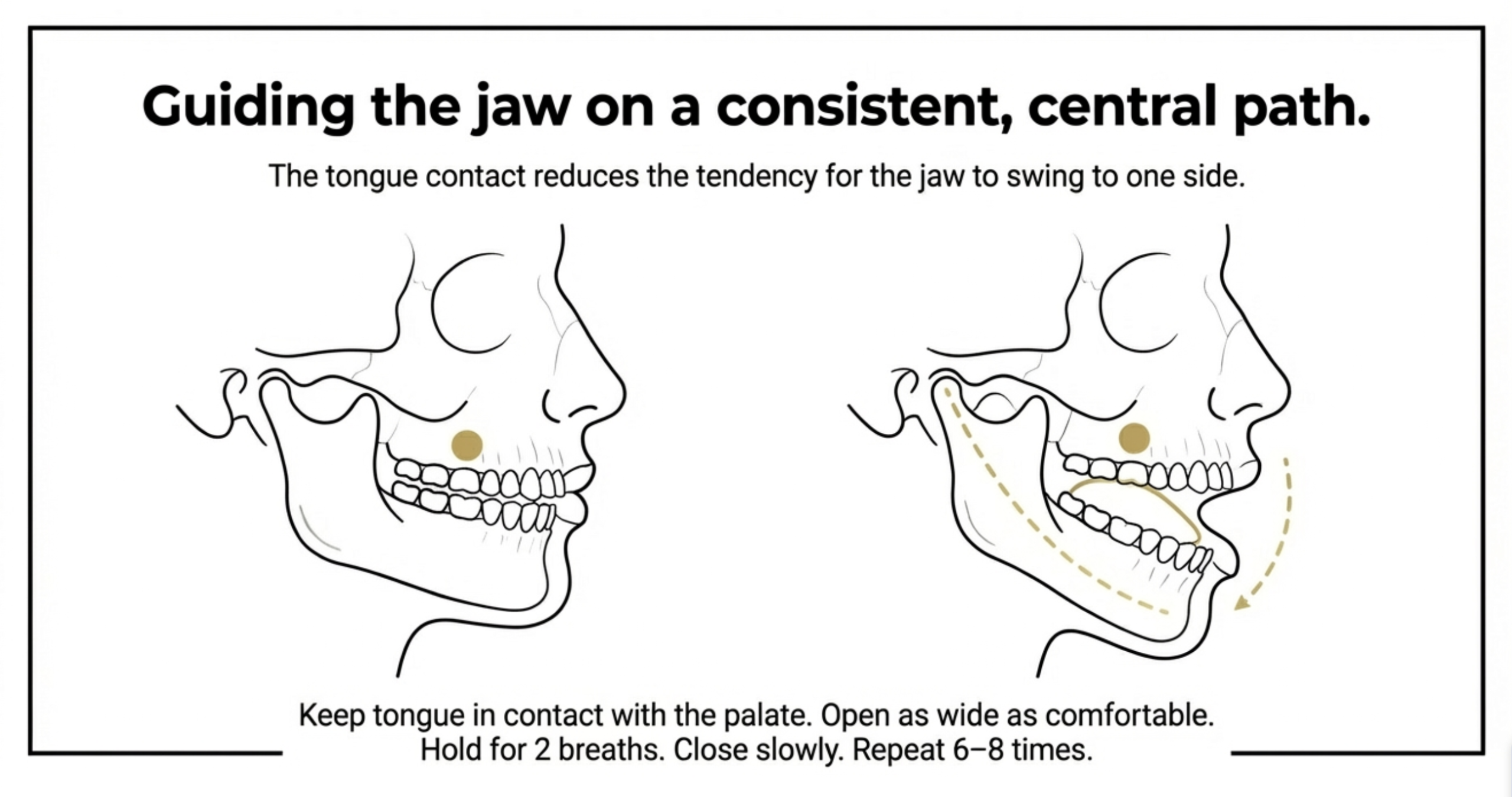
- Place your tongue on the roof of your mouth
- Keeping tongue in contact with the palate, open your mouth as wide as comfortable
- Hold at maximum comfortable opening for 2 breaths
- Close slowly
- Repeat 6–8 times
The tongue contact at the start guides the jaw open centrally, reducing the tendency for it to swing to one side.
Masseter (jaw-closing muscle):
- Place 2–3 fingertips just in front of and below the cheekbone
- Apply gentle circular pressure — not hard, not painful
- Move slowly along the muscle from cheekbone to jawline
- Spend 30–60 seconds per side
Temporalis (temple muscle):
- Place fingertips at your temples
- Apply gentle circular pressure
- Move slowly across the full extent of the muscle toward the ear
- Spend 30–60 seconds per side
Putting It Together: A Simple Daily Routine
You don't need to do all 8 exercises every day. A practical routine:
- Jaw muscle self-massage (masseter + temporalis) — 2 minutes
- Tongue-to-roof controlled opening — 8 reps
- Side-to-side jaw movement — 5 reps each side
- Relaxed resting position check — 3–4 times, 30 seconds each
- Chin tuck stretch — 5 reps
- Resisted mouth opening — 6 reps
- Forward jaw glide — 5 reps
How Exercises and a Night Guard Work Together
Jaw exercises and a night guard address different aspects of the same problem. A night guard protects your teeth from grinding pressure — it's passive protection that works regardless of what your jaw does. Jaw exercises address the muscular tension that grinding creates. They don't stop the grinding. They don't protect your teeth. But they reduce morning tightness, maintain mobility, and help build awareness that can reduce daytime clenching.
Used together, they cover different bases. The night guard is non-negotiable for protecting enamel. The exercises are a practical, low-cost complement.
Protecting your teeth during sleep is the foundation.
Find the right Reviv appliance →When to Seek Professional Help
Jaw exercises are appropriate for general muscle tension from grinding and clenching. They are not a primary intervention for diagnosed TMJ disorder, jaw locking, severe restricted opening, or structural joint issues.
Seek assessment from a dentist, physiotherapist, or physician if:
- Jaw opening range is significantly restricted (less than two finger-widths)
- You experience locking — the jaw getting stuck open or closed
- Clicking or popping is new, increasing, or accompanied by discomfort
- Jaw symptoms are affecting eating, speaking, or sleep significantly
- Exercises consistently produce discomfort rather than relief
The Bottom Line
Jaw tension from grinding and clenching is a muscular problem as much as a dental one. Protecting your teeth with a night guard addresses the dental side. Consistent jaw exercises — particularly a brief morning routine targeting the masseter and temporalis — address the muscular tension that accumulates overnight.
Neither replaces the other. Both are simple, low-cost, and significantly more effective than doing nothing.
Start with the morning routine. Build the habit. And if you're not yet wearing a night guard every night, that's the parallel step worth taking — the Reviv how-to-choose guide makes the decision straightforward, or browse the full range of FDA-registered Class I appliances designed for grinding protection.

Frequently Asked Questions
Do TMJ exercises actually work?
Gentle jaw exercises have good evidence for reducing muscle tension and maintaining jaw mobility in people with TMJ-related muscle tightness. They are most effective for the muscular component — reducing tightness from grinding and clenching and improving range of motion. They are not a treatment for structural TMJ conditions such as disc displacement.
How often should I do TMJ exercises?
A brief morning routine (3–4 minutes) targeting the masseter and temporalis through self-massage and controlled opening is the highest priority — daily. Check your jaw resting position 3–4 times during the day. An optional 2–3 minute evening routine before placing your night guard adds extra benefit. Consistency matters more than duration.
Can TMJ exercises make things worse?
When performed gently and within a comfortable range, these exercises are safe for most people with jaw muscle tension. Forcing range of motion, continuing through significant discomfort, or persisting with exercises that produce new clicking can be counterproductive. Stop any exercise that produces sharp discomfort or worsening symptoms.
Should I do jaw exercises before or after wearing my night guard?
The morning routine is best done after removing your night guard — this is when jaw muscles are most tight from overnight activity. The optional evening routine is best done just before placing the night guard, to reduce the tension load the jaw carries into sleep.
Do jaw exercises replace a night guard?
No. Jaw exercises address muscular tension — they do not protect your teeth from grinding pressure during sleep. A night guard protects your enamel. They are complementary tools, not alternatives.