
Night guard vs splint — what’s different?
Is a mouthguard the same as a night guard?
Can I use a sports guard instead?
What is an occlusal splint used for?
Night guard or splint — which is better?
You’ve seen all three terms. Maybe your dentist used one, an online search returned another, and the pharmacy shelf carries a third. Night guard. Splint. Mouthguard.
Are they the same thing with different names? Completely different products? Somewhere in between?
The honest answer: it depends on context, and the terms are genuinely inconsistently used — even among dental professionals. But there are meaningful distinctions worth understanding, because using the wrong appliance for your situation means either inadequate protection or paying for more than you need.
This article cuts through the terminology once and for all.
Already know you need a grinding or clenching appliance?
Compare the Reviv range →The Short Answer: How These Terms Actually Relate
Before going deep, here’s the plain-English version:
- Mouthguard is the broadest term — covers any appliance that goes in your mouth to protect teeth, from sports guards to night guards.
- Night guard is a subset of mouthguard — specifically one worn during sleep to protect against grinding and clenching.
- Splint (or occlusal splint) is a more clinical term for a hard, full-arch appliance — often prescribed for bruxism or jaw management, and functionally overlapping significantly with a night guard.
So: all night guards and splints are mouthguards. Not all mouthguards are night guards or splints. And “night guard” and “splint” overlap substantially but aren’t always identical.
Mouthguard: The Umbrella Term
A mouthguard is any removable appliance worn inside the mouth to protect the teeth, soft tissues, or jaw from force. The term covers a genuinely wide range of products with very different purposes.
Sports mouthguards
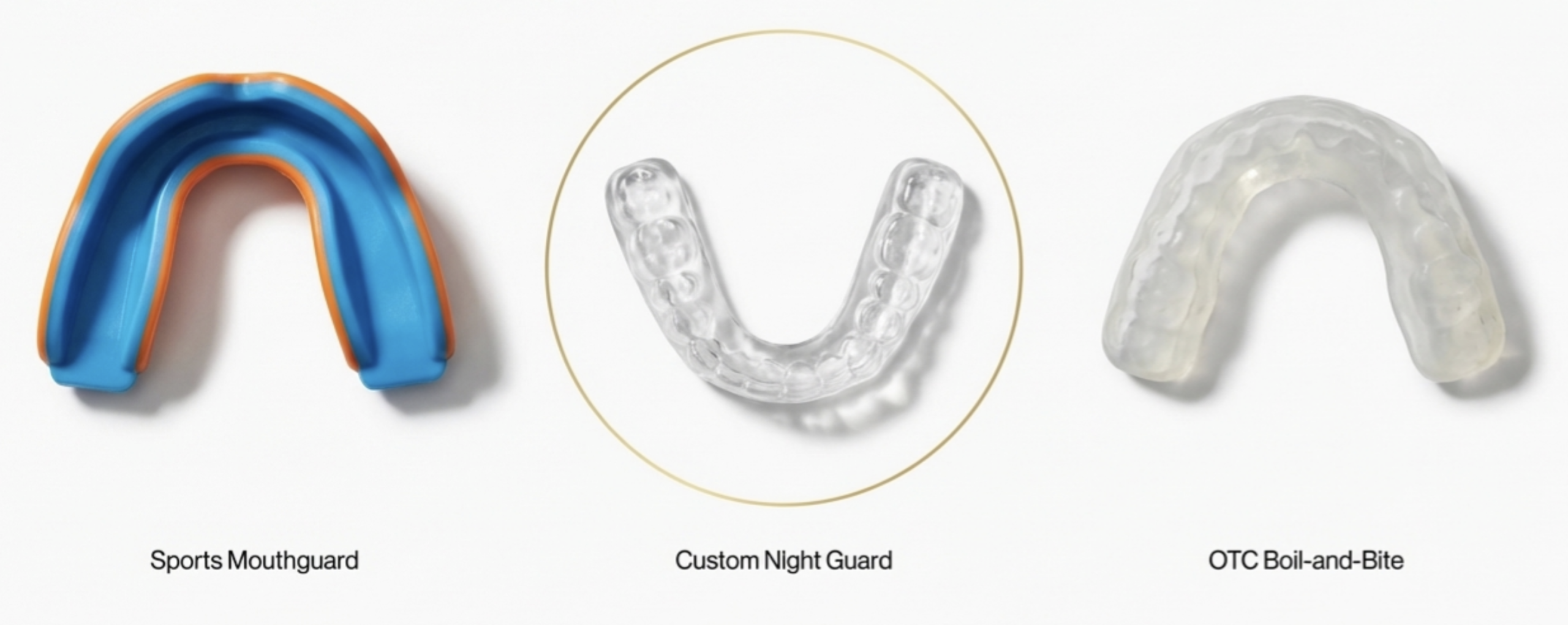
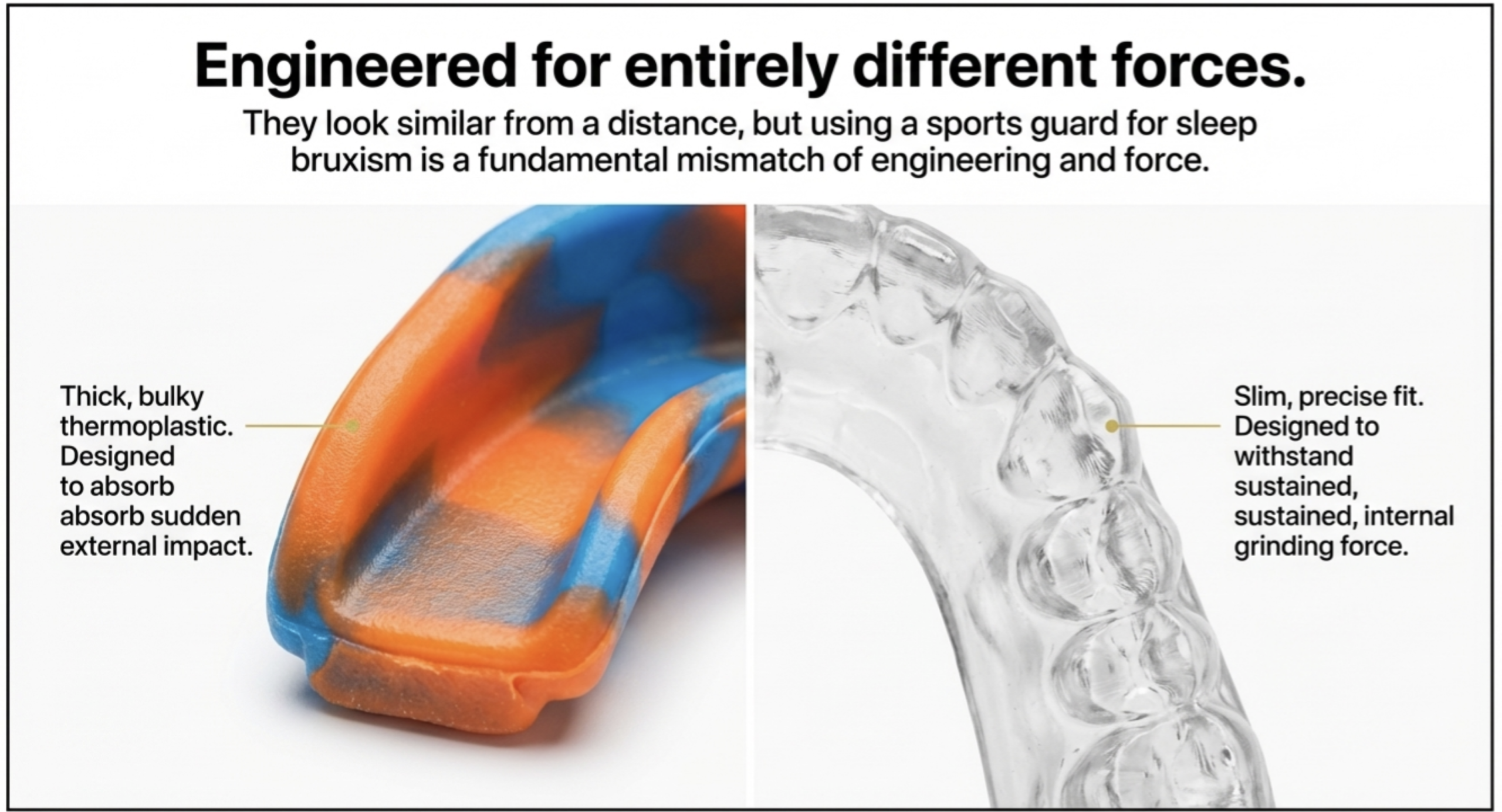
Designed to absorb and distribute the impact of external blows — a punch in boxing, a fall in skateboarding, a collision in rugby. Typically made from soft or dual-layer thermoplastic material, prioritising impact cushioning and bulk. Not designed for the sustained, repetitive grinding force of bruxism — using a sports guard as a night guard is possible but suboptimal.
Night guards (for grinding and clenching)
Designed to protect teeth from the internal forces of grinding and clenching during sleep. Design priorities differ from sports guards: fit precision, appropriate material hardness for grinding intensity, and comfort for all-night wear.
Retainers and orthodontic appliances
Sometimes loosely called mouthguards. These serve an orthodontic function — maintaining tooth position — rather than a protective one. Not relevant to the grinding or clenching conversation.
Night Guard: The Consumer Standard
A night guard is an oral appliance worn during sleep to protect teeth from bruxism. It covers one dental arch and interposes a protective layer between the teeth so that grinding force is absorbed by the appliance rather than the enamel.
Night guard is primarily a consumer term — widely used in marketing, on pharmacy shelves, and in general dental conversations. It doesn’t imply a specific material, design, or prescription status.
Night guards range from basic OTC boil-and-bite products to dentist-fabricated custom appliances, in soft, hard, and dual-layer materials. The term itself doesn’t tell you much about construction quality or protection level.
What makes a night guard effective
- Custom fit from an impression of your actual bite
- Material hardness appropriate to your grinding intensity
- Full arch coverage (molar to molar)
- Adequate thickness for your force level
When your dentist recommends a “night guard,” they usually mean a custom-fitted hard appliance — closer to the clinical end of the spectrum than the pharmacy shelf end.
Occlusal Splint: The Clinical Appliance
An occlusal splint is a rigid, custom-fabricated appliance that covers the full biting surface of one dental arch. Made from hard acrylic, fitted precisely over the teeth, worn primarily during sleep.
If that sounds like a night guard, it’s because functionally a well-made custom night guard and an occlusal splint are very similar. The differences are primarily in:
- Clinical context: Splints are more often prescribed as part of a specific clinical plan — bruxism, bite stabilisation, or jaw muscle management
- Design precision: Splints are fabricated to more exacting standards, with specific attention to how the arches meet on the appliance surface
- Thickness and coverage: Typically hard acrylic, full arch, 2–3mm or more
- Cost and source: Almost always dentist-fabricated — $300–$800+
Types of occlusal splints
Stabilisation splint (Michigan splint): The most common type. Full arch, hard acrylic, worn at night. Designed to provide even contacts across the arch and protect teeth from grinding force.
Anterior repositioning splint: Positions the lower jaw slightly forward. Used for specific jaw management under clinical supervision. Requires professional prescription and monitoring — not a standard night guard.
| Stabilisation splint | Anterior repositioning splint | |
|---|---|---|
| Primary use | Tooth protection from bruxism | Jaw position management |
| Material | Hard acrylic | Hard or dual-layer |
| Who prescribes | General dentist | Often specialist referral |
| OTC available? | No | No |
Full Side-by-Side Comparison
| Appliance | Primary purpose | Material | Custom fit? | Worn when |
|---|---|---|---|---|
| Sports mouthguard | Impact protection | Soft / thermoplastic | Optional | During sport |
| OTC night guard | Light tooth protection | Usually soft | No (boil-and-bite) | Sleep |
| Custom night guard | Moderate–heavy tooth protection | Soft, hard, or dual | Yes | Sleep |
| Stabilisation splint | Tooth protection + bite stability | Hard acrylic | Yes (dentist) | Sleep |
| Anterior repositioning splint | Jaw position management | Hard or dual | Yes (dentist) | As prescribed |
| Retainer | Tooth position maintenance | Varies | Yes | Sleep or day |
Which One Do You Actually Need?
For most people reading this article, the relevant choice is between a custom night guard and an OTC night guard — not between a night guard and a clinical splint.
Light grinding or clenching, no dental wear noted
A quality OTC boil-and-bite guard may be a reasonable starting point. Understand it offers approximate fit and limited protection — worth upgrading to custom if grinding continues.
Confirmed bruxism, some enamel wear, regular jaw tension
A custom night guard — mail-order or dentist-fabricated — is the right level. Hard or dual-layer material for moderate-to-heavy grinding. The terminology (night guard vs occlusal guard) matters less than the construction specification.
Significant bruxism, complex bite history, specific splint recommendation
A dentist-fabricated occlusal splint is appropriate. Follow your dentist’s guidance — there may be clinical reasons for the prescription beyond basic tooth protection.
Jaw management beyond tooth protection
Outside the scope of any OTC or standard mail-order product. Professional assessment and prescription are necessary.
Why the Terminology Is So Inconsistent
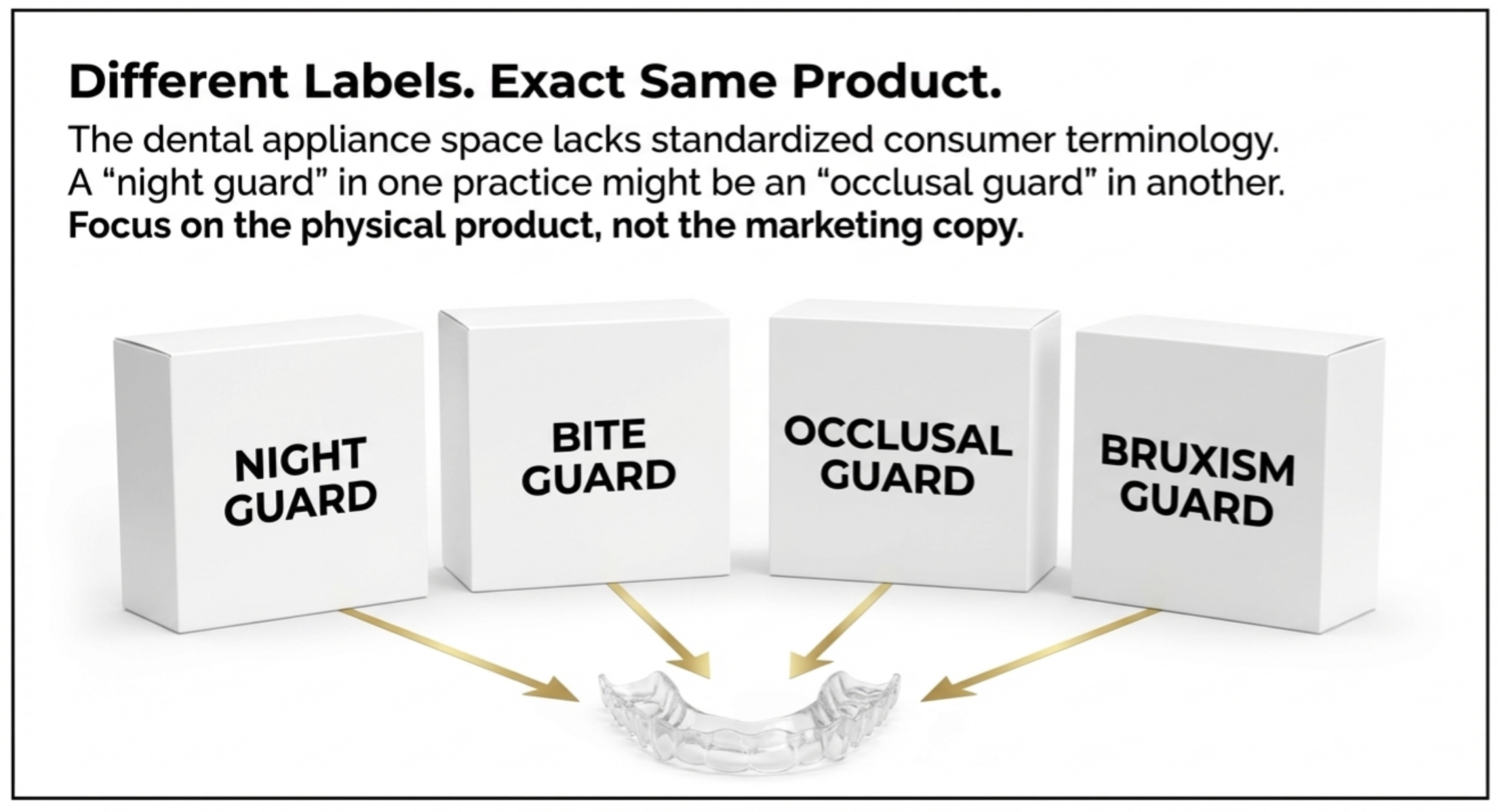
The dental appliance space has no standardised consumer terminology. Different manufacturers, dentists, and markets use the terms differently. A “night guard” in one practice might be described as an “occlusal guard” in another and a “bite guard” by a third — all referring to the same appliance.
Adding to this, the lines between a high-quality custom night guard and a dentist-made occlusal splint genuinely blur. A well-constructed custom mail-order hard night guard made from an accurate impression is functionally very close to a clinical stabilisation splint. The distinction is in how it was prescribed and fabricated — not always in what it does.
The practical implication: focus less on the label and more on the specification. Material, fit quality, arch coverage, and thickness are the variables that determine protection. The name on the box is secondary.
The Bottom Line
Mouthguard is the umbrella. Night guard and splint are subsets — both describe appliances worn to protect teeth from grinding force, with splints typically carrying more clinical specificity and design precision. The terms overlap significantly and are often used interchangeably.
For most people managing bruxism, the practical choice is between an OTC night guard (adequate for light use) and a custom appliance — whether marketed as a night guard, occlusal guard, or splint. The construction matters more than the name.
If your dentist has specifically recommended a splint, follow that guidance. For everyone else: focus on fit, material, and coverage. The Reviv how-to-choose guide helps you find the right match, or browse the full Reviv range of FDA-registered Class I appliances designed for grinding and clenching protection.