
Are OTC guards good enough?
Best OTC guard for heavy grinding?
Can I use HSA/FSA for night guards?
How long does an OTC guard last?
OTC vs custom — what’s the difference?

Most night guard articles treat OTC as a second-class option — something you use until you can afford a “real” guard. That framing misses the point. For a significant portion of grinders, OTC guards are genuinely the right answer. The problem isn’t the OTC category; it’s that most people don’t know when they’ve outgrown it.
This guide covers the OTC options honestly — what each type actually does, which ones are worth buying, and the specific signals that tell you the $25 drugstore guard is no longer sufficient. It also covers the tier most articles skip: DTC custom guards, which occupy the premium OTC price range while delivering lab-fabricated custom fit — the category that makes the dentist’s $600 quote look hard to justify.
What “OTC” Actually Covers — and What It Doesn’t
The term “over-the-counter” covers three meaningfully different product types that get lumped together in most roundups:
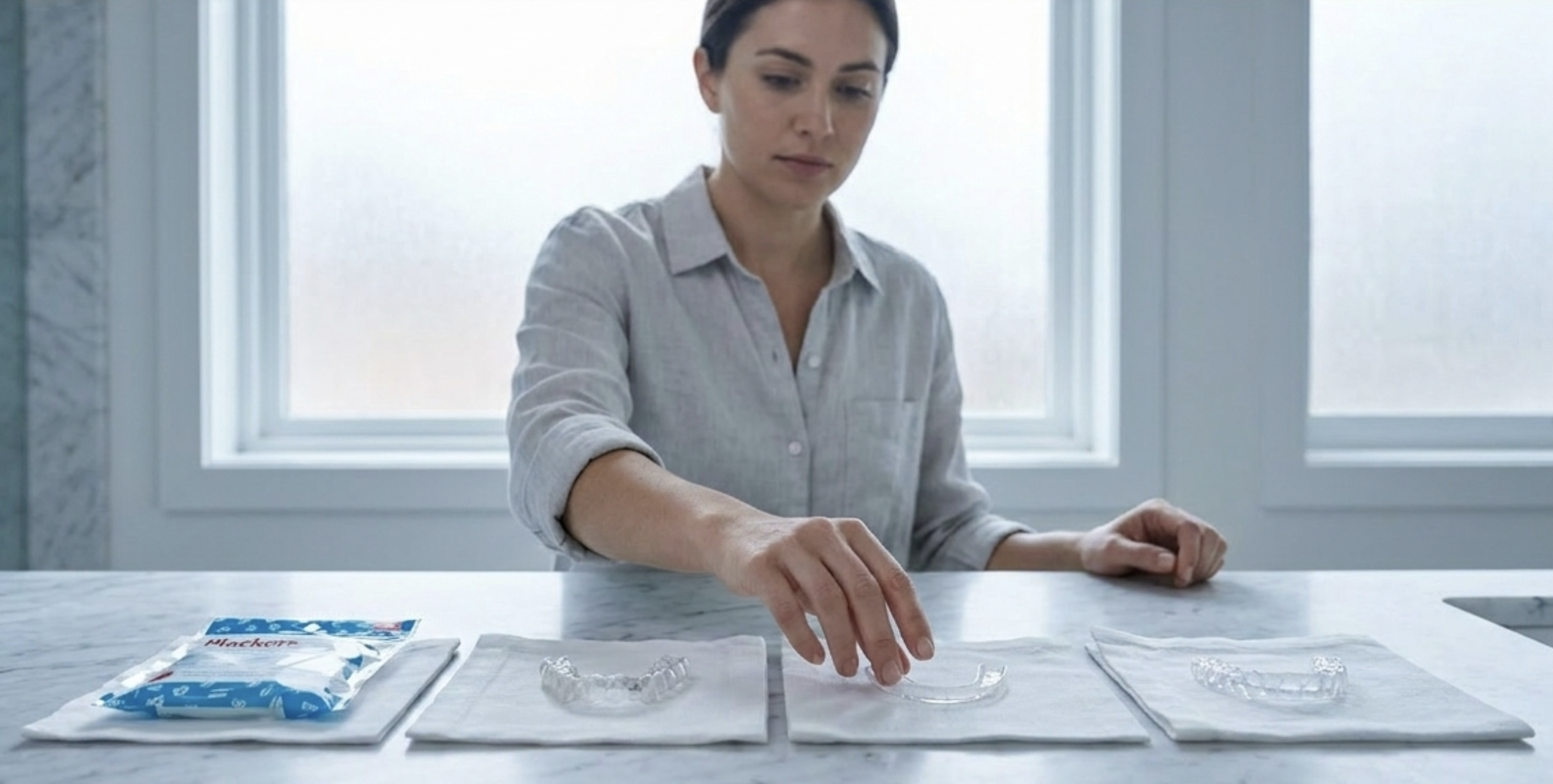
Type 1 — Ready-to-wear disposables (Plackers Grind No More, ~$22/16 pack). Pre-formed, no boiling, no molding. Insert and sleep. BPA-free soft thermoplastic. Each guard is used for 1–5 nights depending on grinding force, then discarded.
Type 2 — Boil-and-bite moldables (DenTek Professional-Fit, Neomen, Oral-B, ~$15–30). Softened in hot water, bitten to create a semi-custom impression, then set. Reusable for weeks to months depending on grind intensity. Better fit retention than ready-to-wear.
Type 3 — DTC custom via impression kit (Pro Teeth Guard, Chomper Labs, Reviv, Remi, ~$80–200). Ordered online, impression kit mailed to you, custom guard fabricated by dental lab from your exact impressions. Technically not “off-the-shelf” but categorised as OTC for purposes of the cost-conscious searcher — and priced in the same range relative to the $400–800 dentist alternative.
The distinction matters because Types 1 and 2 are generic-fit thermoplastic that approximates your arch. Type 3 is the same lab-custom process a dentist uses, delivered through a different distribution model. They’re not the same category, even though they’re all “not from a dentist.”
The OTC Options: Honest Assessment
Plackers Grind No More — best for compliance over fit
The most popular OTC guard on Amazon for one reason: zero friction. No boiling, no molding, no getting the fit wrong. Open the package, insert, sleep. For people who have tried moldable guards and found them too bulky, fidgety to prepare, or easy to skip — the disposable format removes every excuse.
What it actually does: BPA-free soft thermoplastic, pre-formed to a general arch shape. Provides a cushion layer between upper and lower teeth. Doesn’t fit your specific arch — it fits an approximation of most arches.
Who it’s right for: Light grinders who want something to wear right now with no setup. Travellers. People who want to test whether they can tolerate wearing a guard at all before committing to anything custom.
The honest limitation: The material is soft throughout. It will compress under meaningful force. Heavy grinders will go through a pack in days. At $22 for 16 guards and heavy nightly use, the cost compounds quickly. The convenience premium is real — but it has an upper limit.
DenTek Professional-Fit — best boil-and-bite for most people
The most widely available moldable guard, sold in most drugstores. BPA-free, three-step fitting process (boil, bite, set), produces a semi-custom fit that holds for weeks to months. Marketed as the #1 OTC dental guard brand, though that claim is self-reported.
What it actually does: The boil-and-bite process creates a mold that loosely matches your arch. Better retention than pre-formed guards — less shifting during sleep. Dual-layer design on some versions (firm base, softer top) provides more force distribution than a purely soft guard.
Who it’s right for: Light to moderate grinders who want a boil-and-bite option they can find at a pharmacy today. The fitting process is straightforward and well-documented. Lasts 2–6 months for light grinders.
The honest limitation: “Semi-custom” is doing some work in that description. The fit is better than pre-formed but still approximates your arch rather than matching it. Under significant grinding force, the guard can still rock and shift.
Neomen Professional Dental Guard — best boil-and-bite for slim profile
Online-only (Amazon), slim profile, easy molding process, one of the least expensive boil-and-bite options at around $20 for a pack of four. The Wirecutter-adjacent testing called it “one of the slimmest and easiest-to-mold guards” across 11 tested options, which is meaningful when most boil-and-bite guards are noticeably bulky.
Who it’s right for: Light grinders who found DenTek or other moldable guards too thick. The slim profile means less jaw-muscle loading overnight.
The honest limitation: Four guards in a pack assumes a turnover rate — this isn’t positioned as a long-term solution but as a recurring purchase. For light grinders where each guard lasts 2–4 months, the economics are fine. For heavy grinders, the math breaks down quickly.
The Soft Guard Problem Nobody Explains Clearly
Here’s the piece of information that should be in every OTC guard roundup but almost never is: soft guards can cause jaw muscles to clench harder.
The mechanism is the same one that makes you chew more when you have gum in your mouth. A soft, compressible material against your teeth gives the jaw musculature something to bear down against. For some people — particularly clenchers — a soft guard doesn’t passively absorb force; it actively invites the muscles to generate more of it. The effect has been described as “like doing bicep curls for your jaw” — the resistance training your masseter didn’t need.
This doesn’t mean soft guards are always wrong. For pure grinders (lateral movement, not vertical compression), soft guards absorb the lateral force reasonably well. For clenchers and combined grinder-clenchers, the compressibility becomes a liability.
The practical implication: if you use a soft OTC guard and wake up with more jaw tension than before, this may be why. It’s not universal — some people tolerate soft guards perfectly well — but it’s common enough to be worth knowing before you attribute morning jaw soreness to something else.
The Five Signals That Tell You It’s Time to Upgrade
OTC guards are right for a portion of grinders. The following signals mean you’ve outgrown them:
Signal 1: You’re replacing guards more often than every 8 weeks. A soft OTC guard lasting under 8 weeks on a nightly grinder signals grind force that the material can’t absorb adequately. You’re spending more per year than a custom guard would cost — and getting less protection.
Signal 2: You wake up with consistent jaw soreness most mornings. A guard that’s working should be absorbing force before it manifests as muscle fatigue. If jaw soreness is a regular feature of your mornings despite wearing a guard, either the material isn’t absorbing adequately or the fit is causing the guard to shift and create uneven contact points.
Signal 3: Your dentist has flagged enamel wear at two or more consecutive check-ups. A guard that’s doing its job should be taking the wear instead of your teeth. Progressive enamel wear while using a guard means the guard isn’t intercepting the force effectively — either because the material has worn through in the high-contact zones or because the fit doesn’t cover those zones properly.
Signal 4: You’ve cracked or chipped a guard. Structurally failing a soft guard means your grinding force exceeds what soft thermoplastic was designed to handle. This is the clearest material-mismatch signal.
Signal 5: You wake up without the guard in. If you’re consistently removing the guard in your sleep — consciously or not — the guard is uncomfortable enough to trigger removal. This is almost always a fit issue. A guard that doesn’t fit well shifts, rocks, or creates pressure points that your sleeping brain eventually rejects. A custom-fit guard resolves this because it snaps securely onto your specific arch geometry.
The Premium OTC Tier: DTC Custom Guards
This is the category that the “OTC vs dentist” framing obscures. DTC custom guards from companies like Pro Teeth Guard, Chomper Labs, Sentinel, and Reviv are not the same as boil-and-bite OTC guards — and they’re not the same as a dentist visit either. They occupy a genuinely different tier:
- You order online, no dentist appointment needed
- An impression kit arrives in 2–3 days
- You take impressions of your teeth at home (15–20 minutes)
- The impressions go to a dental lab — the same type of lab that makes dentist-ordered guards
- A custom guard fabricated from your exact arch arrives in 2–3 weeks
- Cost: $80–200, depending on material and brand
- Dentist equivalent: $400–800 for the same lab output, plus chair time
The fit difference between a boil-and-bite and a lab-custom guard is not marginal — it’s the difference between a guard that approximates your arch and one that snaps securely onto it. For moderate to heavy grinders where guard shifting is a real issue, this matters.
Which DTC custom brands are credible:
- Pro Teeth Guard — multiple material options (soft, hard, ultra-hard, hybrid), strong refund and re-impression policy, lab-direct pricing. Consistently recommended in bruxism communities. The hard and ultra-hard options are the appropriate tier for moderate to heavy grinders.
- Chomper Labs — subscription model at ~$129, clean impression process, good for people who want seamless reordering without repeating the impression step.
- Sentinel — small-brand pricing, dentist-grade lab output. Solid for people who don’t need subscription or warranty frills.
- Reviv — FDA-registered Class I device (Device Code BRW) with a biomechanical bite surface design rather than flat acrylic. R1 (soft, light grinders), R2 (dual-layer, moderate grinders and clenchers), R3 (hard, heavy grinders). The R2 is the most commonly appropriate model for the grinding-and-clenching pattern. Find your model →
HSA and FSA Coverage: The Hidden Discount
This is the most underreported piece of information in night guard buying advice: night guards — both OTC and DTC custom — are eligible for Health Savings Account (HSA) and Flexible Spending Account (FSA) funds.
Night guards qualify as dental devices under IRS guidelines. This means if you have an HSA or FSA, your guard is effectively purchased with pre-tax dollars — a 20–37% discount depending on your tax bracket.
Most major DTC brands accept HSA and FSA cards directly at checkout:
- Pro Teeth Guard — HSA/FSA accepted
- Chomper Labs — HSA/FSA accepted
- Smile Brilliant — HSA/FSA accepted
- Reviv — HSA/FSA accepted
If you’re comparing a $150 DTC custom guard against a $25 OTC boil-and-bite, applying HSA funds to the DTC guard brings the effective cost down to $90–120 for most people. The durability math (2–5 years vs 3–6 months) then makes the upgrade unambiguously rational for any moderate grinder.
Check your HSA/FSA card’s eligible expense list if uncertain — Truemed and FSAstore can confirm specific products’ eligibility if a brand doesn’t accept the card directly.
Frequently Asked Questions
Are OTC night guards good enough for teeth grinding?
For light grinders — yes. If your guards last 3+ months, you wake up without jaw soreness, and your dentist hasn’t flagged enamel wear, OTC is adequate and cost-effective. For moderate to heavy grinders, soft thermoplastic OTC guards wear through too quickly and the per-night cost exceeds a custom guard within a few months.
What is the best OTC night guard for heavy grinding?
Honestly — none of them. No off-the-shelf soft thermoplastic guard is well-suited for heavy grinding. The material isn’t built for the force volume and the generic fit doesn’t distribute heavy grinding load adequately. Heavy grinders should move to a DTC custom hard acrylic guard from Pro Teeth Guard, Sentinel, or Reviv R3. The upgrade pays for itself within 3–4 months compared to rapidly replacing OTC guards.
Can I use my HSA or FSA for a night guard?
Yes — night guards are eligible HSA/FSA dental expenses. This applies to both OTC guards and DTC custom guards. Most major DTC brands (Pro Teeth Guard, Chomper Labs, Reviv, Smile Brilliant) accept HSA and FSA cards directly at checkout. Using pre-tax HSA/FSA funds effectively discounts the purchase by 20–37% depending on your tax bracket.
How long does an OTC night guard last?
Disposable guards (Plackers): 1–5 nights each depending on grinding force. Boil-and-bite (DenTek, Neomen): 3–6 months for light to moderate grinders, 3–8 weeks for heavy grinders. DTC custom hard acrylic: 2–5 years with proper care.
What is the difference between OTC and custom night guards?
OTC guards are generic-fit thermoplastic, available same-day, $15–60. Custom guards are fabricated from impressions of your specific dental arch by a lab — either via dentist ($400–800) or DTC impression kit ($80–200). The custom fit means the guard snaps securely onto your arch rather than approximating it, which matters most for people whose grinding force shifts loose-fitting guards during sleep.
The Bottom Line
OTC guards are genuinely appropriate for light grinders. Plackers for zero-friction simplicity. DenTek or Neomen for better fit via boil-and-bite. These are legitimate products for the right user, not just a placeholder until you can afford something better.
The mistake is staying on OTC past the point where it’s working. The five upgrade signals above are the objective criteria — if any apply, the economics of continuing with OTC guards no longer make sense. A DTC custom guard from Pro Teeth Guard, Chomper Labs, or Reviv costs $80–200, uses the same lab fabrication process as a dentist guard, is eligible for HSA/FSA funds, and lasts 2–5 years. The value gap between OTC and DTC custom is much smaller than the gap between DTC custom and dentist — and most of the protection benefit of the latter is available from the former.
Browse the Reviv range — or use the 60-second model selector to find the right guard for your grinding pattern.