
What’s the best way to clean a night guard?
Can you use toothpaste on a night guard?
Can you use mouthwash to clean a night guard?
Is an ultrasonic cleaner worth it?
How long should a night guard last?
Your night guard goes in your mouth every night. It sits against your teeth and gums for 6–8 hours, accumulating saliva, bacteria, and the mineral deposits that come with sustained contact with oral fluids.
Most people clean their guard inconsistently — a rinse here, a scrub there — and then wonder why it starts smelling, looking cloudy, or feeling sticky. A few go further and soak it in mouthwash, which actually damages certain guard materials faster than doing nothing.
The reality is that cleaning a night guard properly takes about two minutes a day and ten minutes once a week. The method matters — some approaches extend the life of your guard significantly, others degrade it. And for people who want a zero-effort deep clean, ultrasonic cleaners have become genuinely good.
Why Cleaning Your Night Guard Actually Matters
Bacterial load. The warm, moist environment of an oral appliance is ideal for bacterial growth. An unclean guard accumulates biofilm — the same bacterial film that forms on teeth overnight — that you’re placing directly against your gums and teeth each night.
Odour. Biofilm and bacterial accumulation are the primary drivers of the unpleasant smell that develops in neglected guards. Consistent cleaning keeps it from developing.
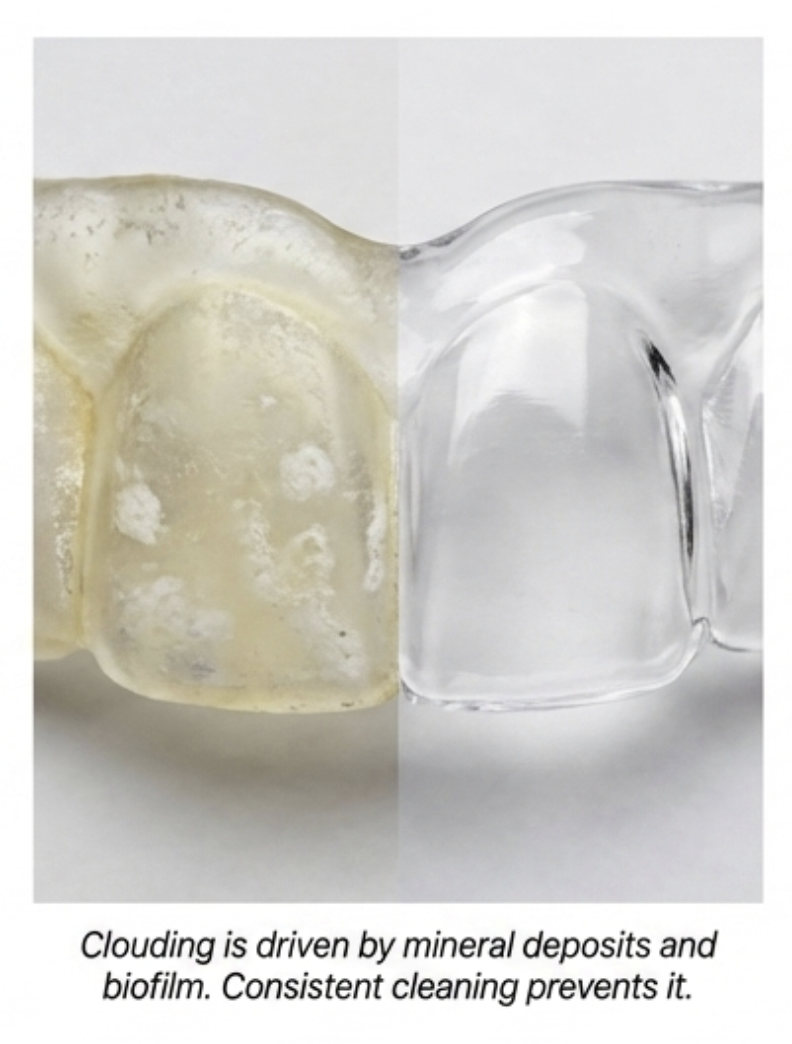
Calcium and mineral deposits. Saliva contains calcium and other minerals that deposit on the appliance surface over time. These calculus deposits cloud the material, create a rough surface texture that accumulates more bacteria, and become difficult to remove once hardened. Regular cleaning prevents build-up before it sets.
Material degradation. Some cleaning agents — particularly mouthwash and toothpaste — are actively harmful to guard materials. Mouthwash contains alcohol that degrades certain plastics. Toothpaste is abrasive and scratches the guard surface. Using the right method extends the life of the guard significantly.
Fit preservation. Heat is the primary enemy of night guard fit. Hot water, dishwashers, and direct sun can warp a guard fitted precisely to your bite. A warped guard no longer distributes force correctly.
The Daily Cleaning Routine (Every Morning)
This takes 60–90 seconds and should happen every morning immediately after removing the guard.
Step 1: Rinse immediately
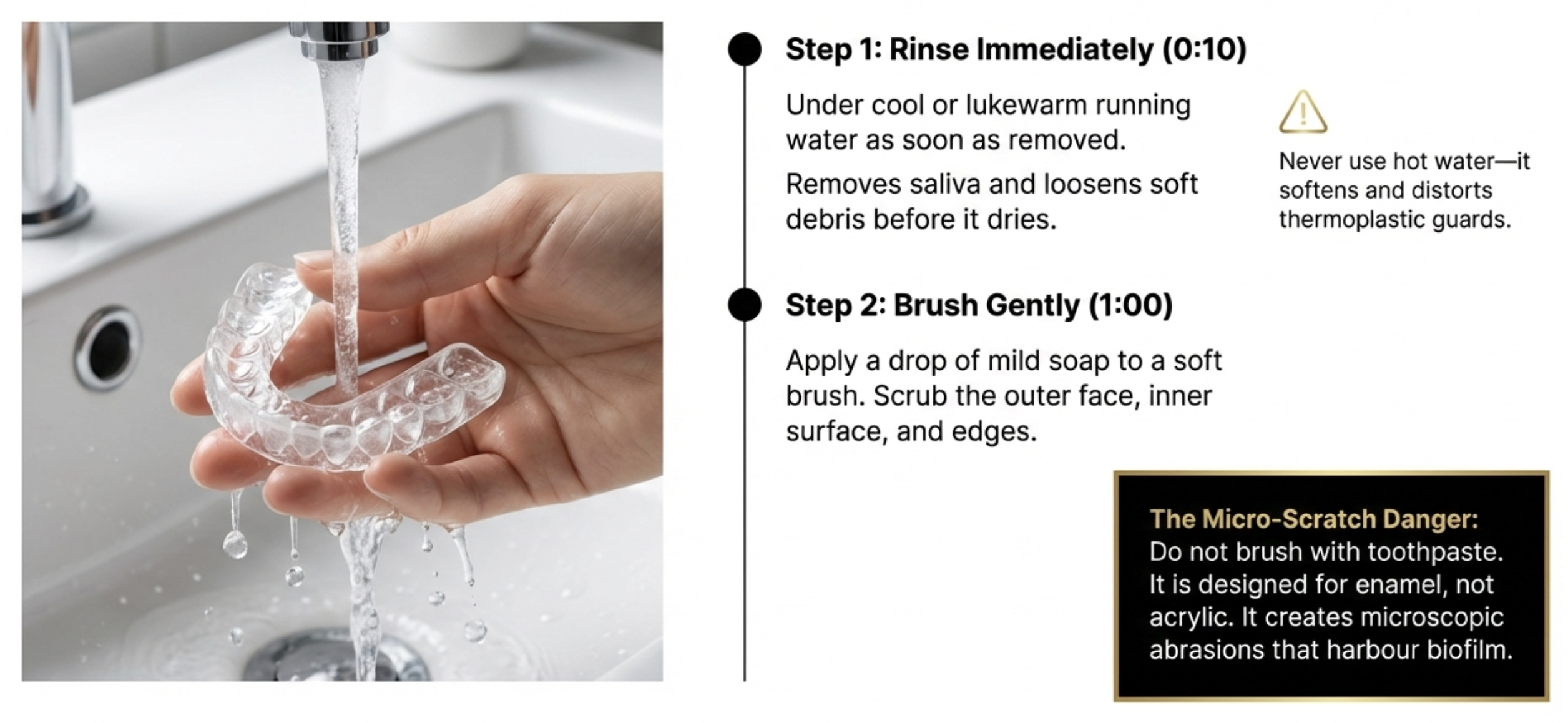
As soon as you remove your night guard, rinse it under cool or lukewarm running water. This removes the layer of saliva and loosens soft debris before it dries and adheres. Use cool or lukewarm water only — hot water can begin to soften and distort the material of certain guards, particularly softer thermoplastic ones.
Step 2: Brush gently
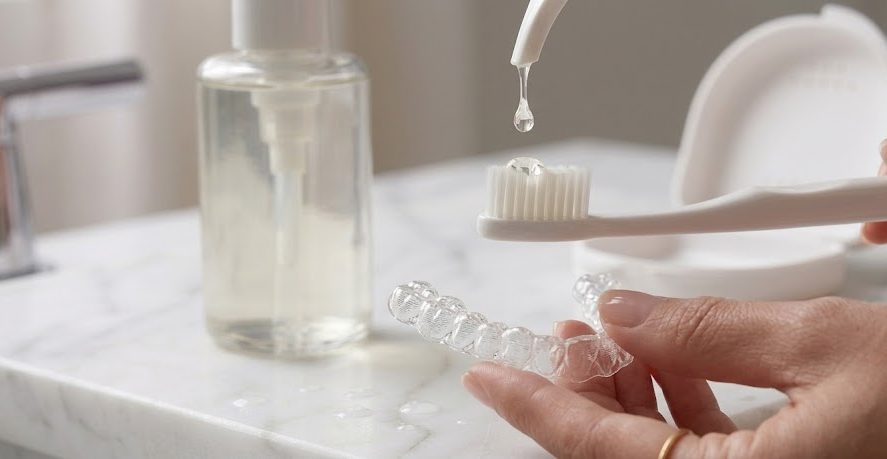
Use a soft-bristle toothbrush and a small amount of mild liquid hand soap or unscented dish soap. Brush all surfaces: the outer face, the inner surface that contacts your teeth, and the edges. Do not use toothpaste. Toothpaste contains abrasive particles designed to polish tooth enamel — which is much harder than the acrylic or thermoplastic of your guard. On guard material, it leaves micro-scratches that cloud the surface and create more sites for bacterial adhesion.
Step 3: Rinse again
Rinse thoroughly under cool water to remove all soap residue. Soap left on the guard can cause mild irritation to oral tissues.
Step 4: Air dry before storing
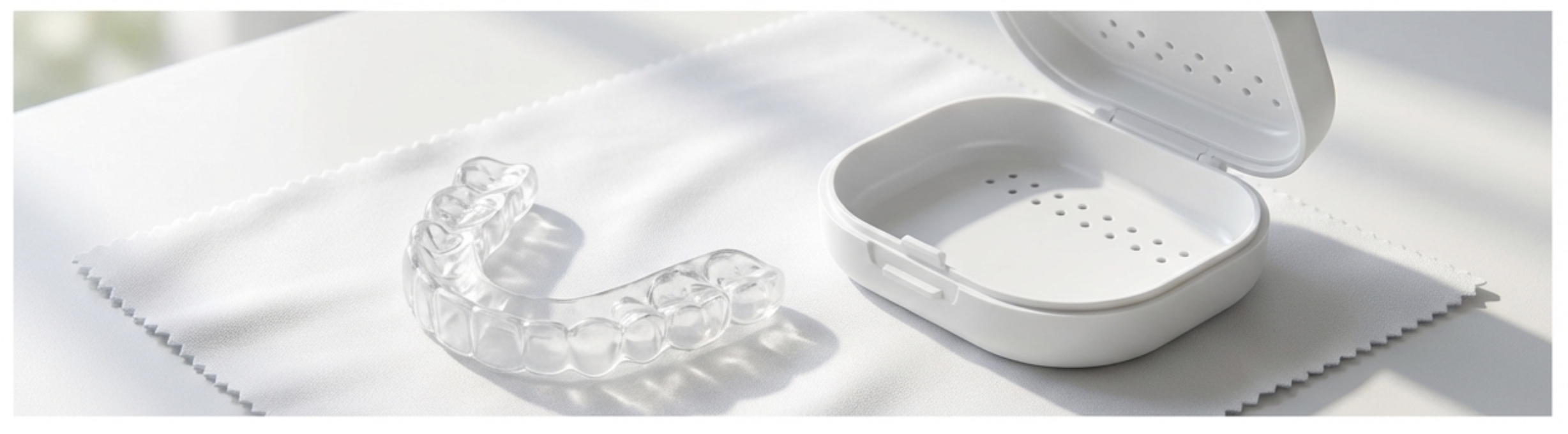
Place the guard on a clean surface and allow it to air dry before closing the storage case lid. Storing a damp guard in a sealed case creates exactly the warm, moist, dark conditions that bacteria need to thrive. Pat dry with a clean cloth if you’re in a rush, but leave the case ajar for 20–30 minutes if possible.
The Weekly Deep Clean
Once-a-week deep cleaning removes what daily brushing can’t: the biofilm and mineral deposits that accumulate in the microscopic surface texture of the guard.
Soaking method (manual deep clean)
Option A — Diluted dental appliance cleaner: Dental appliance cleaning tablets dissolve in water and create a mild cleaning solution. Soak for the time specified — typically 15–30 minutes. These products are formulated to remove biofilm and mineral deposits without damaging guard materials. Efferdent, Retainer Brite, and similar products work well.
Option B — White vinegar and water: A 50/50 mix of white vinegar and water is an effective, chemical-free alternative. White vinegar is mildly acidic — it dissolves calcium deposits and has reasonable antibacterial properties without degrading most guard materials. Soak for 15–30 minutes, then rinse very thoroughly.
What not to soak in: mouthwash (alcohol degrades plastics), bleach solutions (too harsh, causes discolouration), hot water (warps the shape), or undiluted hydrogen peroxide.
Ultrasonic cleaning method
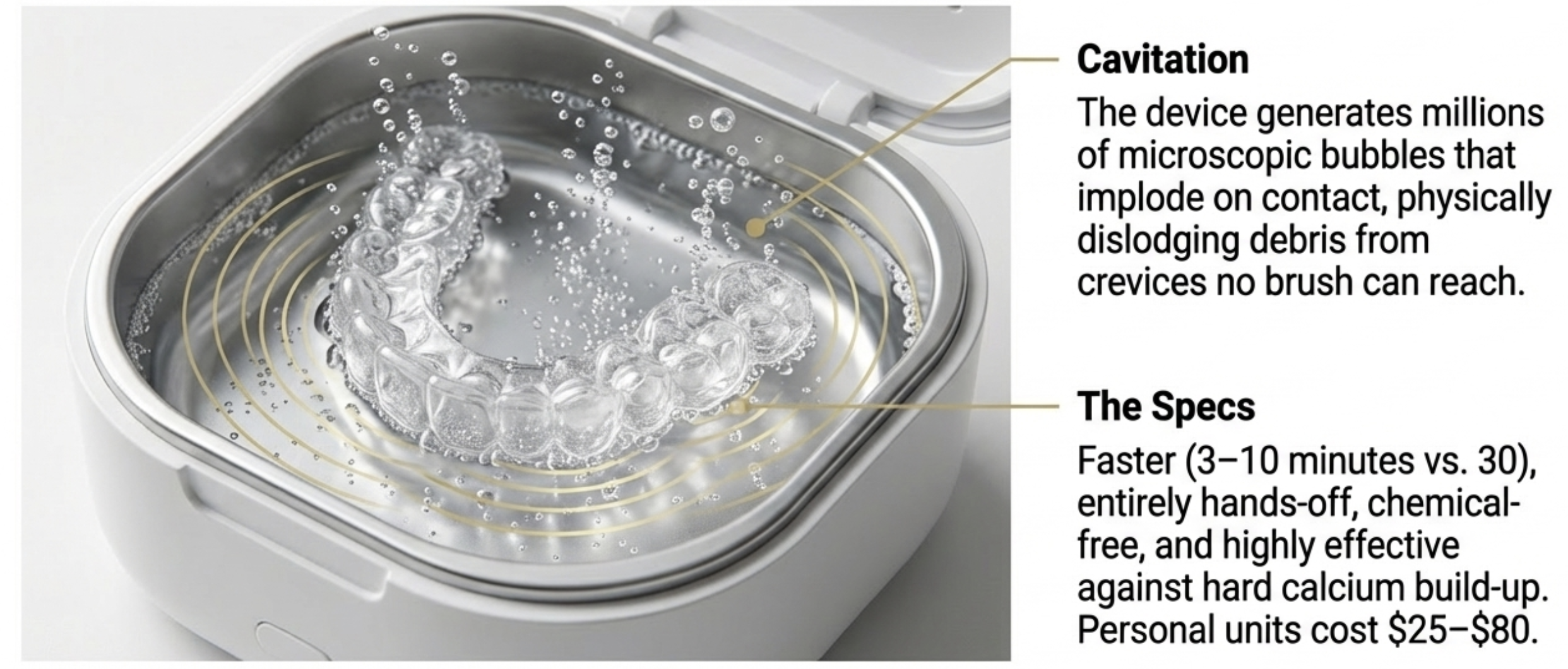
An ultrasonic cleaner is a small device — about the size of a coffee mug — that creates ultrasonic vibrations in a water bath. These vibrations generate millions of microscopic bubbles that implode on contact with the guard’s surface (a process called cavitation), physically dislodging debris, biofilm, and deposits from surfaces and crevices that manual cleaning and soaking can’t reach.
For night guard cleaning, ultrasonic devices are more thorough than soaking, faster (3–10 minutes vs 15–30), hands-off, effective without chemicals, and particularly good at removing calcium build-up. A decent device for personal use runs $25–$80.
Ultrasonic vs Manual: Which Should You Use?
| Manual (soap + soak) | Ultrasonic cleaner | |
|---|---|---|
| Daily debris | Excellent | Excellent |
| Biofilm | Good | Very good |
| Mineral deposits | Moderate | Very good |
| Surface crevices | Limited | Good |
| Weekly time | 20 min (soaking) | 5 min |
| Effort | Active (brushing) | Passive (button press) |
| Cost | Low (soap + tablets) | $25–$80 upfront |
| Risk of damage | Low (correct method) | Very low |
Manual cleaning done correctly and consistently is entirely adequate for most people. Ultrasonic cleaning is genuinely better — particularly for mineral deposits and surface crevices — and the convenience is real. It’s a worthwhile upgrade if you want the best possible hygiene with minimal effort, or if you’re dealing with stubborn odour or clouding that soaking hasn’t resolved.
How to Store Your Night Guard
Cleaning and storage go together. A well-cleaned guard stored poorly can still accumulate bacteria.
- Use a ventilated case. The important feature is ventilation — small holes or gaps that allow air circulation. A fully sealed case traps moisture. If your case has no ventilation, leave the lid slightly open after placing a dry guard inside.
- Keep it away from heat. Don’t leave your case on a sunny windowsill, in a car, or anywhere that gets warm. Heat warps the material and ruins the fit.
- Keep it away from pets. Dogs are attracted to the scent of oral appliances and will chew them. Store the case out of reach.
- Travel. Take the case and cleaning supplies with you. A small bottle of mild soap and a couple of appliance cleaner tablets takes up minimal space.
Troubleshooting Common Problems
“My guard smells even after cleaning.”
This indicates biofilm has established more deeply than surface cleaning can reach. Increase to twice-weekly deep soaking for 2–3 weeks. If odour persists, an ultrasonic cleaner with a cleaning tablet will typically resolve it. Persistent odour that doesn’t respond to any cleaning may indicate the material has degraded enough to harbour bacteria irreversibly — at which point replacement is the answer.
“My guard is turning yellow or cloudy.”
Yellowing and cloudiness are typically caused by mineral deposits and surface micro-scratching from toothpaste use. Switch to soap-only for daily cleaning. For mineral deposits, soak weekly in white vinegar solution — or use an ultrasonic cleaner, which is particularly effective here. Some discolouration from years of use is cosmetic only and doesn’t affect function.
“My guard has white spots.”
White spots are almost always calcium deposits from saliva minerals. White vinegar soaking dissolves them effectively. Ultrasonic cleaning removes them physically. They’re not a hygiene problem in themselves but suggest a need for more consistent mineral-removing cleaning.
“My guard feels slimy.”
Sliminess indicates biofilm that daily rinsing hasn’t been removing adequately. Step up to daily brushing (not just rinsing) and add weekly soaking. This resolves quickly with consistent attention.
How Long Should a Night Guard Last?
Cleaning consistently extends lifespan significantly. Approximate lifespans with good care:
- OTC soft guards: 3–6 months
- Custom soft guards: 6–18 months
- Custom hard acrylic guards: 2–5 years
- Custom dual-layer guards: 1–3 years
Signs it’s time to replace regardless of age: visible holes or thin spots in the bite surface, structural cracking or splitting, persistent odour that cleaning doesn’t resolve, the guard no longer fits snugly, or significant warping. A well-maintained hard acrylic guard lasting 3–5 years is realistic. A soft guard cleaned inconsistently may last 3 months. The difference is almost entirely in care.
The Bottom Line
Cleaning your night guard correctly takes two minutes a day and ten minutes once a week. The method matters more than the frequency — mild soap and cool water daily, vinegar or appliance cleaner weekly, always air-dry before storing, never heat, never toothpaste, never mouthwash.
For those who want to upgrade to a more thorough, hands-off routine, an ultrasonic cleaner is genuinely worth it — particularly for mineral deposit removal and overall hygiene standard. Browse Reviv appliance care accessories for options that work with your appliance.
And if you’re not yet wearing a night guard consistently, cleaning considerations are secondary — finding the right appliance is the first step. Browse the full Reviv range of FDA-registered Class I oral appliances designed for tooth protection from grinding pressure.