
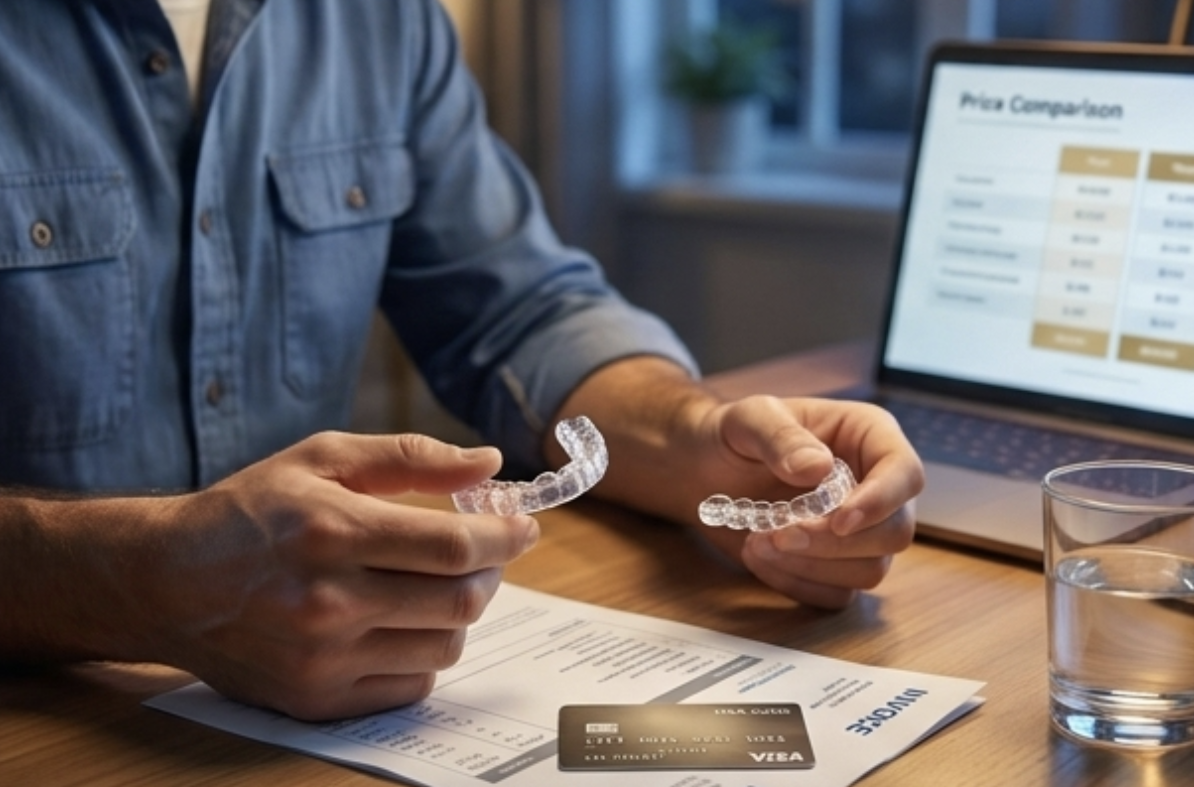

How much does a custom night guard cost?
Is a custom night guard worth the cost?
Does dental insurance cover night guards?
What’s the cheapest custom night guard?
How much should I pay for a night guard?

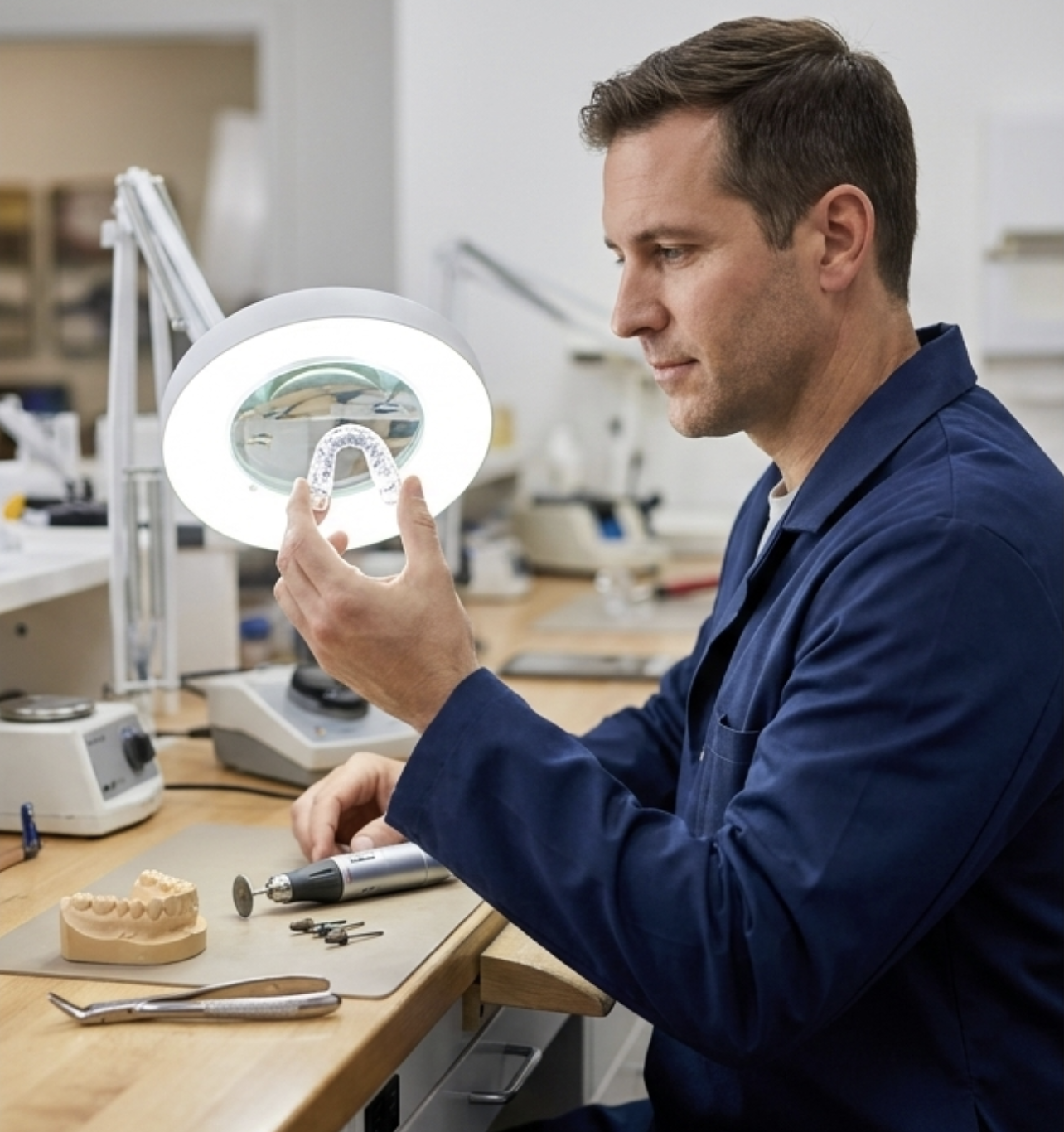

The night guard market runs from $15 to $800 for what is, at its core, a piece of custom acrylic. That price range is not explained by quality differences. It is explained by distribution model and who handles the impressions.
This guide breaks down what you actually get at each price tier, where the dentist markup goes, what the cheapest route to a genuinely custom guard looks like, and how to calculate whether spending more is rational for your specific grinding pattern. It also covers the variables most cost guides ignore: total cost of ownership across different lifespan assumptions, insurance coverage realities, and how HSA and FSA funds change the effective price comparison.
The Four Price Tiers: What You’re Actually Getting
Tier 1: Drugstore OTC — $15 to $30
Generic thermoplastic guards sold at pharmacies — DenTek, Plackers, Oral-B. Either pre-formed ready-to-wear or boil-and-bite moldable. No impression required, available same day.
What you’re getting: Generic-fit soft thermoplastic. For pre-formed guards, the fit approximates the average adult arch. For boil-and-bite, the hot water softening creates a loose mold of your teeth — better than generic, but not precision-fitted. The material is soft throughout, which means it compresses under force and wears through faster than harder materials.
Realistic lifespan: 2–8 weeks for moderate to heavy grinders. 3–6 months for light grinders.
Right for: Light grinders, first-time users, travel, short-term use while waiting for a custom guard.
Tier 2: DTC custom via impression kit — $80 to $200
Online labs — Pro Teeth Guard, Chomper Labs, Sentinel, Reviv, Remi, Smile Brilliant, ClearClub. You order, receive an impression kit, take molds of your teeth at home, return the impressions, and receive a lab-fabricated custom guard 2–3 weeks later.
What you’re getting: A guard fabricated by a dental lab from impressions of your specific arch. The same fabrication process and materials used by dentist-ordered guards. Multiple material options: soft, hard acrylic, dual-laminate, biomechanical. The fit is custom — the guard snaps onto your exact arch geometry rather than approximating it.
Realistic lifespan: 1–3 years (dual-laminate) to 2–5 years (hard acrylic) for consistent wearers with proper care.
Right for: Moderate to heavy grinders, anyone who has outgrown OTC guards, anyone who has been quoted $400+ by a dentist and wants an equivalent product at a third of the cost.
Tier 3: Dentist-made custom — $300 to $800
Your dentist takes impressions in-chair, sends them to a dental lab, and receives a finished guard 1–2 weeks later. You return for a fitting appointment.
What you’re getting: The same lab-fabricated custom guard as Tier 2 — with in-person impressions, a dentist’s clinical assessment of your bite, and in-chair fitting adjustments included. The guard itself is identical: the same dental labs that serve dentists also serve DTC companies.
What the premium pays for: Chair time (impressions appointment + fitting appointment), dental staff cost, dentist oversight, the ability to make fit adjustments in person, and practice overhead. Not the guard.
Right for: People with complex bite issues (significant misalignment, dental work that affects occlusion, TMJ-related clinical needs), people who want a dentist’s clinical eye on their grinding pattern, or people whose insurance covers the cost.
Tier 4: Dentist-made with digital scan — $500 to $1,000+
Some practices now use intraoral scanners instead of impression putty, producing a digital model of your teeth that goes directly to a CAD/CAM lab. The output is a milled acrylic guard of high precision.
What you’re getting: The most precise fit available, no impression putty involved. The digital workflow can produce slightly better marginal fit than putty impressions in some cases. The premium over standard dentist-made is the equipment amortisation and the more specialised lab process.
Right for: Patients with complex restorations, people who have had poor results with putty impressions, people for whom maximum precision justifies maximum cost.
| Tier | Price range | Fabrication | Fit | Lifespan (moderate grinder) | Cost/night |
|---|---|---|---|---|---|
| Drugstore OTC | $15–30 | Pre-formed / boil-and-bite | Generic | 2–16 weeks | $0.27–$2.14 |
| DTC custom | $80–200 | Dental lab (impression kit) | Custom | 1–5 years | $0.11–$0.55 |
| Dentist custom | $300–800 | Dental lab (in-chair impression) | Custom | 1–5 years | $0.16–$2.19 |
| Dentist digital | $500–1,000+ | CAD/CAM lab (digital scan) | Custom (highest precision) | 2–5 years | $0.27–$1.37 |
What the Dentist Price Actually Covers
The most important piece of information on this topic: in most cases, your dentist is not making your night guard. They are taking impressions and sending them to a dental lab. The lab makes the guard. The dentist receives it back, adjusts it at a fitting appointment, and delivers it to you.
The cost breakdown of a typical $500 dentist-made guard looks roughly like this:
- Lab fabrication cost: $50–$150 (the guard itself)
- Impression materials and supplies: $15–$30
- Chair time — impressions appointment: $80–$150 (dentist time + staff)
- Chair time — fitting appointment: $80–$150
- Practice overhead: allocated across all procedures
- Dentist margin: remainder
This is not a criticism of dentists — running a practice is expensive and their time has value. But it clarifies why DTC custom guards can be lab-identical to dentist guards at a fraction of the cost: the DTC model removes the chair time, the fitting appointments, and the practice overhead. What remains is the lab cost plus a smaller distribution margin.
The corollary is also true: the case for paying dentist rates is specifically for what chair time and clinical oversight provides — in-person fitting adjustments, a dentist’s assessment of your specific bite and grinding pattern, and integration with your broader dental care. If you don’t need those things, you’re paying for them anyway.
The DTC Custom Tier: What to Know Before Ordering
DTC custom labs vary more than the category label suggests. Key factors that differentiate them:
Material options. Better labs offer multiple material choices: soft thermoplastic (light grinders), hard acrylic (heavy grinders), dual-laminate (comfort-durability balance), and specialty designs like Reviv’s biomechanical surface. A lab that only offers one material type is limiting your options before you start.
Re-impression policy. If your impressions are poor — the most common failure point — a reputable lab will send new putty and remake the guard at no charge. This is a baseline expectation. Labs that charge for re-impressions are worth avoiding.
Guarantee and adjustment policy. Pro Teeth Guard offers a 110% money-back guarantee in the first 60 days. Chomper Labs offers free adjustments within the subscription model. Remi includes both upper and lower guards by default. These policies matter because fit issues occasionally arise despite good impressions — you want a path to resolution.
Notable brands and what distinguishes them:
- Pro Teeth Guard ($95–$195) — largest material selection, strong guarantee, long track record. The ultra-hard option is particularly well-regarded for heavy grinders.
- Chomper Labs (~$129) — subscription model, saves impression digitally for easy reorders, competitive on per-guard cost for regular replacers.
- Sentinel ($89–$169) — straightforward pricing, dentist-grade materials, smaller brand with consistently strong reviews.
- Reviv ($80–$160) — FDA-registered Class I device (BRW), biomechanical occlusal surface design rather than flat acrylic, three models for different grind patterns: R1 (soft, light grinders), R2 (dual-layer, moderate/clenchers), R3 (hard, heavy grinders). Find your model →
- Remi ($99) — includes upper and lower guard by default, 1mm/1.3mm/2mm thickness options, 45-night guarantee.
Total Cost of Ownership: The Honest Calculation
Price-per-guard comparisons are misleading without lifespan in the denominator. A $25 guard replaced every 5 weeks costs $260 per year. A $150 guard lasting 3 years costs $50 per year. The calculation that matters is cost-per-night.
| Guard | Price | Lifespan (heavy grinder) | Annual cost | Cost per night |
|---|---|---|---|---|
| Drugstore boil-and-bite | $25 | 5 weeks | $260 | $0.71 |
| Soft OTC DTC | $60 | 8 weeks | $390 | $1.07 |
| DTC hard custom (Pro Teeth Guard) | $150 | 2.5 years | $60 | $0.16 |
| DTC biomechanical R2 (Reviv) | $130 | 2 years | $65 | $0.18 |
| Dentist custom hard | $500 | 2.5 years | $200 | $0.55 |
The table makes the upgrade case clearly: a heavy grinder spending $260/year on OTC guards would pay for a DTC custom guard in under 7 months — and then pay $60/year for the following 2+ years instead of $260. The dentist equivalent costs 3x more annually than DTC custom for identical fabrication.
Light grinders where OTC guards last 4+ months look different — at that wear rate the annual OTC cost is $60–$90, which competes with DTC custom on economics. For light grinders, OTC is genuinely the rational choice.
Insurance, HSA, and FSA: The Variables That Change the Math
Dental insurance
Coverage for night guards varies significantly by plan. The general picture:
- Many plans exclude night guards entirely or classify them as cosmetic/elective
- Plans that cover them typically require dentist documentation of medical necessity for bruxism
- Coverage where it exists is usually 50–80% of the dentist fee, after deductible, with annual maximums that may limit replacement frequency
- DTC custom guards are almost never directly covered by insurance because they’re not billed by a licensed dental provider
If your plan covers dentist-made guards at 70% and your dentist quotes $500, your out-of-pocket cost is $150 — comparable to DTC custom without insurance. In that case, the dentist route may be worth pursuing for the clinical oversight included. Call your insurer before assuming coverage; the answer varies widely.
HSA and FSA funds
Night guards — both OTC and DTC custom — qualify as eligible HSA and FSA expenses under IRS guidelines. This is the most underutilised cost-reduction lever in this category.
Using pre-tax HSA/FSA funds to purchase a $150 DTC custom guard saves $30–$56 depending on your marginal tax rate (20–37%). The effective cost becomes $94–$120. Most major DTC labs accept HSA/FSA cards directly:
- Pro Teeth Guard — HSA/FSA accepted at checkout
- Chomper Labs — HSA/FSA accepted
- Reviv — HSA/FSA accepted
- Smile Brilliant — HSA/FSA accepted
- Remi — HSA/FSA accepted
If you have unspent HSA/FSA funds approaching year-end, a DTC custom night guard is one of the most practical ways to use them — assuming you need one.
Is a Custom Night Guard Worth the Cost?
The answer depends entirely on your grinding severity and which custom tier you’re considering.
DTC custom vs OTC, moderate to heavy grinder: Yes, unambiguously. The cost-per-night math is decisive — DTC custom is 4–6x cheaper per night for heavy grinders than OTC soft guards, and the fit means better protection. The upgrade pays for itself within 3–7 months depending on your current OTC spend.
DTC custom vs OTC, light grinder: Marginal. If your OTC guards last 4+ months and cost $25 each, your annual spend is $75–$90 — comparable to the amortised cost of a DTC custom guard. The custom guard wins on fit quality and total protection, but the economics are close enough that OTC is defensible for light grinders.
Dentist custom vs DTC custom, no complex bite issues: Hard to justify. The lab output is identical. You’re paying $150–$600 more for chair time and impressions taken by a professional rather than yourself. Unless your insurance covers the difference or you have clinically complex needs, the premium is distribution overhead.
Dentist custom vs DTC custom, complex bite issues: Potentially justified. If you have significant dental work affecting your bite, a history of ill-fitting guards causing bite shifts, or TMJ-adjacent concerns that warrant clinical monitoring, the dentist’s clinical assessment and in-chair fitting adjustments have real value. This is the legitimate case for the dentist premium.
Frequently Asked Questions
How much does a custom night guard cost?
Custom night guards cost $80–$200 from DTC online labs or $300–$800 from a dentist. The fabrication process is the same — dental lab, custom impressions, acrylic guard. The price difference is chair time, clinical oversight, and practice overhead. DTC is the rational choice for most people without complex bite issues.
How much should a custom night guard cost from a dentist?
Dentist-made custom guards typically run $300–$800 nationally, with $400–$600 being most common. Major cities tend toward the higher end. The price covers the impressions appointment, the dentist sending your impressions to an external lab, the lab fabrication, and a fitting appointment. The lab portion of that cost is typically $50–$150.
Is a custom night guard worth the cost?
For moderate to heavy grinders — yes, clearly. A DTC custom hard guard at $150 amortised over 2.5 years costs $0.16/night. A $25 soft OTC guard lasting 5 weeks for a heavy grinder costs $0.71/night — 4.4x more expensive, and less protective. The upgrade economics are decisive for anyone grinding hard enough to go through OTC guards in under 3 months.
Does dental insurance cover night guards?
Sometimes. Plans vary widely — some exclude guards entirely, others cover 50–80% with documented medical necessity from a dentist. DTC custom guards are generally not insurance-reimbursable but are eligible for HSA and FSA funds, which effectively discounts the price by your marginal tax rate.
What is the cheapest way to get a custom night guard?
DTC impression kit labs — Pro Teeth Guard, Sentinel, Chomper Labs, Reviv — at $80–$200. Paying with HSA/FSA funds brings the effective cost to $50–$160 depending on your tax bracket. This is the lowest-cost route to a genuinely lab-fabricated custom guard — identical lab output to a dentist-ordered guard at roughly 25–35% of the dentist price.
The Bottom Line
The price difference between a $500 dentist guard and a $150 DTC custom guard is distribution margin, not quality. Both are made in dental labs from your impressions. The dentist premium buys clinical oversight and in-person fitting — worth it for complex cases, hard to justify for straightforward bruxism.
For most moderate to heavy grinders, DTC custom at $80–$200 is the rational choice. Use HSA/FSA funds if you have them — the effective cost drops to $50–$160. Calculate your current annual OTC spend to confirm the upgrade timeline: at heavy grind rates, DTC custom typically pays for itself in under 6 months.
Browse the Reviv range — FDA-registered DTC custom guards from $80–$160, HSA/FSA eligible, with a 60-second model selector to match your grinding pattern.