
Is a dentist night guard better than online?
Are online custom night guards safe?
How are DTC custom guards made?
When should I use a dentist instead?
What’s the actual difference?

The assumption most people make when comparing dentist-made and online night guards is that quality differs. It largely doesn’t — and understanding why requires knowing one thing about how dental devices are actually made.
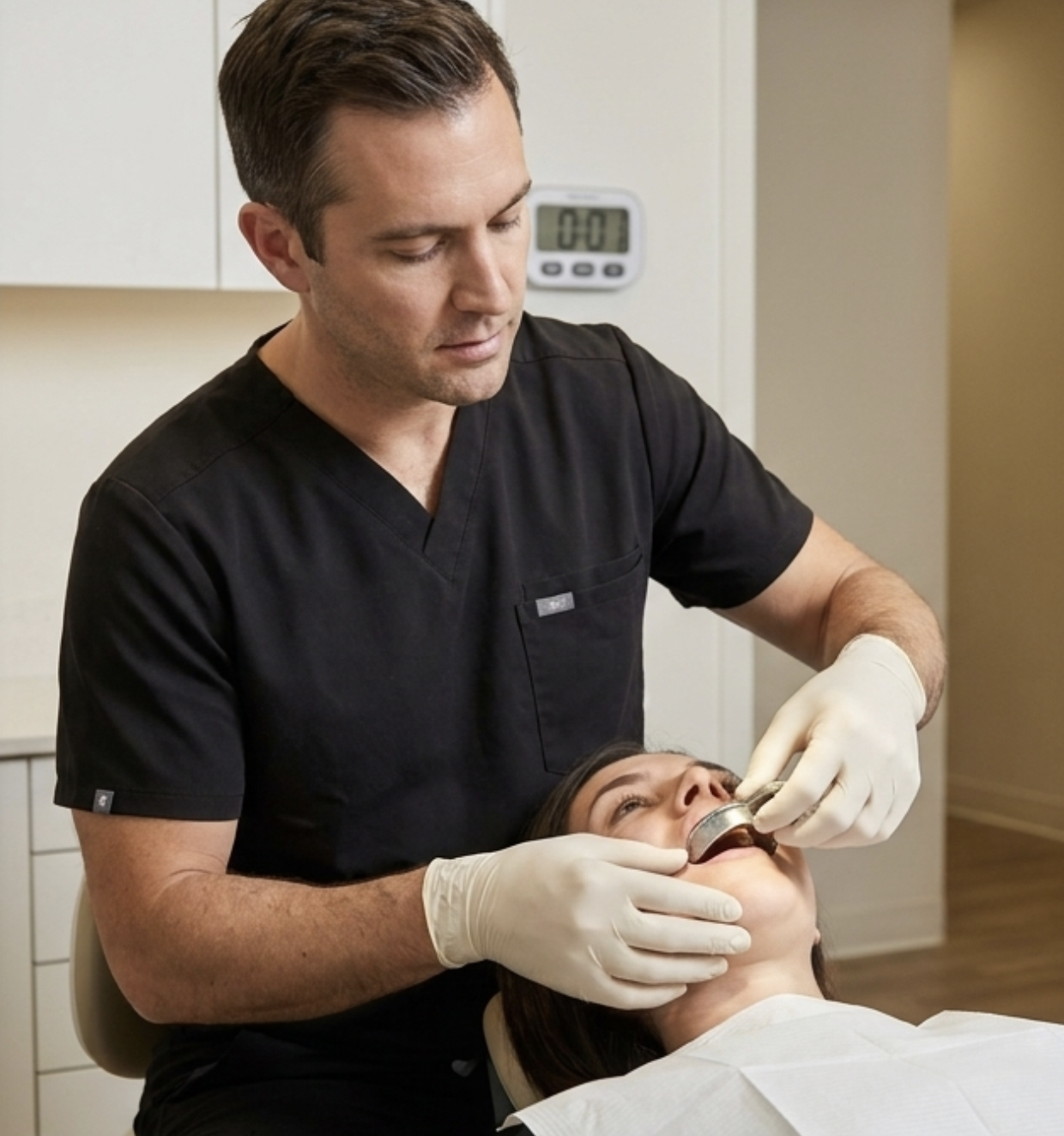
In most cases, your dentist does not fabricate your night guard. They take impressions of your teeth and send them to a dental laboratory. The lab fabricates the guard. The dentist receives it back and fits it. This is the same process a DTC online lab uses — the difference is who takes the impressions and how much surrounds the transaction.
This article is the complete comparison: what’s genuinely the same between dentist and DTC guards, what’s genuinely different, the specific situations where each route is the right choice, and how to engage with the safety concerns that legitimate critics of DTC guards raise — because some of those concerns are real, and you deserve an honest answer.
What’s Actually the Same
The fabrication process
Both dentist-made and DTC custom guards are fabricated by dental laboratories from impressions of your teeth. The lab receives an impression — either putty molds taken by a dentist or putty molds you took at home — and produces a guard from hard acrylic, soft thermoplastic, or dual-laminate material. The machinery, materials, and quality standards are the same because in many cases it’s literally the same lab.
Major DTC companies use FDA-registered dental labs that also serve dental practices. The putty formulas are dental-grade. The acrylic is the same material. The guard that arrives from Pro Teeth Guard or Reviv was made by the same type of technician, using the same equipment, as the guard made for your dentist’s patient.
The material
Hard acrylic from a DTC lab and hard acrylic from a dentist’s lab are the same material. Soft thermoplastic is the same. Dual-laminate is the same. The choice of material determines durability, comfort, and appropriate use — not whether you ordered it online or through a dental practice. Both routes offer all material options.
Full-arch custom fit
Both dentist and DTC guards are fitted to your specific dental arch from your impressions. The fit precision depends on the quality of the impressions — whether professional or at-home — not on where the guard was ordered from. A good set of at-home impressions produces a guard that fits comparably to one made from in-chair impressions for most people.
What’s Actually Different
How impressions are taken
This is the most significant genuine difference. A dentist uses professional equipment, has taken thousands of impressions, and can immediately identify and correct a poor impression — retaking it before you leave the chair. They can also use a digital intraoral scanner, eliminating putty impressions entirely and producing a more precise digital model.
With DTC, you take impressions at home from written instructions. The process is straightforward for most people — the kits are designed for non-professionals — but the quality depends on your execution. The two most common mistakes: biting through to the impression tray (which corrupts the mold) and moving while the putty sets. Most reputable DTC labs will send new putty and remake the guard for free if impressions are poor — but this adds 2–3 weeks to the process.
For the majority of people with reasonably straightforward dental anatomy, at-home impressions produce guards that fit well. For people with complex dental situations — significant crowding, extensive restorations, or bite issues that require clinical assessment to even photograph accurately — in-chair impressions by a professional are meaningfully better.
Clinical oversight and fitting adjustments
A dentist doesn’t just deliver the guard — they assess your bite with it in place, check that it doesn’t create uneven contact points or shift your bite, and can grind or add material to adjust the occlusal surface until it’s correct. This clinical fitting process, when done well, produces a guard that sits precisely within your existing bite geometry.
DTC guards arrive ready to wear. If the fit is slightly off, you contact the lab and mail the guard back for adjustment — a process that takes another 2+ weeks. Some people do multiple adjustment cycles. In practice, most DTC guards fit adequately on arrival if impressions were good, but the adjustment process is slower and more cumbersome than in-chair.
Integration with your dental care
A dentist making your guard knows your dental history — your existing restorations, any bite issues they’ve been monitoring, your bruxism pattern over time. They can factor all of this into the guard prescription and monitor how your bite responds to wearing it over subsequent check-ups. This continuity of care is real clinical value, particularly for people with complex or evolving dental situations.
DTC labs work from the impressions you send. They don’t know your dental history, can’t see your bite pattern evolve over time, and can’t flag if something about your impressions suggests an underlying issue worth investigating.
Price
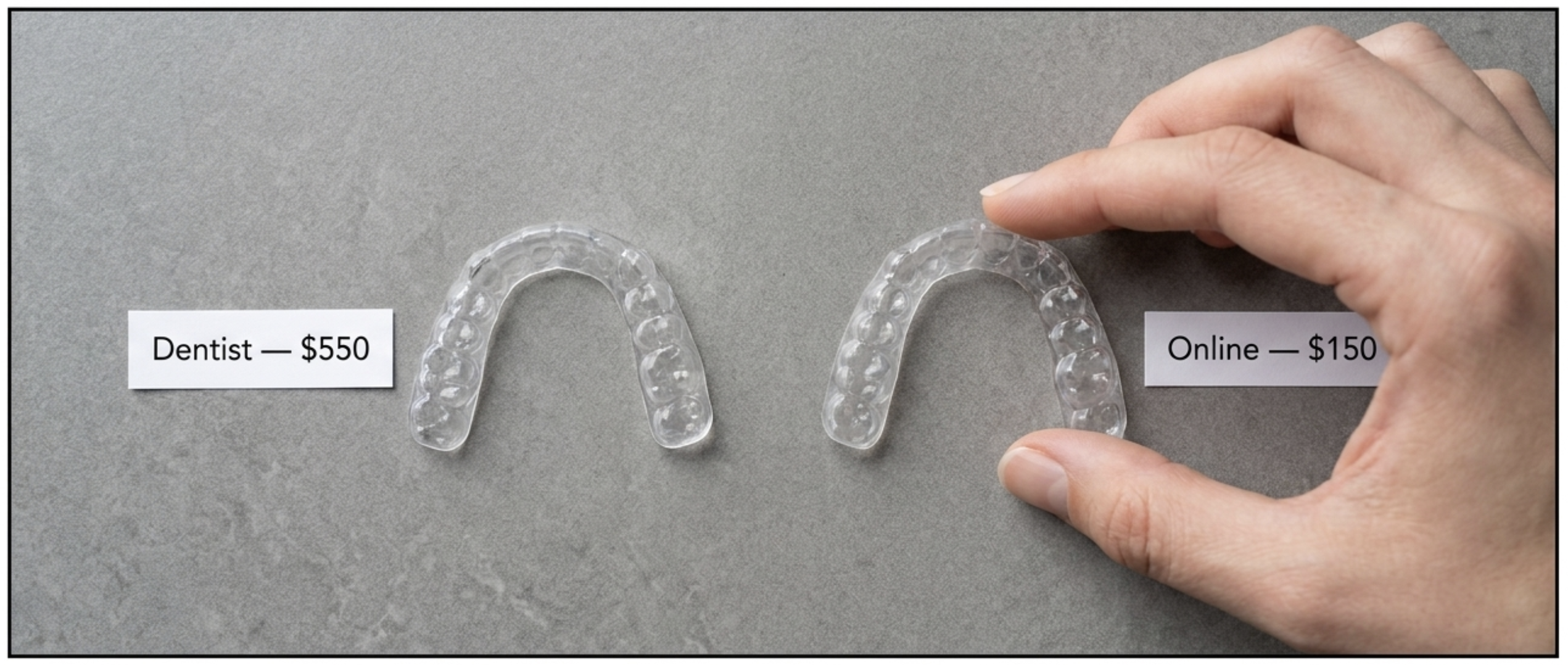
DTC custom guards: $80–$200. Dentist-made custom guards: $300–$800. The price difference is chair time, clinical overhead, and practice margin — not the guard itself. The lab fabrication cost is $50–$150 regardless of which route it takes.
Addressing the Safety Concerns Honestly
Two specific criticisms of online night guards appear in the professional literature and deserve direct engagement:
The British Dental Journal study
One frequently cited concern is that online guards have been “associated with tissue damage and teeth movement.” This finding comes from research examining a broad range of online dental products — including partial-coverage devices and appliances not designed by dental professionals. The relevant question is whether this finding applies to full-arch custom guards from reputable DTC labs using standard dental acrylic. The evidence that it does is thin. The tissue damage and teeth movement concerns are most credibly linked to poorly fitted guards (shifted bite contacts causing uneven force distribution) and to partial-coverage designs — not to well-fitted full-arch guards from dental labs.
The practical implication: order from labs that use full-arch coverage, dental-grade materials, and offer re-impression policies. The concern cited in the literature is real for some products. It’s less applicable to established DTC labs producing standard full-arch guards.
The NTI (anterior-only) guard problem
Some guards cover only the front teeth — the NTI or anterior deprogrammer design. The clinical concern here is genuine: when only front teeth are in contact with the guard, back teeth have no contact surface and may over-erupt (continue growing until they find contact). Over time this can create an open bite — a permanent change to how your teeth meet. This is a real risk documented in the dental literature.
The safeguard is simple: use full-arch guards. Reputable DTC labs — and most dentists — use full-arch designs by default. If you encounter any guard marketed as covering only your front teeth, do not use it without clinical supervision. This applies to dentist-prescribed NTI devices as well — they have legitimate clinical uses in some contexts, but only under professional monitoring.
The impression accuracy concern
This is the most legitimate ongoing concern with DTC guards. A poorly executed at-home impression produces a poorly fitting guard. A poorly fitting guard can create uneven bite contacts that, over time, cause the bite to shift toward the high contact points. This is why impression quality matters — and why the re-impression policy is a non-negotiable quality signal when evaluating DTC labs. If a lab doesn’t offer free re-impressions, that’s a reason to look elsewhere.
When to Choose the Dentist Route
The dentist is the right choice when what they add — clinical oversight, in-person fitting, integration with your dental history — is worth the price premium. That’s the case in the following situations:
- Active TMJ symptoms. If you have jaw pain, clicking, locking, or limited opening — conditions that may be related to your bite and occlusal contact — a dentist can assess the relationship between your guard and your joint mechanics. A DTC lab cannot.
- Significant dental work affecting bite. Implants, full-arch crowns, bridges, or other restorations can complicate how a guard needs to be designed to avoid creating uneven contacts. A dentist can account for this clinically; at-home impressions can’t flag it.
- Active gum disease or loose teeth. These conditions affect how impressions are taken and how a guard can safely be fitted. Clinical assessment before ordering any guard is appropriate.
- Previous poor fit with DTC guards. If you’ve ordered DTC guards and consistently found the fit inadequate despite good impressions, in-chair impressions by a professional may resolve the issue.
- Insurance covers dentist-made guards substantially. If your plan covers 70–80% of a $500 dentist guard, your out-of-pocket is $100–$150 — comparable to DTC custom. In that case the clinical oversight comes at minimal additional cost and is worth having.
When DTC Is the Right Call
For most people with straightforward bruxism and no complicating dental factors, DTC custom delivers equivalent protection at 25–35% of the dentist cost. The clinical case for paying the premium — absent the situations above — is hard to make.
DTC is clearly rational when:
- You have no active TMJ symptoms, gum disease, or loose teeth
- Your dental work is stable and not extensive
- Your insurance doesn’t cover night guards or covers them minimally
- You’ve used guards before and know your preferences (upper vs lower, hard vs soft)
- You want to use HSA or FSA funds — DTC labs accept these directly; the effective cost drops to $50–$160
DTC Brands Worth Using
If you decide the DTC route is appropriate, these are the brands with established track records, full-arch designs, and clear re-impression and adjustment policies:
- Pro Teeth Guard ($95–$195) — the widest material range, 110% money-back guarantee, strong reputation in bruxism communities over many years. The hard and ultra-hard options are appropriate for moderate to heavy grinders.
- Sentinel ($89–$169) — straightforward, dentist-grade materials, no frills. Consistent quality without subscription complexity.
- Chomper Labs (~$129) — subscription model, saves your impressions digitally for easy reorders. Good for people who go through guards every 12–18 months and want frictionless replacement.
- Reviv ($80–$160) — FDA-registered Class I device (Device Code BRW), biomechanical occlusal surface design in addition to custom fit. Three models: R1 (soft, light grinders), R2 (dual-layer, moderate grinders and clenchers), R3 (hard, heavy grinders). The R2 is appropriate for the combined grinding-and-clenching pattern that characterises most nighttime bruxism. Find your model →
Frequently Asked Questions
Is a night guard from a dentist better than online?
For most people with straightforward bruxism — no. Both are fabricated by the same dental labs from your impressions. The dentist adds clinical oversight and in-person fitting adjustments. That oversight is worth paying for if you have complex bite issues, active TMJ symptoms, or significant dental work. For routine grinding protection, DTC custom delivers equivalent protection at 25–35% of the dentist price.
Are online custom night guards safe?
Yes, when ordered from reputable labs producing full-arch guards. The legitimate safety concerns relate to partial-coverage designs that cover only front teeth — these can cause back teeth to over-erupt and create permanent bite changes. Full-arch guards from established DTC labs using standard dental acrylic are fabricated identically to dentist-ordered guards and carry the same safety profile.
How are DTC custom night guards made?
Impression kit sent to you by mail → you take putty molds of your teeth at home → return impressions → dental lab fabricates your guard from the material you selected → finished guard shipped to you in 2–3 weeks. The lab process is identical to the dentist route; the difference is where the impressions are taken.
When should I get a night guard from a dentist instead of online?
Active TMJ symptoms, significant dental work affecting your bite, active gum disease, loose teeth, history of poor DTC fit despite good impressions, or if insurance covers dentist-made guards substantially and closes the cost gap. Outside those situations, the DTC route delivers equivalent output at significantly lower cost.
What is the difference between a dentist night guard and DTC custom?
The guard itself is the same — fabricated by dental labs from your impressions, in the same materials. The differences are: how impressions are taken (professional vs at-home), whether fitting adjustments happen in-person or by mail, clinical oversight of your bite and grinding pattern vs none, and $300–$800 vs $80–$200.
The Bottom Line
The dentist premium pays for clinical oversight, professional impressions, and in-person fitting adjustments — not a better guard. For people with complex bite situations, active TMJ concerns, or substantial insurance coverage, that premium is worth paying. For most people with routine bruxism and no complicating factors, DTC custom is the rational route: same lab, same materials, 25–35% of the cost.
The one safety commitment that applies to both routes: use full-arch coverage. Avoid any guard that covers only your front teeth without explicit clinical supervision. This is a real risk documented in the literature — and it’s avoidable by choosing established labs that use standard full-arch designs.
Browse the Reviv range — FDA-registered DTC custom guards from $80–$160 — or use the model selector to match your grinding pattern.