
You wake up. Your jaw feels tight. Your teeth ache faintly. Your partner mentions — not for the first time — that you were grinding again.
If that sounds familiar, you’re in the right place.
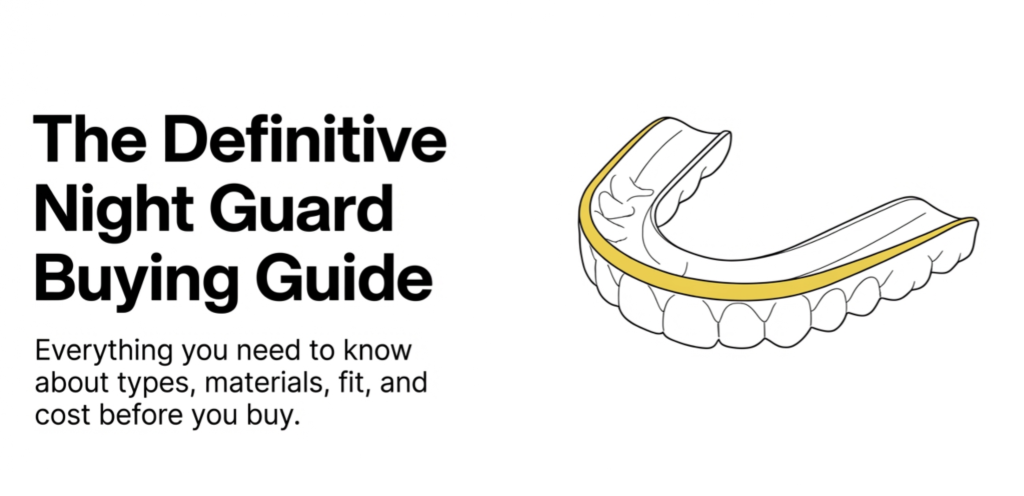
A night guard is an oral appliance worn during sleep to protect your teeth from the pressure of grinding and clenching. Tens of millions of people use them. And yet, most people buy the wrong one — either because the options are confusing, or because no one ever walked them through what actually matters.
This guide does exactly that. By the end, you’ll understand the different types of night guards, which materials hold up best, how fit affects protection, and how to choose an appliance you’ll actually wear every night.
Ready to compare your options now?
Use the Reviv appliance selector →What Is a Night Guard and What Does It Actually Do?
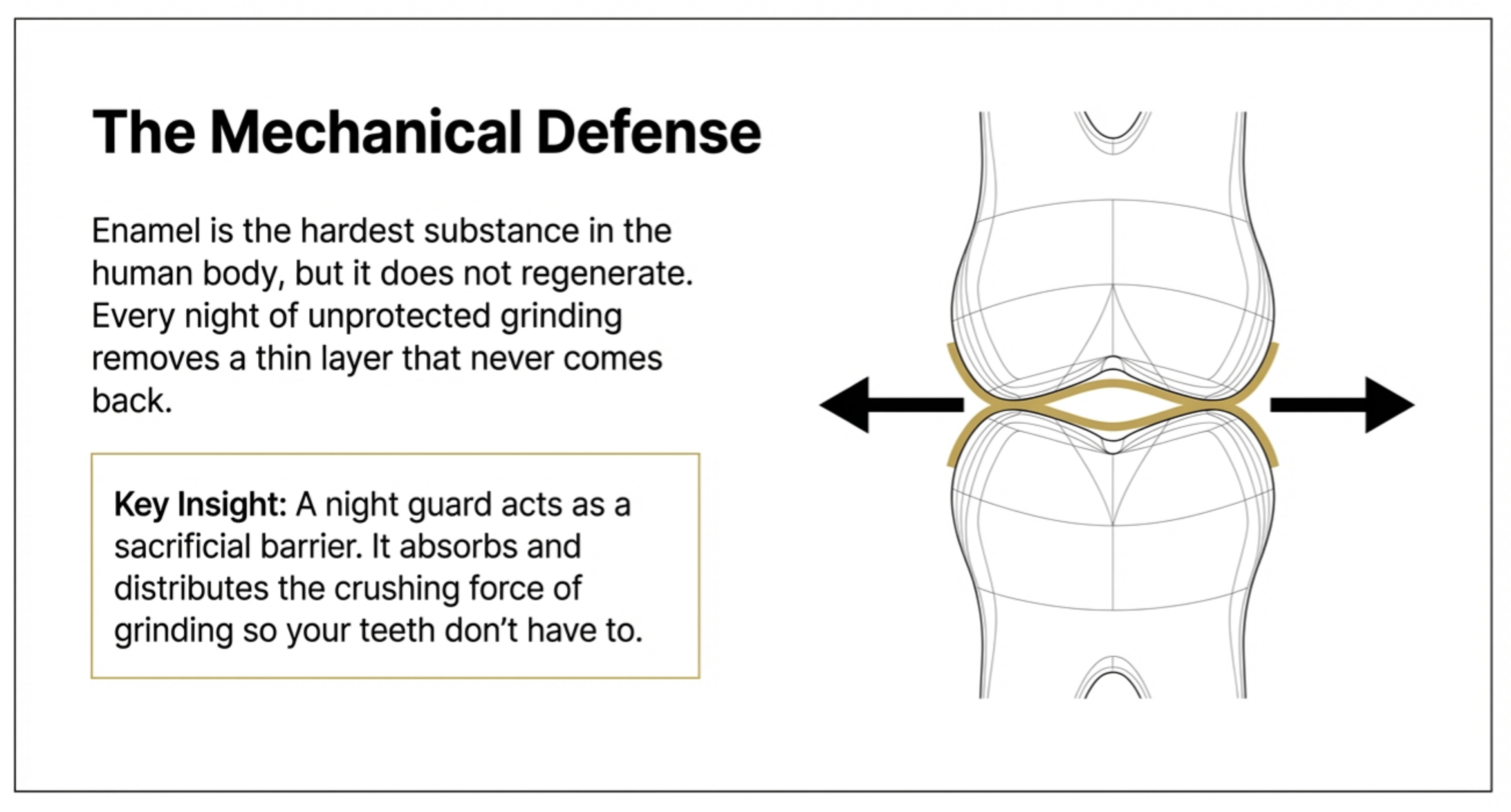
A night guard — sometimes called a dental guard, bite guard, or occlusal guard — is a removable oral appliance that sits over your upper or lower teeth while you sleep. It creates a physical barrier between your top and bottom teeth, absorbing and distributing the force of grinding or clenching instead of letting that force hit your enamel directly.
To be clear about what a night guard does and doesn’t do:
- It protects your teeth from grinding pressure and enamel wear.
- It does not stop the grinding habit — bruxism is driven by the nervous system, and a physical appliance can’t override that.
- It does not treat TMJ disorder or other diagnosed jaw conditions.
- It does not realign your jaw or change your bite.
What it does — protecting your enamel from the mechanical force of grinding — is genuinely significant. Enamel is the hardest substance in the human body, but it does not regenerate. Every night of unprotected grinding removes a thin layer that never comes back. Over years, this leads to worn, flattened, or cracked teeth that are expensive to restore.
A night guard stops that erosion. That’s the job. And when it fits well and you wear it consistently, it does that job very effectively.
The Main Types of Night Guards: A Plain-English Breakdown
Night guards come in several distinct categories. Each has a different design philosophy, a different price point, and a different level of tooth protection.
1. Boil-and-bite night guards
These are the most common OTC (over-the-counter) option. You soften them in hot water, then bite down to create a rough impression of your teeth. They’re inexpensive, widely available, and easy to start with.
The downside: the fit is approximate, not precise. For light grinders a boil-and-bite guard may be adequate. For heavy grinders, the imprecise fit can cause discomfort or leave gaps where grinding force still reaches the teeth.
2. Pre-formed (stock) night guards
These come ready to wear — no fitting required. They’re the cheapest option and the worst fit. Most dental professionals consider stock guards minimally effective for consistent tooth protection because there’s no customisation to your individual bite.
3. Custom-fitted night guards (mail-order)
Mail-order custom guards involve a home impression kit: you take a mold of your teeth and mail it back. The lab fabricates a guard tailored to your exact bite. This category has dramatically improved in quality over the last decade and offers a significant step up from boil-and-bite in both comfort and protection.
4. Dentist-fabricated custom night guards
Made from an in-office impression and fabricated by a dental lab. They offer the most precise fit of any option. The trade-off is cost — dentist-made guards typically run $300–$800+ depending on your location and coverage.
| Type | Fit quality | Protection level | Approx. cost |
|---|---|---|---|
| Stock (pre-formed) | Poor | Minimal | $5–$20 |
| Boil-and-bite | Fair | Moderate | $20–$60 |
| Custom (mail-order) | Good | Good–Excellent | $80–$200 |
| Custom (dentist) | Excellent | Excellent | $300–$800+ |
Table 1: Night guard types compared by fit, protection, and cost.
Soft vs Hard Night Guard: Which Material Is Better?
Material is one of the most consequential decisions in night guard selection — and one of the most misunderstood.
Soft night guards
Soft guards are made from a flexible, rubber-like material. They’re more comfortable for most new users because the pliable texture feels less intrusive. Many people find them easier to adapt to initially, especially light-to-moderate grinders.
The limitation: soft material can actually encourage grinding in some users — the jaw interprets the cushiony resistance as something to chew on and increases bite activity. For heavy grinders, soft guards tend to wear through faster and may not absorb enough force to protect enamel adequately.
Hard night guards
Hard guards — typically made from acrylic — don’t flex under bite pressure. They distribute force evenly across the surface without deforming. For heavy grinders, this means significantly better protection over time.
The adjustment period is longer. A rigid appliance takes 1–3 weeks for most people to stop noticing. But for consistent, long-term tooth protection, hard guards generally outperform soft ones for moderate-to-heavy bruxers.
Dual-layer guards
Some night guards use a soft inner layer for comfort and a hard outer layer for durability. This hybrid design aims to address both concerns — though quality varies considerably between manufacturers.
Compare Reviv appliance designs side by side:
Visit the how-to-choose guide →Upper vs Lower Night Guard: Does It Matter?
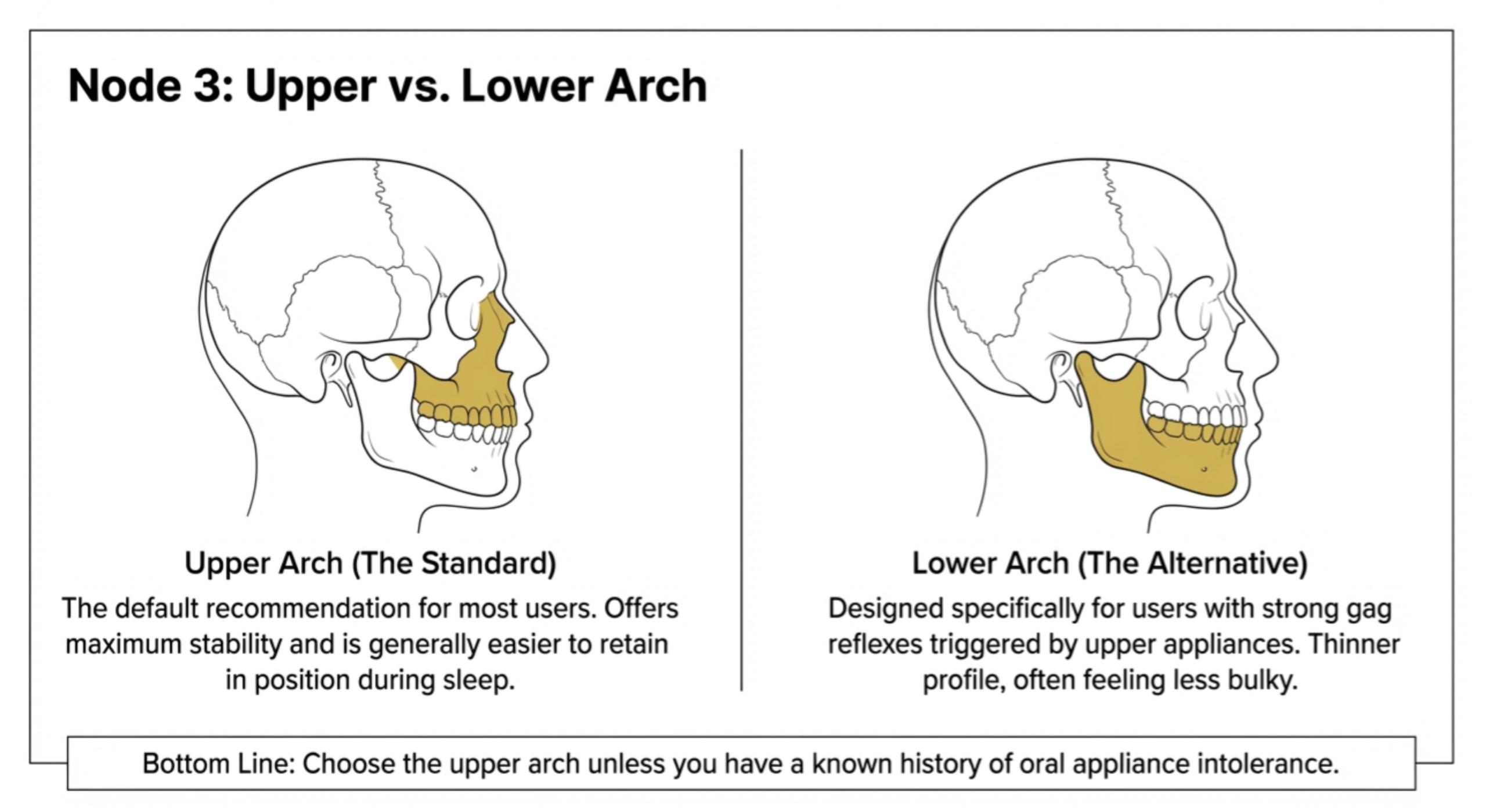
Most commercial night guards are designed for the upper arch. Upper guards are generally considered more stable and easier to retain during sleep.
Lower arch guards exist and are sometimes preferred by people with strong gag reflexes triggered by upper appliances. They tend to be thinner and feel less bulky to some wearers.
For most people starting out, an upper-arch guard is the standard recommendation. If the upper position proves problematic — persistent gag reflex, discomfort, or poor sleep — a lower guard is a legitimate alternative worth discussing with your dentist.
How Fit Affects Protection — and Why It Matters More Than Price
A night guard that doesn’t fit your bite correctly isn’t just uncomfortable — it can be actively counterproductive. A poorly fitting guard can:
- Shift off your teeth during sleep, leaving them unprotected
- Create uneven bite pressure that puts stress on specific teeth
- Cause jaw discomfort from holding an unnatural position all night
- Trigger more grinding activity as your jaw tries to find a comfortable position
Fit matters more than material, more than brand, and more than price. A $50 well-fitting guard will outperform an $800 guard that doesn’t sit correctly on your arch.
What good fit feels like
- Seats firmly over your teeth without requiring significant pressure to click in
- Feels snug — not tight enough to cause discomfort, but secure enough that it doesn’t shift
- Allows your jaws to close naturally without significant bite deviation
- Stays in place throughout the night without falling out
Mild initial tightness is normal and usually resolves within a few days of consistent wear. Sharp pressure on individual teeth, persistent jaw tension, or a guard that moves freely — these are signs of a poor fit that needs to be addressed.
Night Guard Thickness: Finding the Right Balance
Thicker guards offer more material between your teeth — which means more grinding pressure is absorbed before it reaches enamel. But thickness comes with trade-offs.
| Thickness | Best for | Trade-off |
|---|---|---|
| 1–2 mm | Light grinders, first-time wearers | Less durable; may wear through faster under heavy grinding |
| 2–3 mm | Moderate grinders; everyday protection | Slight bulk; most users adapt within 1–2 weeks |
| 3+ mm | Heavy grinders; high-force bruxers | Most noticeable bulk; best long-term protection |
Table 2: Night guard thickness guide by grinding intensity.
When in doubt, start with a mid-range thickness. You can always move to a thicker appliance if you find your guard wearing through faster than expected.
How to Care for Your Night Guard
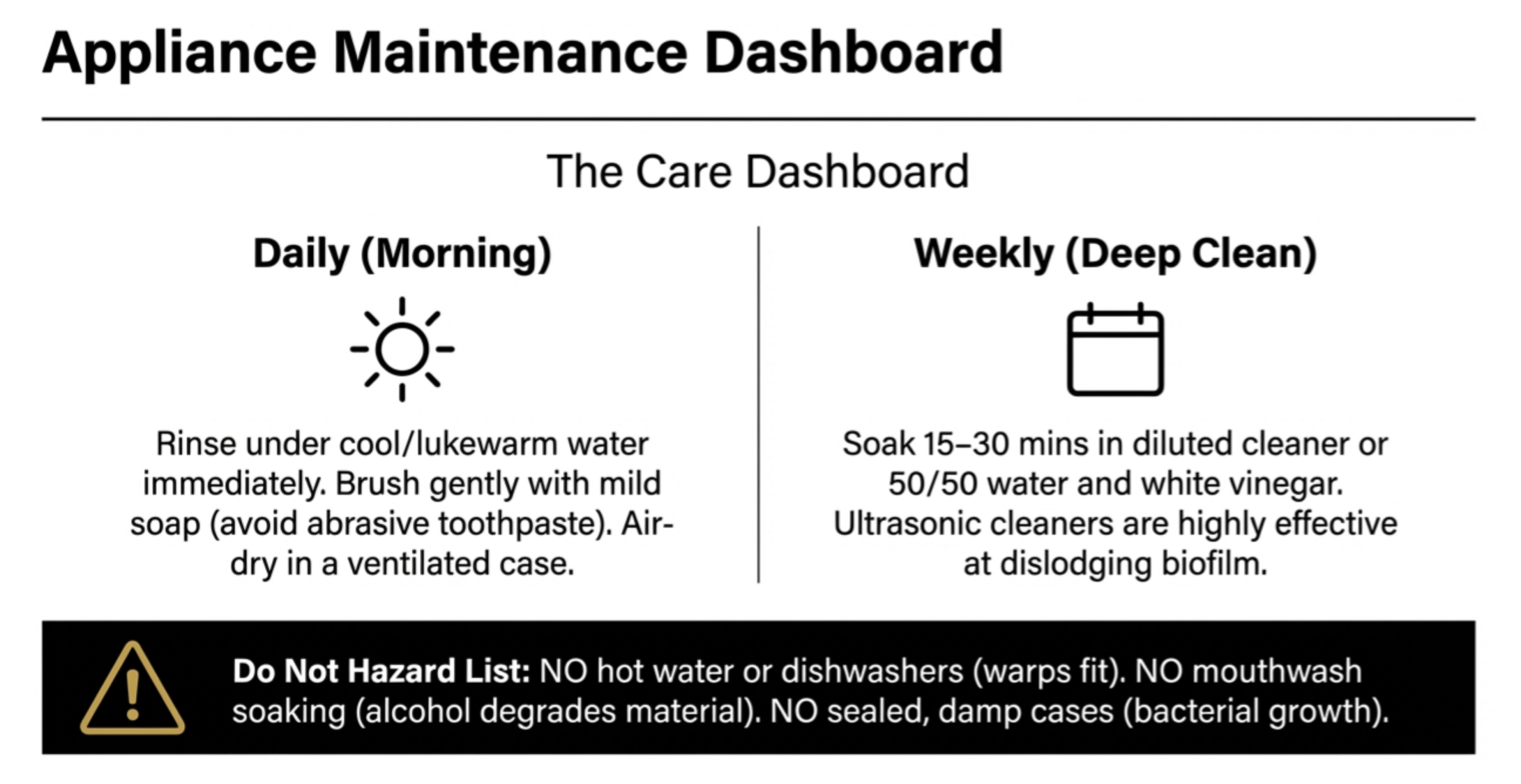
Daily cleaning (every morning)
- Rinse under cool or lukewarm water immediately after removing — never hot water, which warps the appliance
- Brush gently with a soft-bristle toothbrush and mild soap — not toothpaste, which is abrasive
- Rinse thoroughly and air-dry in a ventilated case
Weekly deep clean
Once a week, soak your guard for 15–30 minutes in a diluted dental appliance cleaner or a 50/50 mix of water and white vinegar. This breaks down biofilm that daily brushing misses. Ultrasonic cleaners are also highly effective — they use sonic vibration to dislodge debris from crevices without chemical exposure.
Looking for an effortless deep-clean solution?
Browse Reviv appliance accessories →What to avoid
- Leaving a damp guard in a sealed case — ideal conditions for bacterial growth
- Soaking in mouthwash — the alcohol content can degrade certain guard materials
- Exposing to high heat — car dashboards, hot water, and dishwashers all warp the fit
How Much Does a Night Guard Cost? What to Expect in 2026
- OTC stock guards: $5–$25. Pre-formed, no fit. Adequate for very light use only.
- Boil-and-bite guards: $20–$60. Better than stock, limited customisation.
- Mail-order custom guards: $80–$200. Home impression, lab-fabricated, good protection. Best value for most people.
- Dentist-fabricated custom guards: $300–$800+. Gold-standard fit. Often partially covered by dental insurance.
Does insurance cover night guards?
Many dental insurance plans cover night guards under the orthodontic or restorative benefit — though coverage varies widely by plan. Check with your insurer specifically about bruxism oral appliances. HSA and FSA funds typically cover FDA-registered night guards as qualified medical expenses.
Key Buying Checklist: 7 Things to Confirm Before You Purchase
- FDA registration. Is the device FDA-registered as a Class I oral appliance? This is your baseline for manufacturing quality standards.
- Material type. Soft, hard, or dual-layer? Match to your grinding intensity.
- Arch coverage. Full arch coverage distributes force better than partial.
- Custom fit vs stock. For anything beyond very light use, custom fit is worth the investment.
- Thickness. Appropriate for your grinding intensity? Check product specifications.
- Return policy. A reputable provider should offer a satisfaction guarantee — fit issues happen and should be correctable.
- Care instructions. Clear guidance reflects product quality and brand credibility.
Not sure which appliance ticks every box for you?
Take the Reviv appliance finder →The Bottom Line: Protect Your Teeth Tonight
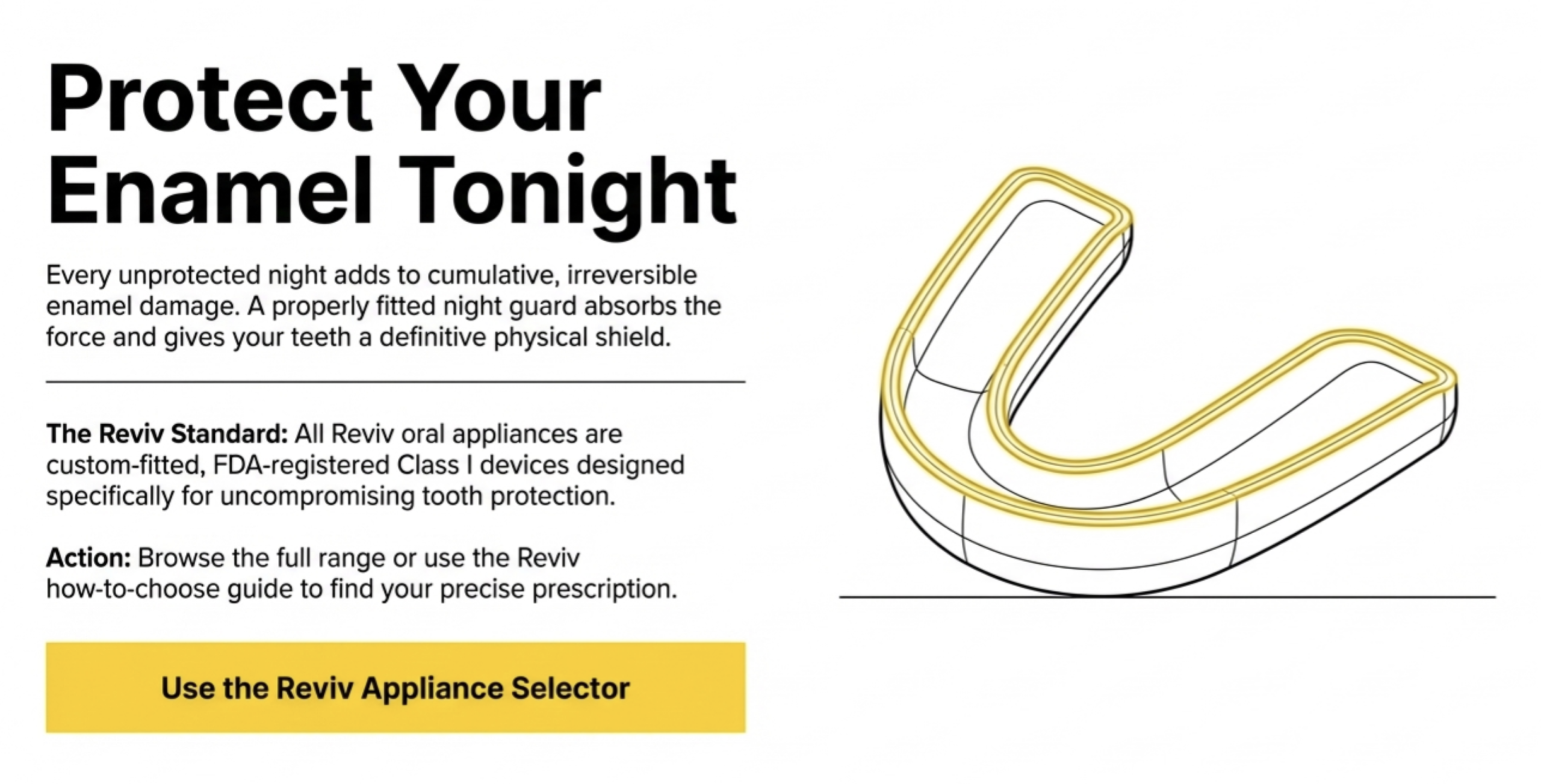
Enamel erosion from grinding is cumulative and irreversible. Every unprotected night adds to a total your dentist will eventually present you with — in the form of recommended restorations, crowns, or veneers.
A good night guard changes that calculation entirely. It absorbs the grinding force. It protects the enamel. It gives your teeth a fighting chance against a habit you may not even be fully aware of.
The right night guard for you depends on your grinding intensity, your budget, and your fit preferences. If you’re not sure where to start, the Reviv how-to-choose page walks you through the decision in a few simple steps.
Ready to explore your options? Browse the full Reviv oral appliance range — all appliances are FDA-registered Class I devices designed specifically for tooth protection from grinding pressure.