


Boil-and-bite vs custom — what’s the difference?
Is boil-and-bite good enough for grinding?
Why is custom better?
How long does a boil-and-bite last?
Is OTC boil-and-bite the same as DTC custom?
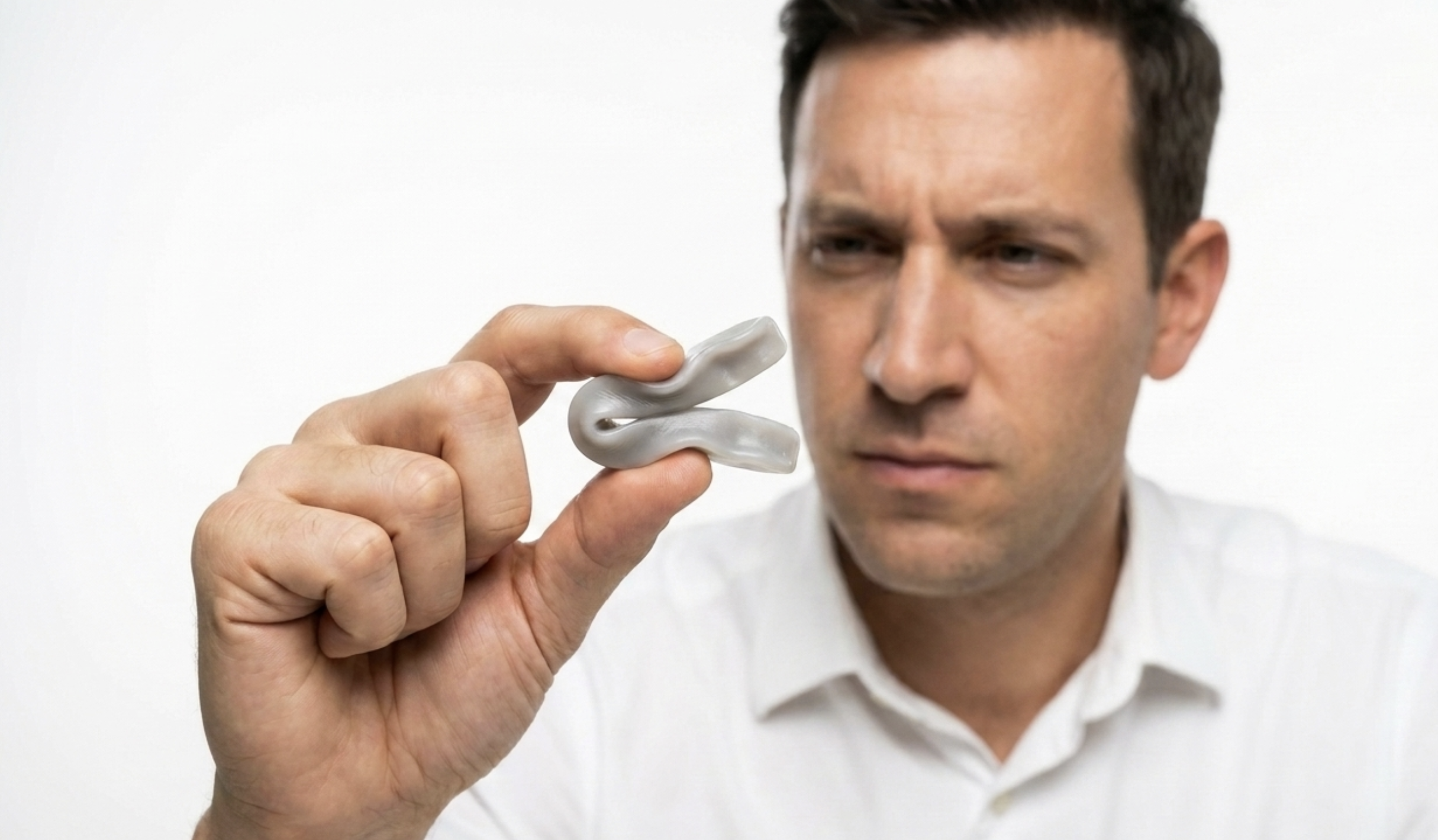
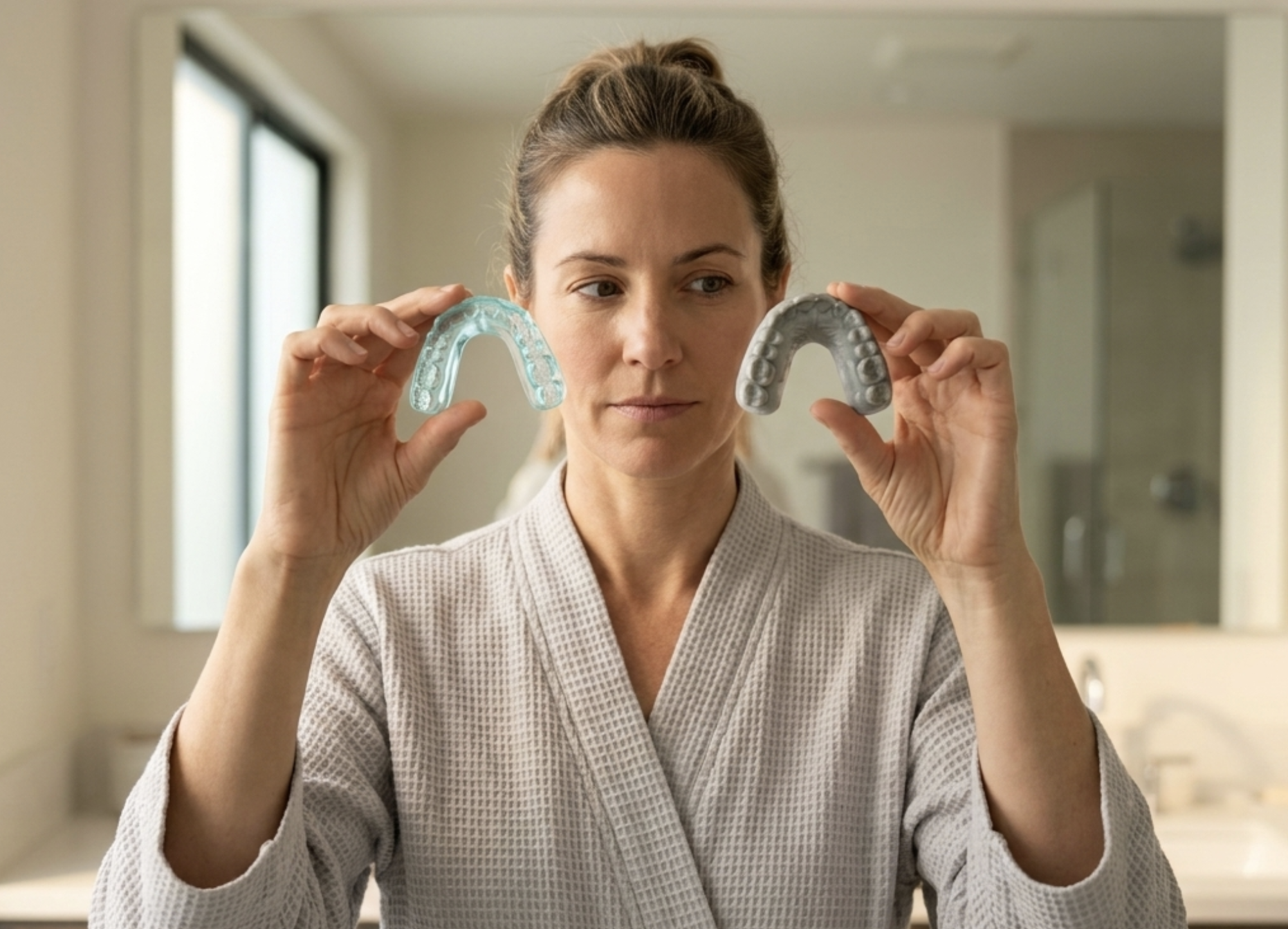
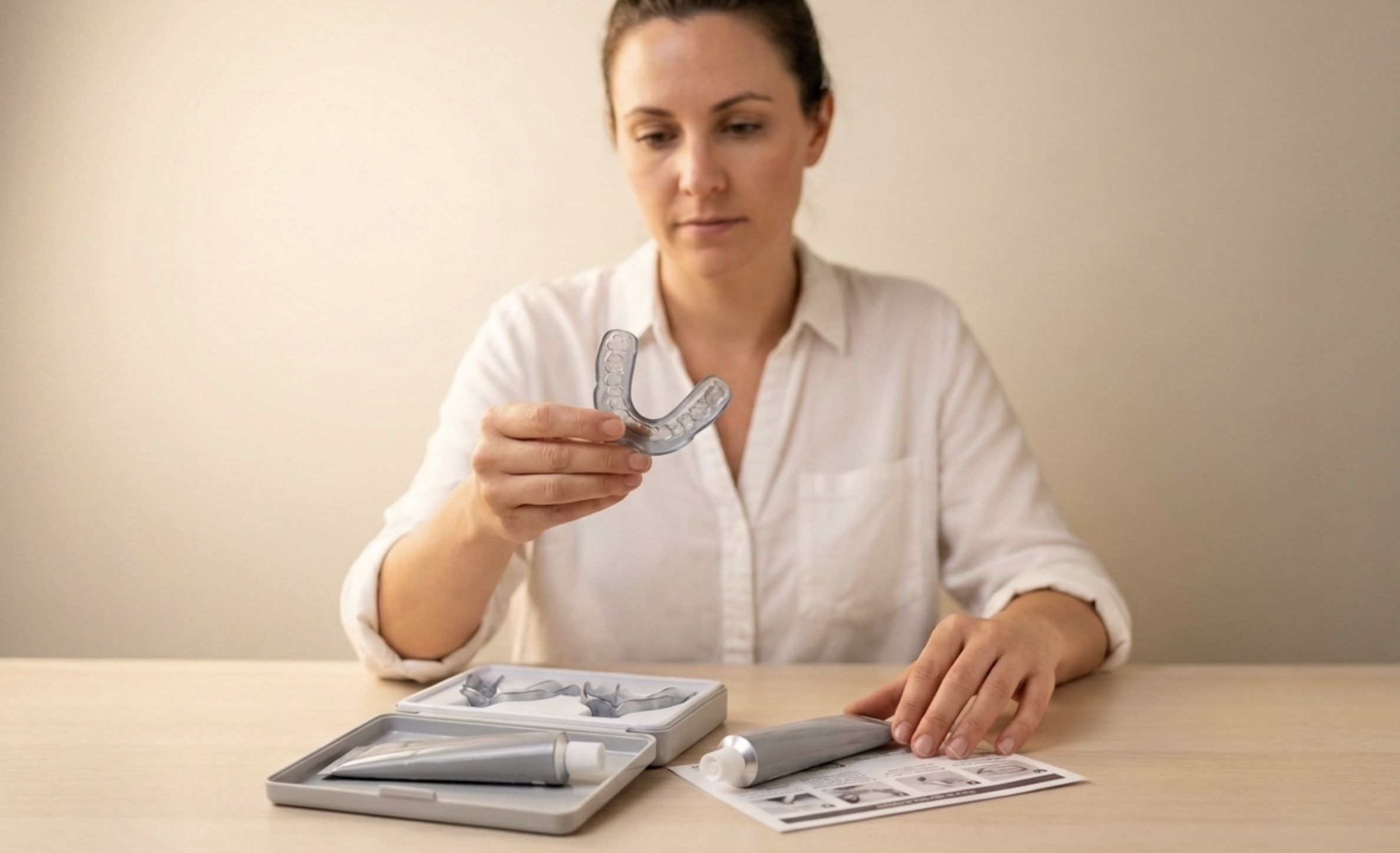
The night guard market splits into two fundamentally different categories, and the distinction matters more than most buyers realise. On one side: boil-and-bite guards, available at any pharmacy, $20–$50, ready in minutes. On the other: custom lab guards, fabricated from dental impressions of your specific arch, $80–$800 depending on the channel.
Most “which is better” articles resolve this comparison quickly and superficially. This one doesn’t — because the honest answer is that it depends on specific variables, and the wrong choice for your situation either wastes money or, in the case of clenchers using soft guards, can make morning symptoms worse rather than better.
This article covers what each type actually is, how the material and fit differences affect protection quality, the real cost comparison over time, and the five signals that tell you it’s time to upgrade from OTC to custom.
What Each Type Actually Is
The terminology in this space is loose enough to cause confusion. “Boil-and-bite,” “OTC guard,” “custom guard,” “DTC guard” — these terms are sometimes used interchangeably when they shouldn’t be. Here’s the precise definition of each.
Boil-and-bite guard
A thermoplastic guard purchased over the counter — at a pharmacy, sports store, or online. You soften it in boiling or near-boiling water until pliable, then bite into it to create an impression of your arch. The thermoplastic deforms under pressure and roughly conforms to your tooth surfaces as it cools and re-hardens.
Material: soft EVA thermoplastic or similar. Thickness: typically 2–4mm. Fit quality: approximate — the material conforms generally to your arch shape but not to the precise geometry of individual teeth. Available in upper or lower arch versions. Cost: $15–$60.
Custom lab guard (dentist or DTC)
Fabricated in a dental laboratory from impressions — either taken by a dentist or from an at-home impression kit provided by a DTC lab. The lab pours stone models from the impressions and thermoforms or pressure-presses the guard material over the exact geometry of your arch. The result is a guard that matches your specific tooth surfaces precisely.
Material: hard acrylic (PMMA), dual-laminate, or specialty biomechanical material. Thickness: 1–4mm depending on specification. Fit quality: precise — even contact across all teeth when the opposing arch closes against it. Available from dentists at $400–$800 or DTC labs at $80–$200. Same fabrication process either way.
The category that doesn’t exist
There is no meaningful middle ground between these two. Products marketed as “semi-custom” or “custom-fit” boil-and-bite guards are still boil-and-bite guards — the thermoplastic fitting process produces an approximate fit regardless of marketing language. If it didn’t come from a dental lab made from impressions, it’s a boil-and-bite guard.
Boil-and-Bite: An Honest Assessment
Most comparison articles are either entirely positive about boil-and-bite guards (written by OTC brands or affiliate reviewers) or entirely dismissive (written by dental practices trying to sell custom guards). The honest picture is more nuanced.
What boil-and-bite guards genuinely do well
- Immediate accessibility — available same day, no lead time, no impression process
- Low financial risk — appropriate for someone testing whether they can tolerate wearing a guard before investing in custom
- Adequate for light grinding — for people with light bruxism where the primary goal is creating a physical barrier between upper and lower teeth, a boil-and-bite guard provides that barrier
- Travel backup — if you leave your custom guard at home, an OTC guard from a pharmacy is better than nothing
The genuine limitations
Fit imprecision and uneven force distribution. A boil-and-bite guard creates an approximate mold of your arch, not a precise one. The result is uneven contact between the guard surface and the opposing arch — some teeth contact the guard more heavily than others. Under grinding force, this means some teeth are absorbing disproportionate load. For people with existing dental work (crowns, veneers, bridges, implants), this uneven loading is a specific concern.
The soft material problem for clenchers. This is the most important limitation and the least discussed. A soft thermoplastic guard compresses under the vertical force of clenching. As it compresses, the jaw’s proprioceptive system detects the give and the muscles continue loading — the same mechanism that makes you grip harder when holding something soft. For confirmed clenchers, a soft boil-and-bite guard can increase morning jaw soreness rather than reducing it. Identifying whether your primary pattern is clenching or grinding is essential before choosing guard material.
Wear rate. Soft thermoplastic wears and deforms faster than hard acrylic. For moderate to heavy grinders, a boil-and-bite guard may need replacement every 3–6 months. At $30–$50 per guard, this is $60–$200 per year indefinitely — which compares less favourably to a $150 custom guard lasting 2–3 years once you do the maths.
Custom Lab Guards: What You’re Actually Paying For
The price premium of a custom lab guard — whether from a dentist or a DTC lab — pays for two things: material and fit precision. These are not cosmetic differences.
Hard acrylic: the material difference
Hard acrylic (PMMA) doesn’t compress under grinding and clenching force. It maintains its geometry across the full range of bruxism force volumes — from light grinding to the maximum clenching force a heavy bruxer generates. The implications:
- The guard’s occlusal surface stays flat and even throughout its lifespan — it doesn’t develop uneven wear patterns that alter the bite contacts over time
- For clenchers, the non-compressible surface doesn’t give the jaw muscles something to load against
- Lifespan of 2–5 years under correct care — 4–10x the lifespan of a soft guard at the same grinding intensity
Precise fit: what it actually means
A custom guard made from impressions of your arch contacts every tooth surface at the correct point. When the opposing arch closes against the guard, the force is distributed evenly across all teeth that contact the guard surface. No single tooth is receiving disproportionate load.
This matters for everyday use: a well-fitted guard stays in place through the night without requiring the jaw to hold it in position. A boil-and-bite guard that doesn’t seat precisely may shift during sleep — audibly, or without the wearer knowing — creating variable and uneven contact patterns.
DTC custom: the dentist premium demystified
Dentist-made custom guards and DTC custom guards are fabricated by the same type of dental laboratories using the same materials and processes. The dentist adds professional impression taking, in-person fitting adjustments, integration with your dental history, and the ability to identify and adjust high contact points at a fitting appointment.
For people with complex bite issues, misaligned arches, or significant existing dental work, this clinical oversight is genuinely valuable. For people with straightforward bruxism and healthy dentition, a well-executed DTC custom guard at $80–$200 provides equivalent tooth protection at a fraction of the dentist price. The guard itself is the same quality. See the full dentist vs DTC comparison for when each makes sense.
Why Material Is the Most Important Variable
If there is one takeaway from this comparison, it’s that material type — not brand, not price within a category — is the variable that most determines whether a guard serves you well.
The two material categories behave fundamentally differently:
- Soft thermoplastic — compresses under load, deforms over time, comfortable immediately, appropriate for light grinding, wrong for clenching
- Hard acrylic — dimensionally stable under load, wears slowly, requires an adjustment period, appropriate for moderate to heavy grinding and any clenching pattern
The mistake most people make is choosing material based on comfort rather than function. Soft guards feel better in the hand and in the mouth during the first night. Hard guards feel foreign for 1–3 weeks before becoming unremarkable. But for anyone with moderate or heavy bruxism, or a confirmed clenching pattern, choosing the comfortable option is choosing the wrong material. More on this in the full types of mouth guards breakdown.
Why Fit Is the Second Most Important Variable
After material, fit precision determines protection quality. The relevant fit questions:
- Does the guard seat firmly without rocking?
- Does it stay in place through the night without the jaw muscles holding it?
- Does the opposing arch contact the guard surface evenly across all teeth?
- Is there localised pressure on a specific tooth rather than general awareness?
A boil-and-bite guard will pass the first two tests adequately for most people — it seats and stays. It typically fails the third: uneven contact across the arch is the norm with approximate thermoplastic fitting. A custom lab guard, made from precise impressions and adjusted at fitting, passes all four.
The True Cost Comparison
| Boil-and-Bite OTC | DTC Custom Lab | Dentist Custom | |
|---|---|---|---|
| Initial cost | $15–$60 | $80–$200 | $400–$800 |
| Material | Soft thermoplastic | Hard acrylic / dual-laminate | Hard acrylic / dual-laminate |
| Fit precision | Approximate | Lab-precise from impressions | Lab-precise + clinical adjustment |
| Lifespan (moderate grinder) | 3–6 months | 2–3 years | 2–5 years |
| Cost per night (moderate grinder) | ~$0.25–$0.55 | ~$0.10–$0.25 | ~$0.22–$0.44 |
| Appropriate for clenchers | No — soft material worsens clenching symptoms | Yes — with hard acrylic specification | Yes |
| Appropriate for dental work | With caution — uneven contacts | Yes | Yes — with clinical oversight |
The cost-per-night comparison is the most useful lens. For a moderate grinder going through a boil-and-bite guard every 4 months at $40 each, the annual cost is $120 for three guards that provide approximate fit and declining protection quality as they wear. A DTC custom guard at $150 lasting 2.5 years is $60 per year — less than half — with significantly better protection quality. The boil-and-bite is only cheaper if it lasts longer than it typically does for moderate grinders, or if the person only needs it for a short trial period.
The Five Signals It’s Time to Upgrade to Custom
- You’re going through boil-and-bite guards in under 6 months — the wear rate signals grinding intensity that soft thermoplastic can’t adequately handle long-term
- Your dentist is still noting progressive tooth wear despite wearing a guard — the guard is providing insufficient protection, likely because the soft material is absorbing but not fully distributing the force
- Morning jaw soreness is worsening, not improving — the primary signal that you’re a clencher on a soft guard; the soft material is stimulating more muscle loading, not less
- You have crown, bridge, veneer, or implant restorations — the uneven force distribution of a boil-and-bite guard concentrates load at the high contact points, which are often over dental restorations
- The guard shifts during sleep — if you’re waking with the guard in a different position or finding it on the pillow, the approximate fit is not providing consistent protection through the night
Full Comparison Summary
| Variable | Boil-and-Bite | Custom Lab Guard |
|---|---|---|
| Availability | Same day, any pharmacy | 2–3 weeks lead time |
| Material | Soft thermoplastic (EVA) | Hard acrylic or dual-laminate |
| Fit | Approximate — general arch shape | Precise — individual tooth geometry |
| Force distribution | Uneven — concentrates at high contacts | Even — across full arch contact |
| Clenching suitability | Poor — soft material compounds clenching | Good — hard material doesn’t stimulate loading |
| Durability | 3–12 months | 2–5 years |
| Adjustment period | Minimal — comfortable immediately | 1–3 weeks |
| Cost per night | Higher long-term for moderate/heavy grinders | Lower long-term for moderate/heavy grinders |
| Best for | Light grinders, first-time guard testing | Moderate to heavy grinders, clenchers, dental work |
Frequently Asked Questions
What is the difference between a boil-and-bite and a custom night guard?
A boil-and-bite guard is softened in hot water and bitten into to create an approximate fit — material is soft thermoplastic, fit is generic. A custom lab guard is fabricated from dental impressions in hard acrylic or dual-laminate — material is rigid, fit matches your exact arch geometry. The protection quality, durability, and suitability for clenchers differ significantly between the two.
Is a boil-and-bite guard good enough for teeth grinding?
For light grinders, it provides adequate basic protection and is a reasonable low-cost starting point. For moderate to heavy grinders, the soft material wears through in 3–6 months and the approximate fit means some teeth receive more load than others. Over a year, the economics of replacing boil-and-bite guards regularly often exceed the cost of a single DTC custom guard — which also provides better protection.
Why is a custom night guard better than boil-and-bite?
Three primary reasons: material (hard acrylic doesn’t compress under force, lasts 2–5 years), fit precision (even force distribution across all teeth rather than concentrating at high contact points), and clenching suitability (hard material doesn’t stimulate additional muscle loading the way soft material does for clenchers).
How long does a boil-and-bite mouthguard last?
Light grinders: 6–12 months. Moderate grinders: 3–6 months. Heavy grinders: weeks to a few months. The soft thermoplastic compresses and deforms under sustained grinding force significantly faster than hard acrylic. Your current guard’s wear rate is the most useful signal of your grinding intensity.
Is an OTC boil-and-bite the same as a DTC custom guard?
No — these are different categories despite both being available without a dentist visit. OTC boil-and-bite is soft thermoplastic fitted at home in hot water. DTC custom is fabricated in a dental lab from impressions of your teeth in hard acrylic — the same material and process as a dentist guard, at lower cost because the dentist’s professional overhead is removed.
The Bottom Line
Boil-and-bite guards are appropriate for light grinders testing whether they can tolerate wearing a guard, or as a short-term backup. For anyone with moderate to heavy grinding, confirmed clenching, existing dental work, or a guard that’s wearing through in under 6 months — the upgrade to a custom lab guard is the right move, and the long-term economics usually justify it within the first year.
The most important variable is material: soft thermoplastic is the wrong choice for clenchers regardless of price or brand. Hard acrylic custom — either from a DTC lab at $80–$200 or a dentist at $400–$800 — is the specification that handles clenching force correctly. The Reviv model selector matches your grinding and clenching pattern to the right custom design, or browse the full range of FDA-registered Class I appliances.