


What is a daytime mouth guard?
Is there a guard to wear during the day?
Can I talk normally with one in?
How is it different from a night guard?
Who needs a daytime guard?

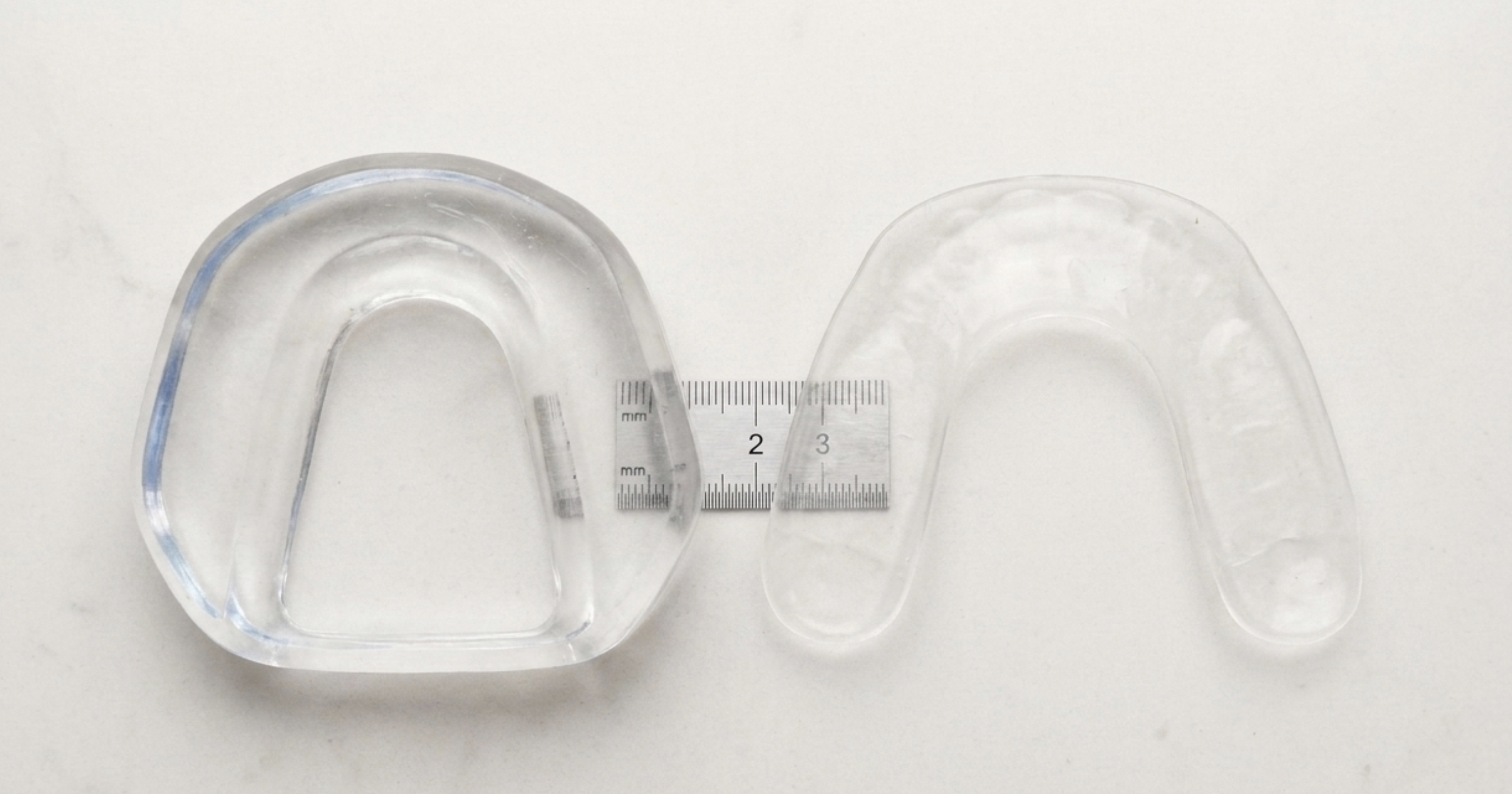

If you search for mouth guards, almost everything you find is about nighttime grinding. The products are designed for sleep. The marketing talks about waking up without jaw pain. The comparisons assume you’re unconscious while wearing the thing.
But a significant portion of bruxism is daytime — clenching during concentration, stress, driving, screen time. It’s quieter than nighttime grinding (no audible sound, no partner to notice it), which is why it often goes unaddressed for longer. And a nighttime guard, however well-fitted, does nothing for clenching that happens at a desk at 2pm on a Tuesday.
This guide covers the daytime mouth guard category properly — what it is, who needs one, how it differs from a nighttime guard, what to look for when choosing, and the specific concerns people have about wearing one during the day.
What Is a Daytime Mouth Guard?
A daytime mouth guard is a thin oral appliance worn during waking hours to protect teeth from the damaging effects of awake bruxism — the clenching and grinding that happens while conscious, typically during periods of concentration, stress, or as a side effect of certain medications.
The defining characteristic is thickness: daytime guards are 1mm or less, compared to 2–4mm for nighttime guards. This thin profile serves three requirements that nighttime guards don’t need to meet:
- Normal speech — a 3mm guard in your mouth during a meeting affects articulation noticeably; a 1mm guard does not once adapted
- Natural swallowing — thin guards don’t alter the swallowing reflex the way thicker ones can
- Discrete appearance — at 1mm, a clear hard acrylic guard is essentially invisible from normal conversational distance
Daytime guards are made from hard acrylic rather than soft thermoplastic. This is not about durability alone — daytime clenching is a vertical compression force, and soft material compresses under that force in a way that can stimulate additional muscle loading. A hard, non-compressible contact surface is the correct material for a clenching appliance, regardless of whether it’s worn day or night.
Who Needs a Daytime Mouth Guard?
Daytime clenchers
The primary user. You clench during concentration — deep work, stressful meetings, driving, difficult conversations. You may be completely unaware you’re doing it until you notice the symptoms: jaw muscle fatigue or soreness that builds through the day (not first thing in the morning), tension headaches that worsen in the afternoon, tooth sensitivity on specific teeth that becomes more prominent after stressful periods.
The tell-tale pattern: jaw soreness that is worse by 4pm than at 8am, and better the morning after a weekend with low stress than after a demanding work day.
Stimulant medication users
Adderall, Vyvanse, Ritalin, and other amphetamine-based medications produce jaw clenching as a side effect in a significant proportion of users. The mechanism is dopaminergic — the same pathway that produces the medication’s therapeutic effects also increases jaw muscle activation. This is primarily a daytime pattern (the medication’s active window) rather than a nighttime one. The specific guard implications for stimulant-driven clenching are worth understanding if this applies to you.
Cheek biters and tongue clenchers
Some people respond to stress by biting the inner cheek or pressing the tongue forcefully against the teeth — related parafunctional habits that a daytime guard can partially interrupt by changing the oral environment. Not the primary use case, but a common secondary one.
People who grind at both day and night
If you clench during the day and grind at night, you need two separate guards — one for each pattern. The daytime ultra-thin guard doesn’t provide sufficient protection for the higher-force nighttime grinding pattern, and a nighttime guard is too thick for daytime speech and discretion. This is the most underserved segment: people managing both patterns who are told to “just use your night guard” for daytime without understanding why that doesn’t work.
How a Daytime Guard Differs from a Night Guard
| Nighttime guard | Daytime guard | |
|---|---|---|
| Thickness | 2–4mm | ≤1mm |
| Material | Soft, hard, or dual-laminate | Hard acrylic only |
| Wear pattern | Static, 7–8 hours | On-off throughout day |
| Speech impact | Significant (not worn awake) | Minimal after adaptation |
| Force it handles | High — unconscious grinding force | Moderate — conscious clenching |
| Lifespan | 1–5 years | 6 months–2 years |
| Visibility | Not worn in public | Near-invisible at 1mm |
The most important difference is that a daytime guard is a conscious-wear appliance. Unlike a nighttime guard where you put it in, lose consciousness, and it does its job — a daytime guard competes with your workday, your conversations, and your awareness of having something in your mouth. This is why the design requirements are so different: the guard has to be comfortable enough to forget about, thin enough not to interfere with speech, and discrete enough not to require explanation.
What to Look For
1mm or less thickness
This is the non-negotiable threshold for daytime wear. Guards marketed as “ultra-thin” that are 1.5mm or 2mm are not daytime guards — they are thin nighttime guards. A genuine daytime appliance sits at or under 1mm. At this thickness, hard acrylic is slightly flexible rather than fully rigid, but it maintains a non-compressible contact surface that’s appropriate for clenching force.
Hard acrylic material
Soft thermoplastic at 1mm provides almost no protection — it compresses immediately under daytime clenching force and the thin profile means there’s almost nothing left after compression. Hard acrylic at 1mm maintains its geometry under force. There is no rational soft daytime guard.
Full arch coverage
Some products cut out the front teeth (the “no-show” design) to make the guard less visible from the front. The tradeoff is that teeth not covered by the guard can super-erupt — continue growing slightly until they find contact — which can change your bite over time. Full-arch coverage avoids this risk. For most people, a full-arch 1mm clear guard is sufficiently invisible without requiring an architectural compromise.
Custom fit from impressions
A daytime guard that shifts during speech is worse than no guard — the movement changes how you articulate sounds and makes the guard obvious. Custom fit from dental impressions produces a guard that seats accurately and doesn’t shift during normal jaw movement. OTC boil-and-bite guards at 1mm are not appropriate for daytime use — the approximate fit is sufficient for nighttime static wear but not for the dynamic oral environment of a working day.
Common Concerns — Answered Honestly
Can I talk normally while wearing it?
Yes — after a brief adaptation period of a few days. The first day with a new daytime guard usually involves slight changes to sibilant sounds (s, sh) as your tongue adjusts to the new oral geometry. Most people report that colleagues or clients cannot tell they are wearing anything after the first week. The key is custom fit — a guard that seats accurately gives the tongue consistent reference points for speech; a shifting guard does not.
A practical approach: practice speaking alone for 30 minutes before wearing the guard in meetings. Reading aloud, phone calls, and podcasts all accelerate adaptation.
Can I drink water while wearing it?
Yes. Water is fine and won’t affect the guard or your hydration. Remove the guard for any other drink — hot liquids can warp the material, acidic drinks (coffee, juice) sit against the enamel surface under the guard creating an acidic environment, and carbonated drinks get trapped under the appliance uncomfortably.
Can I eat with it in?
No. Remove it for all food. Food particles trapped under the guard create a bacterial environment against your teeth, and the chewing forces far exceed what the thin material is designed for. Daytime guards are for wearing between meals and activities, not during them.
Will people notice?
At 1mm with a custom fit, the guard is near-invisible at conversational distance. Clear hard acrylic against your teeth reads as nothing from more than 30cm away in normal light. The moment people notice is typically when speaking with an unfamiliar speech pattern during the first few days of adaptation — which resolves quickly. Some wearers in client-facing or high-visibility settings choose to disclose; most find it unnecessary.
How long should I wear it each day?
Wear it during the periods when you know you clench — for most people this is during concentrated work, commuting, and stressful meetings. There is no minimum; the protection benefit accumulates with wear time. Many daytime guard users develop a pattern of wearing it during specific high-clenching contexts rather than continuously. Remove it when you notice you’re not clenching — meals, conversations where you’re relaxed, exercise.
The Available Daytime Guard Options
The daytime guard market is smaller than the nighttime market and less well-known, but several established DTC labs offer purpose-designed options:
- Reviv RD1 — FDA-registered Class I (BRW), ultra-thin hard biomechanical design, custom-fit from impressions. The daytime companion to the R2 nighttime guard for people managing both patterns. Browse Reviv →
- Pro Teeth Guard daytime — approximately 1mm hard acrylic, custom-fit from impressions, full arch. Long track record, clear re-impression policy.
- Chomper Labs ultra-thin — approximately 0.8mm, custom-fit, hard rigid material. Among the thinnest commercially available options.
- Sentinel No-Show Day Guard — partial coverage (front six teeth exposed) for maximum discretion. The tradeoff of partial coverage described above applies here.
If You Clench Both Day and Night
This is worth addressing directly because it’s underserved by most guidance. If your pattern includes daytime clenching and nighttime grinding or clenching, you need two separate appliances — one for each context. Using your nighttime guard during the day means wearing something 2–4mm thick that affects speech and is visible. Using your daytime guard at night means underprotecting against the significantly higher force volumes of unconscious nighttime bruxism.
The good news: most DTC labs can fabricate both guards from a single set of impressions. You take impressions once and specify both a daytime ultra-thin and a nighttime standard guard. The combined cost is typically $150–$280, which is still well below a single dentist-made guard. For a full breakdown of the day-and-night combined pattern, the complete clenching guide covers both patterns and the guard selection for each.
For Reviv specifically, the RD1 (daytime) and R2 (nighttime grinding-and-clenching) are designed as paired solutions — the biomechanical surface approach applied to both use cases. Choosing the right size and model for your jaw applies to both.
Frequently Asked Questions
What is a daytime mouth guard?
A thin oral appliance (1mm or less) worn during waking hours to protect teeth from awake bruxism — clenching and grinding that occurs while conscious. Unlike nighttime guards (2–4mm), the thin profile allows normal speech, swallowing, and discrete wear in professional settings. Always made from hard acrylic, not soft thermoplastic.
Is there a mouth guard to wear during the day?
Yes — daytime mouth guards are a distinct product category from nighttime guards. They are not simply thinner nighttime guards but purpose-designed appliances with different thickness, material, and wear-pattern requirements. Purpose-designed options are available from several DTC labs including Reviv (RD1), Pro Teeth Guard, Chomper Labs, and Sentinel.
How is a daytime mouth guard different from a night guard?
Thickness is the primary difference: 1mm vs 2–4mm. The thinner profile enables normal speech and discrete appearance that nighttime guards don’t need to achieve. Material is typically the same (hard acrylic) but daytime guards don’t need to absorb the higher sustained force volumes of unconscious nighttime grinding — appropriate protection at lower thickness for the generally lower force of conscious daytime clenching.
Can I talk normally while wearing a daytime mouth guard?
Yes, with a well-fitted ultra-thin custom guard. A guard made from impressions of your specific arch seats accurately and allows normal tongue placement for speech. The adaptation period is typically 3–7 days, after which most people report no detectable speech changes. Generic guards that shift during speech are the problem, not the appliance type.
Who needs a daytime mouth guard?
People whose jaw soreness or tension builds through the day rather than being worst first thing in the morning. Stimulant medication users who experience jaw clenching during the medication’s active window. Anyone who grinds at night and also clenches during the day — two separate patterns requiring two separate guards. Cheek biters and other parafunctional habit holders where a guard interrupts the oral environment.
The Bottom Line
The daytime mouth guard category exists because a significant portion of bruxism is awake — and a nighttime guard does nothing for clenching that happens at your desk. The appliance is different in every meaningful way from its nighttime counterpart: thinner, harder material only, custom-fit for speech, worn on-and-off rather than statically through sleep.
If you clench during the day, a purpose-designed daytime guard is the right tool. If you also grind at night, you need both — daytime and nighttime guards are not substitutes for each other. Most people are served well by a 1mm hard acrylic custom guard for daytime and a hard or dual-laminate custom guard for nighttime, ordered from the same lab using one set of impressions.
The Reviv model selector covers both the RD1 (daytime) and nighttime options — or browse the full range of FDA-registered Class I appliances.