


Why does Adderall or Vyvanse cause jaw clenching?
How do I stop clenching on Adderall?
Can stimulants damage your teeth?
Does a night guard stop jaw clenching?
Should I tell my dentist I’m on Adderall?


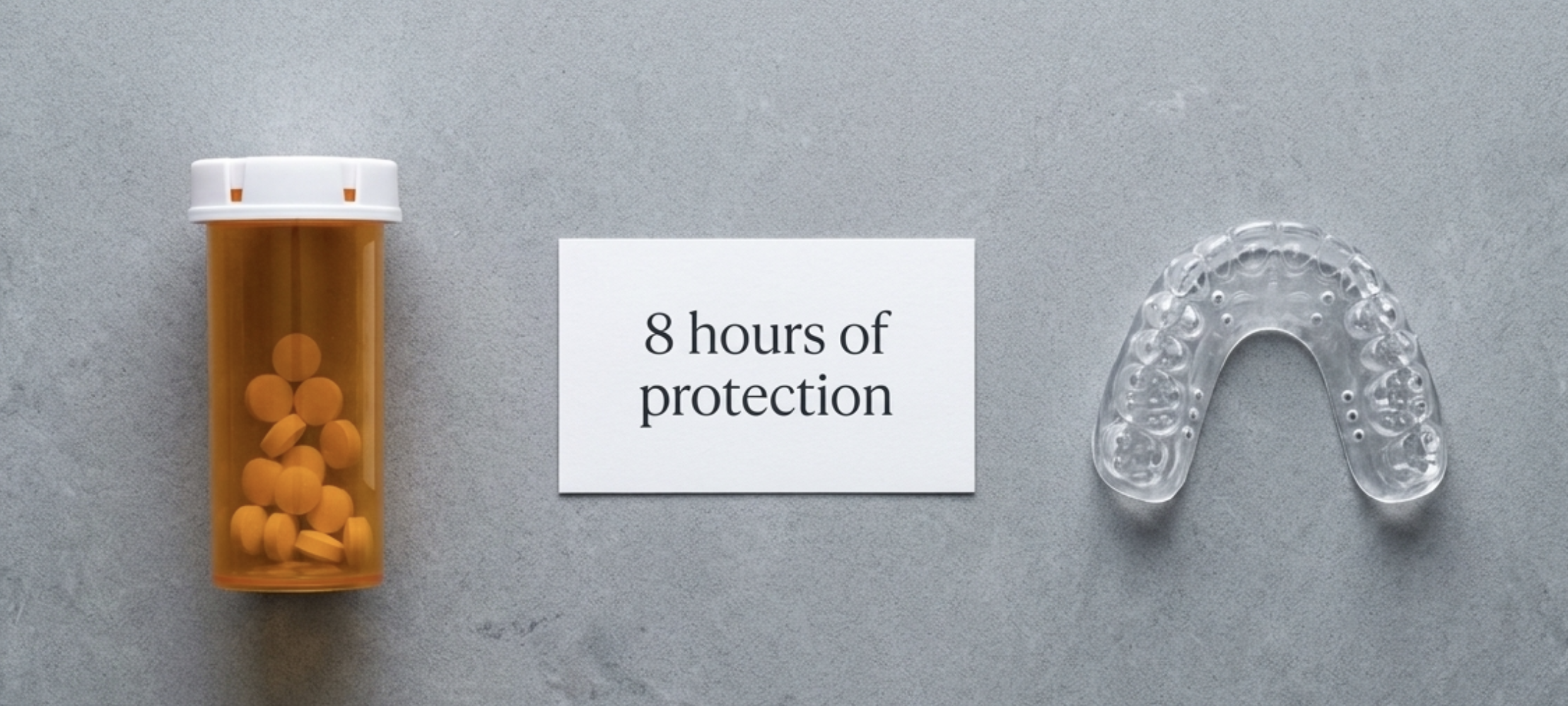
You started a stimulant medication and noticed your jaw. Maybe a friend pointed it out. Maybe you caught yourself clenching at your desk, teeth pressed hard together, jaw muscles tight. Maybe your dentist mentioned new wear at your last check-up.
Jaw clenching and teeth grinding on Adderall, Vyvanse, and other stimulant medications is real, common, and frequently underreported. It doesn’t happen to everyone — but for those it affects, it can happen consistently enough to cause genuine dental damage over time.
This article explains why stimulants trigger jaw clenching, what the dental consequences are, and — most importantly — how to protect your teeth while you continue treatment.
Why Stimulant Medications Cause Jaw Clenching
The dopamine and norepinephrine mechanism
Adderall (amphetamine salts) and Vyvanse (lisdexamfetamine) work primarily by increasing the availability of dopamine and norepinephrine in the brain. Elevated norepinephrine activates the sympathetic nervous system — the same system that drives the “fight or flight” response: increased heart rate, heightened alertness, elevated muscle tone. One of the muscles that responds to this elevated sympathetic activation is the masseter — the primary jaw-closing muscle.
In simple terms: stimulants put the nervous system in a higher-arousal state, and a higher-arousal nervous system tends to produce more jaw tension. This isn’t a quirk — it’s a downstream consequence of the same mechanism that makes them effective for attention.
Why it’s more pronounced in some people
Not everyone who takes Adderall or Vyvanse develops significant jaw clenching. Several factors influence susceptibility:
- Dose — higher doses produce stronger sympathetic activation and tend to correlate with more jaw tension
- Timing — medications taken later in the day may still be active at bedtime, increasing nighttime clenching
- Individual neurochemistry — people with a pre-existing tendency toward jaw tension, anxiety, or bruxism appear more vulnerable
- Caffeine co-use — combining stimulants with caffeine amplifies the sympathetic arousal effect
The jaw clenching tends to be most noticeable during the peak medication effect — typically several hours after the dose. For extended-release formulations like Vyvanse, the active window is long and clenching can persist well into the evening or night.
What Stimulant-Induced Jaw Clenching Does to Your Teeth
The dental consequences of medication-induced jaw clenching are the same as any other form of bruxism — they just have a specific, identifiable cause.
Enamel wear. Sustained clenching applies compressive force to the biting surfaces repeatedly throughout the day or night. Over months and years, this wears away enamel. Enamel doesn’t regenerate — once worn, it’s gone.
Stress fractures and cracks. High compressive force creates stress within the tooth structure, manifesting as craze lines and eventually deeper fractures. These often don’t cause pain until they reach a certain depth.
Cusp fractures. The raised peaks on back teeth are particularly vulnerable to compressive overload. Heavy clenchers are at elevated risk of cusp fractures, especially on teeth with existing fillings.
Restoration failure. Crowns, inlays, onlays, and large fillings all bear the same compressive forces as natural teeth. Stimulant users who clench tend to go through dental work faster than non-clenchers.
Jaw muscle fatigue. Chronically overworked jaw muscles can become hypertrophied — visibly enlarged — and carry residual tension that feels like soreness or persistent tired jaw even when not actively clenching.
Recognising Stimulant-Related Jaw Clenching
During the day (while medicated)
- Jaw muscles feel tight or fatigued, especially in the afternoon
- You catch yourself with teeth pressed together rather than slightly apart
- Tension in the temples or behind the ears
- Jaw awareness that wasn’t there before starting medication
At night
- Waking with jaw soreness or stiffness
- Morning headaches at the temples
- Teeth feel sensitive or tender in the morning
At the dentist
- New enamel wear at check-ups
- Flattened tooth surfaces or stress fractures
- Increased tooth sensitivity without apparent cavity
What You Can Do: A Layered Approach
Layer 1: Protect your teeth (the non-negotiable)
Regardless of what else you do, protecting your teeth from the clenching force is the most important step. A well-fitted oral appliance worn at night absorbs whatever clenching occurs during sleep — protecting your enamel from the force your jaw generates.
For stimulant users who clench, appliance specification matters:
- Hard or dual-layer material is strongly preferred over soft — stimulant-induced clenching can be forceful, and soft guards compress under heavy load
- Custom fit from an impression of your bite distributes force evenly rather than concentrating it on individual teeth
- Full arch coverage — molar to molar — is essential; clenching load is highest at the back teeth
For identifying whether your clenching is primarily nighttime or daytime — the distinction affects which guard type and thickness you need.
Layer 2: Discuss medication timing with your prescriber
For people taking extended-release stimulants like Vyvanse, the medication may still be partially active late in the evening. Discussing whether earlier dosing could reduce overlap with sleep is a clinician conversation — don’t modify your regimen without medical guidance.
Layer 3: Reduce co-stimulants
Caffeine amplifies the sympathetic arousal that stimulant medications produce. Reducing or eliminating caffeine — particularly in the afternoon — can meaningfully reduce the combined stimulant load on the nervous system.
Layer 4: Build jaw relaxation awareness during the day
Awake clenching — which is what most stimulant-induced jaw tension is — responds to conscious awareness in a way that sleep bruxism doesn’t. The technique most consistently recommended is the “lips together, teeth apart” habit: maintaining a jaw resting position where your lips are gently closed but your teeth are not in contact. Setting periodic reminders to check and reset jaw position can reduce the cumulative clenching load over time.
Layer 5: Address underlying tension
Stimulant-induced jaw clenching is often worst on high-stress days. Regular physical exercise, mindfulness or structured relaxation, and consistent sleep hygiene can reduce the arousal load at night.
Talking to Your Dentist About This
Many people on stimulant medications don’t mention it to their dentist, and dentists don’t always ask. Being explicit helps:
- Tell your dentist you’re on stimulant medication and have noticed jaw tension or clenching
- Ask them to specifically look for wear patterns consistent with clenching
- Discuss whether your current appliance is appropriate for the force levels involved
- Ask whether the wear pattern they see is consistent with stimulant use
A dentist who understands the mechanism can give you more targeted guidance — including whether your appliance needs upgrading to a harder material or greater thickness.
If Jaw Clenching Is Significantly Affecting Quality of Life
For some people, stimulant-induced jaw clenching goes beyond a dental concern — it’s uncomfortable enough to affect concentration, mood, or daily function. In these cases, raise it as a side effect concern with your prescribing clinician. Options that may be discussed:
- Dose adjustment — lower doses may produce less jaw tension while maintaining therapeutic benefit
- Medication switch — different stimulant formulations have different pharmacokinetic profiles; some people find clenching less pronounced on one vs another
- Non-stimulant ADHD medications — atomoxetine, guanfacine, and others do not carry the same jaw tension mechanism
These are clinician decisions. Significant jaw clenching from medication is a legitimate side effect worth discussing — it doesn’t have to be silently tolerated.
The Bottom Line
Jaw clenching and teeth grinding on Adderall, Vyvanse, and other stimulants is a direct consequence of how these medications work — elevated sympathetic arousal, increased jaw muscle tone, and a nervous system running at higher baseline tension. It’s common, underreported, and capable of causing real dental damage over time.
The most important protective step is a well-fitted oral appliance that guards your teeth from the force your clenching generates while you sleep. Beyond that, a layered approach — medication timing discussions with your prescriber, caffeine reduction, daytime jaw awareness, and stress management — can reduce the clenching load your appliance needs to handle.
If you’re not yet wearing a night guard and you’re on stimulant medication, the Reviv how-to-choose guide is a practical starting point — or browse the full range of FDA-registered Class I appliances designed for tooth protection. Your treatment matters. So do your teeth.


Pingback: CPAP Alternatives: 7 Non-Machine Options for Sleep Apnea - TMJ Mouthguard
Pingback: Why NBA Players Wear (and Chew) Their Mouthguards: The Jaw Tension Behind the Trend - TMJ Mouthguard
Pingback: Ozempic Teeth: What People Are Reporting and What the Evidence Shows - TMJ Mouthguard
Pingback: Ozempic and Jaw Clenching: Why GLP-1 Medications May Trigger Bruxism - TMJ Mouthguard
Pingback: How to Prevent Ozempic Teeth: A Practical Protection Guide - TMJ Mouthguard
Pingback: Why So Many Nurses Grind Their Teeth: Jaw Tension on the Frontlines - TMJ Mouthguard