
What is an ultra-thin daytime guard?
What does “no-show” mean?
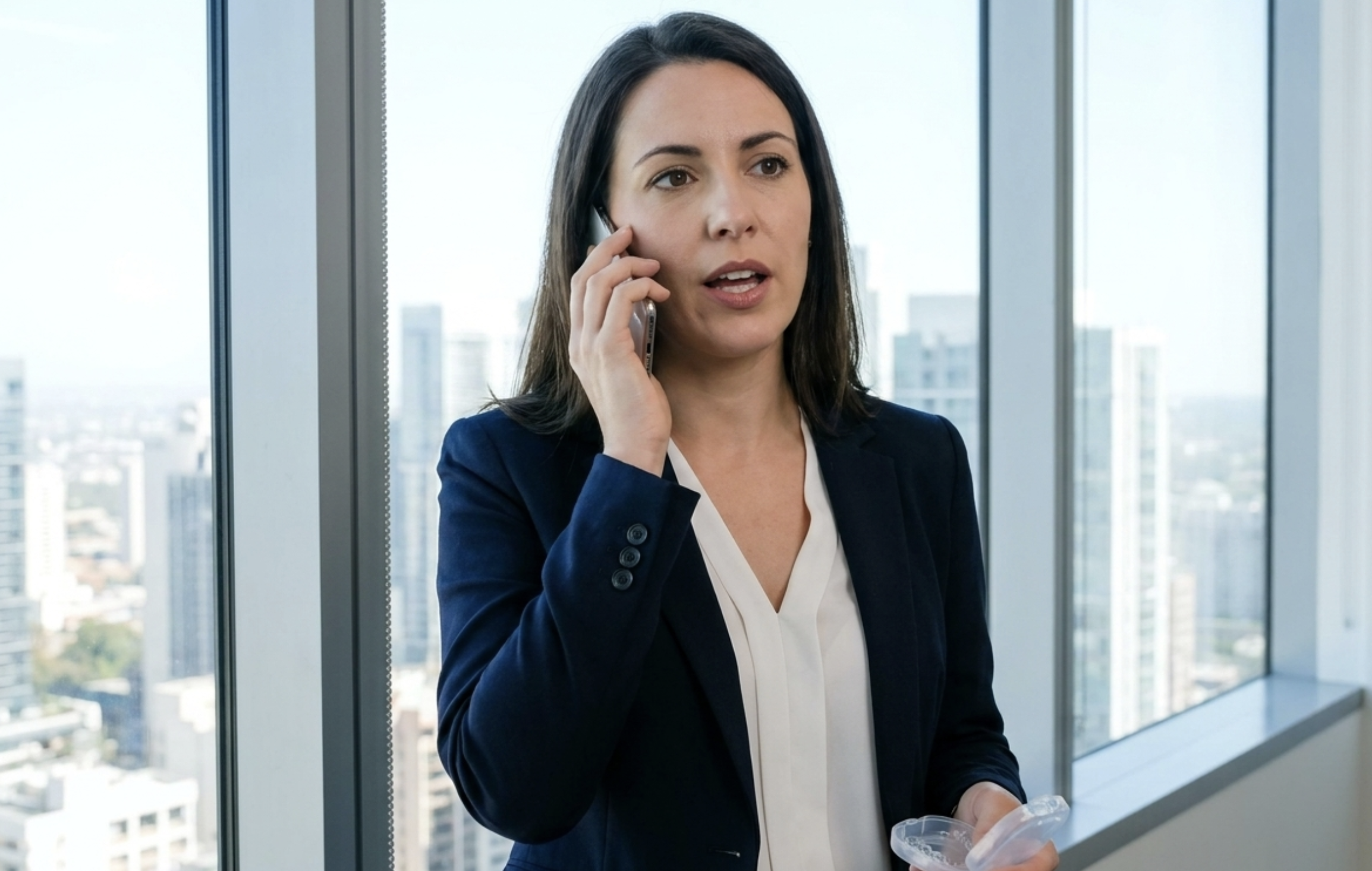
Can I wear one to work or in meetings?
Is it the same as a night guard?
What’s the best ultra-thin option?


The search term “ultra thin daytime mouth guard” is used by someone who already knows they need a daytime guard. They’re not asking whether one exists — they’re asking which one is discrete enough to wear at work, in meetings, on dates, and in the rest of their actual life without becoming a thing they have to explain.
That’s the right question, and this article answers it directly. What “ultra thin” and “no-show” actually mean in practice, the three design principles that determine whether a daytime guard is genuinely discrete, the available options compared honestly, and the specific scenarios where each matters.
Why Discretion Is the Core Requirement — and Why Most Guards Fail It
A nighttime guard doesn’t need to be discrete. You wear it in the dark, alone or with a partner who already knows, for hours while unconscious. The requirements are protection, comfort enough to keep wearing it, and durability. Appearance is irrelevant.
A daytime guard has a completely different brief. It needs to be present during work calls, client meetings, presentations, conversations with people who don’t know about your jaw clenching habit, first dates, and every other social and professional context of a normal day. The moment it becomes a thing people notice — a visible object, a change in your speech, an odd shape behind your lips — it stops being wearable for most people’s actual lives.
Most “daytime” guards fail this brief in one or more ways:
- Too thick — 1.5mm or 2mm guards affect speech noticeably and change the lip profile
- Wrong material — soft guards at any thickness compress and shift during speech, making them audible
- Poor fit — a generic or approximate-fit guard shifts during jaw movement, which is both noticeable and ineffective
- Partial coverage — some designs remove the front facing to improve appearance, but this leaves teeth exposed
A genuinely discrete daytime guard solves all four. Here’s what that requires.
What “Ultra-Thin” Actually Means in Material Terms
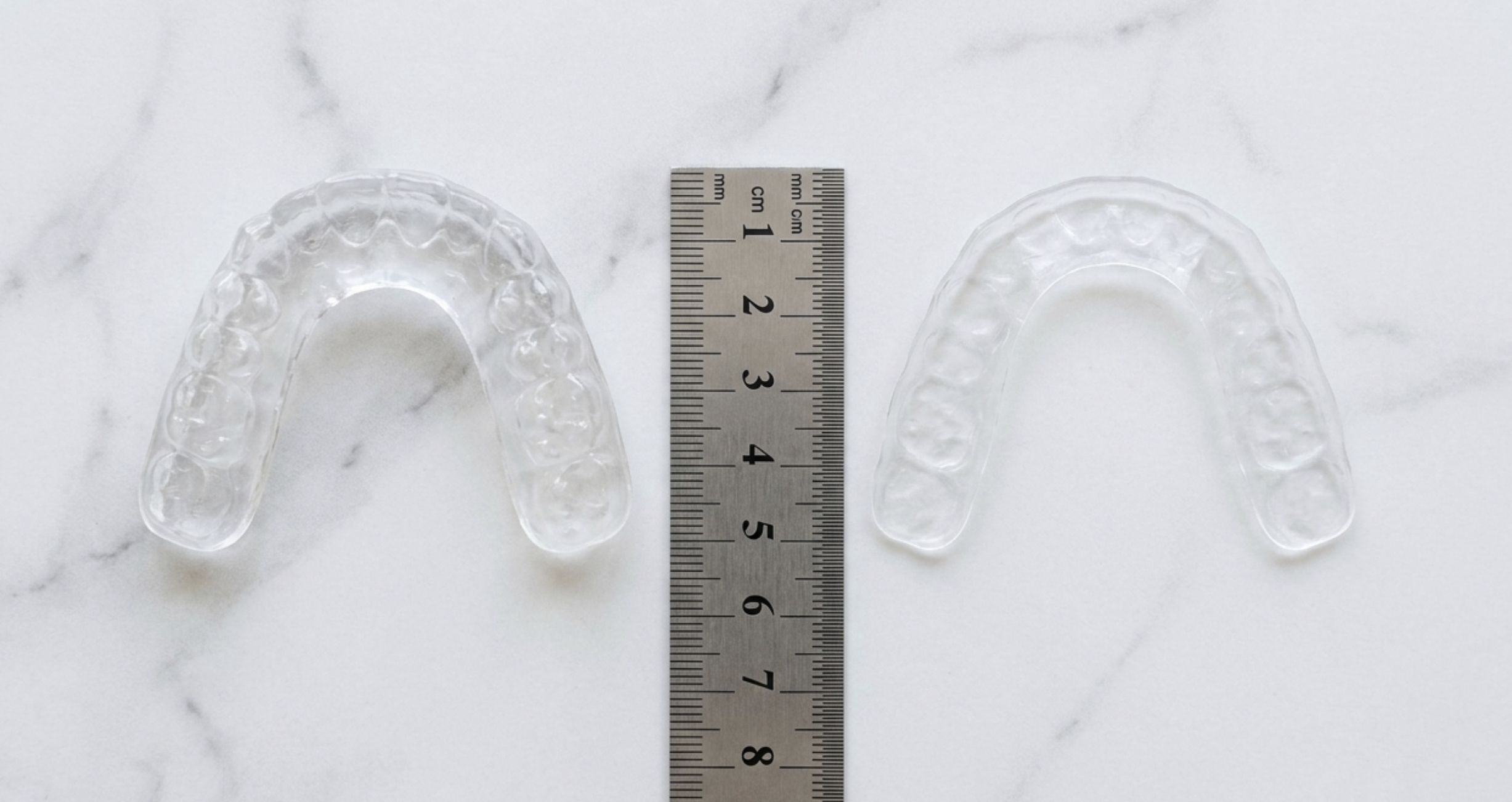
The threshold for speech compatibility is approximately 1mm. Below that, the guard is thin enough that the tongue can still make contact with the palate and teeth in the positions required for normal articulation. Above 1.5mm, the altered oral geometry becomes detectable in speech — particularly in sibilants (s, sh) and dentals (t, d, th).
At 1mm, the guard material must be hard to provide any meaningful protection. Soft thermoplastic at 1mm compresses immediately under clenching force — you’d be biting through to nothing. Hard acrylic at 1mm maintains its geometry under the force loads of awake bruxism, which are generally lower than unconscious nighttime grinding force but still require a non-compressible surface to provide protection.
The practical range for a genuinely discrete guard is 0.8mm to 1.0mm in hard acrylic. Below 0.8mm, the material becomes fragile for regular removal and reinsertion. Above 1.0mm, the speech impact begins to be detectable by careful listeners. Chomper Labs’ ultra-thin sits at approximately 0.8mm — the thinnest commercially available option from a major DTC lab.
The Three Design Principles of a No-Show Guard
Principle 1: Thickness at or below 1mm
This is the primary variable. It determines whether the guard is visible as a profile behind the lips, whether it affects swallowing, and whether it changes speech in a detectable way. There is no workaround for thickness — material or fit quality cannot compensate for a guard that’s too thick to be speech-compatible.
When evaluating any product marketed as a “daytime guard” or “ultra-thin,” the first question is the actual thickness in millimetres. Products that don’t specify, or that specify 1.5mm or 2mm, are not daytime appliances despite the marketing language.
Principle 2: Hard material, not soft
A soft guard at 1mm provides no meaningful protection — it compresses under the first clenching force and the thin compressed layer does essentially nothing. Beyond protection, soft material shifts during the dynamic jaw movements of speech and eating, which creates audible clicking or movement that draws attention. Hard acrylic at 1mm maintains dimensional stability — it stays where it seats, which is what allows normal speech patterns to work around it consistently.
Principle 3: Custom fit from impressions
This is what makes the difference between a guard that is discrete and one that only appears discrete at rest. A custom-fit guard made from impressions of your specific arch seats accurately on your teeth and doesn’t shift during jaw movement. A generic or boil-and-bite guard at 1mm will shift during speech — the slight rocking motion is noticeable to you and audible to others. Custom fit is the reason the guard stays invisible during a meeting rather than just during a static smile.
For a full comparison of custom vs OTC fit quality, the dentist vs DTC comparison covers the fit precision difference and why it matters for appliances worn during speech.
The Available Options — Compared Honestly
Reviv RD1
Ultra-thin hard biomechanical design, FDA-registered Class I (BRW), custom-fit from impressions. The daytime-specific model in the Reviv range — the same biomechanical occlusal surface approach applied to the 1mm daytime format. Designed for the combined daytime clenching and protection brief. HSA/FSA eligible. The paired daytime companion to the R2 nighttime guard for people managing both patterns. Browse Reviv →
Chomper Labs Ultra-Thin
Approximately 0.8mm — the thinnest commercially available option from a major DTC lab at this writing. Hard rigid material, custom-fit from their standard impression process. Particularly appropriate for people who want the absolute minimum profile. The 0.8mm thickness is at the edge of structural integrity for the material — replacement frequency may be slightly higher than 1mm options under heavy daytime clenching.
Pro Teeth Guard Ultra-Thin Daytime
Approximately 1mm hard acrylic, custom-fit, full arch. Long track record, strong re-impression and adjustment policy. A straightforward, reliable option without specialty features. 110% money-back guarantee applies.
Sentinel No-Show Day Guard
Partial coverage design — the front-facing portion of the first six teeth is cut away, leaving only the back portion of the guard. This makes the guard completely invisible from the front when smiling or speaking. The tradeoff: the front six teeth are not covered on the facial surface. For people whose clenching concentrates on back teeth, this may be acceptable. For people who also want front tooth protection, a full-arch ultra-thin is more appropriate. There is also the longer-term concern about uncovered front teeth — without the opposing contact provided by a guard, any eruption tendency in the back teeth is unbalanced.
SportingSmiles Ultra-Thin
1mm, full coverage, custom-fit. Covers approximately half the tooth height rather than the full tooth — lower profile guard that sits at the gum margin. Good value, established lab. Less well-known than the above options but with consistent positive reviews from daytime clenchers specifically.
| Option | Thickness | Coverage | Material | Price range | FDA-registered |
|---|---|---|---|---|---|
| Reviv RD1 | ≤1mm | Full arch | Hard biomechanical | $80–$130 | Yes (BRW) |
| Chomper Labs ultra-thin | ~0.8mm | Full arch | Hard rigid | ~$129 | Varies |
| Pro Teeth Guard daytime | ~1mm | Full arch | Hard acrylic | $95–$145 | Varies |
| Sentinel No-Show Day Guard | ~1–2mm | Partial (back teeth) | Hard acrylic | ~$129 | Varies |
| SportingSmiles ultra-thin | 1mm | Full arch (half height) | Hard acrylic | ~$95 | Varies |
Use-Case Scenarios: Where Discretion Actually Matters
Office work and desk concentration
The highest-volume use case. Daytime clenching is most intense during focused concentration — deep work, problem-solving, screen-intensive tasks. Wearing a guard during the 2–4 hours of highest-concentration work provides protection during the period of maximum clenching force. Because this is usually solo or in small group settings where speech is intermittent, the adaptation period for speech is less demanding than in high-verbal settings. Identifying your peak clenching triggers helps narrow when wearing the guard produces the most benefit.
Video calls and meetings
The scenario most people worry about. At 1mm with a custom fit, the guard is not visible on video at normal camera distance. Speech adaptation is the main variable — give yourself the first week of wearing it during calls where your appearance doesn’t affect stakes (internal calls, informal check-ins) before using it in high-stakes external presentations. By the time you need full verbal fluency in a client meeting, the adaptation is complete.
Driving and commuting
An underappreciated high-clenching context. The combination of mild stress, concentration, and jaw-forward driving posture makes commuting a significant clenching trigger for many people. Wearing the guard during the commute is a zero-visibility context — no one is watching your mouth — and captures protection during a period of consistent clenching force.
Social settings
The most discretion-sensitive context. Dinner, dates, social conversation. A 1mm full-arch guard is genuinely invisible in these settings — the clear material against teeth reads as nothing. The only variable is speech comfort, which is resolved by the adaptation period before using it socially. Most people who wear daytime guards in social settings report that nobody has ever noticed without being told.
Frequently Asked Questions
What is an ultra-thin daytime mouth guard?
A custom-fit hard acrylic appliance at 1mm or less, designed for discrete wear during waking hours. Thin enough for normal speech and swallowing, clear enough to be near-invisible at conversational distance, and hard enough to protect against daytime clenching force without compressing under load. Different from a nighttime guard in every relevant specification.
What does “no-show” mean for a daytime mouth guard?
Not visible to others during normal interaction — not literally invisible. A full-arch 1mm clear hard acrylic guard achieves this through thinness and material clarity. Some brands use a partial-coverage no-show design that exposes the front teeth — genuinely invisible from the front, but leaves front teeth uncovered and carries a longer-term risk of bite changes from unbalanced posterior tooth eruption. A full-arch ultra-thin guard is generally the better long-term choice.
Can I wear an ultra-thin guard to work or in meetings?
Yes. A well-fitted 1mm custom guard is near-invisible at conversational distance and allows normal speech after a short adaptation period. The adaptation is typically 3–7 days — any initial changes to sibilant sounds resolve with consistent wear. Video calls are fine; the guard is not visible at normal camera distance. Most people report colleagues cannot tell they are wearing anything.
Is an ultra-thin daytime guard the same as a night guard?
No. Thickness (1mm vs 2–4mm) is the primary difference, but the use case is also different: the daytime guard is worn consciously, removed for meals, and worn for variable periods during high-clenching contexts. The nighttime guard is worn statically for 7–8 hours of sleep against higher unconscious grinding force. Neither substitutes for the other — if you need both, order both.
What is the best ultra-thin daytime mouth guard?
The best option is a custom-fit 1mm hard acrylic guard from a reputable DTC lab. Key criteria in order of importance: full arch coverage, 1mm or less thickness, hard acrylic material (not soft), custom fit from dental impressions. The established options are Reviv RD1, Pro Teeth Guard ultra-thin daytime, Chomper Labs ultra-thin, and Sentinel No-Show Day Guard — each with different design approaches at similar price points.
The Bottom Line
An ultra-thin daytime guard that actually works as a no-show appliance needs three things: 1mm or less thickness, hard acrylic material, and custom fit from impressions. Anything that doesn’t meet all three criteria either provides inadequate protection, shifts during speech, or both.
The available options that meet this brief — Reviv RD1, Chomper Labs ultra-thin, Pro Teeth Guard daytime, Sentinel No-Show — are all custom DTC appliances in the $80–$130 range, HSA/FSA eligible, fabricated from dental lab impressions. The differences between them are design approach and brand — not a meaningful quality gap. Choose based on whether you want full arch (Reviv, Chomper, Pro Teeth Guard, SportingSmiles) or partial coverage (Sentinel), and whether the biomechanical surface design is relevant to you.
The Reviv model selector identifies whether the RD1 is the right fit for your daytime pattern — or browse the full Reviv range including paired nighttime options if you need both.