
Can a mouthpiece treat sleep apnea?
Sleep apnea mouthpiece vs night guard?
CPAP vs oral appliance — which is better?
Who is a good candidate for a MAD?
Can I have both sleep apnea and bruxism?
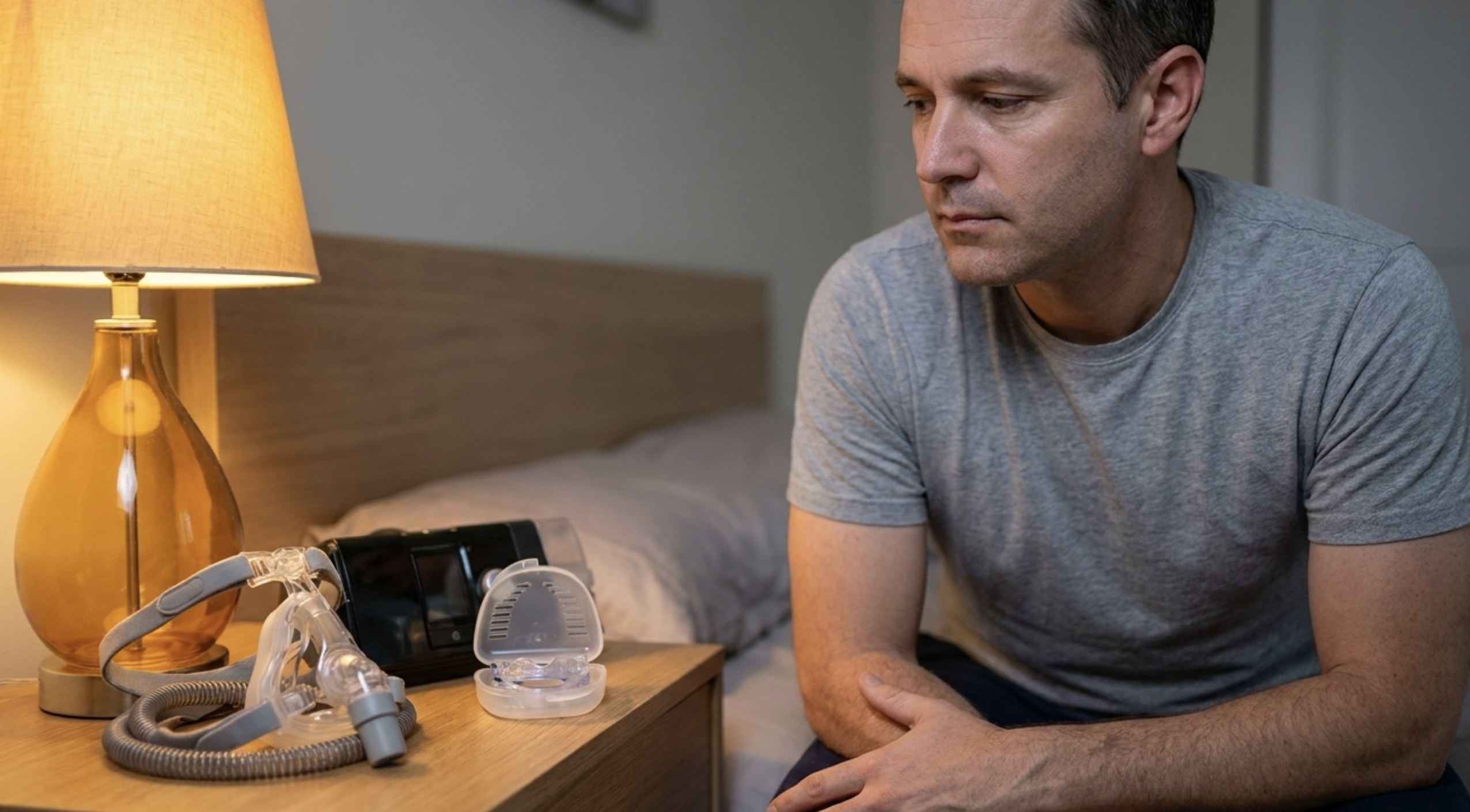
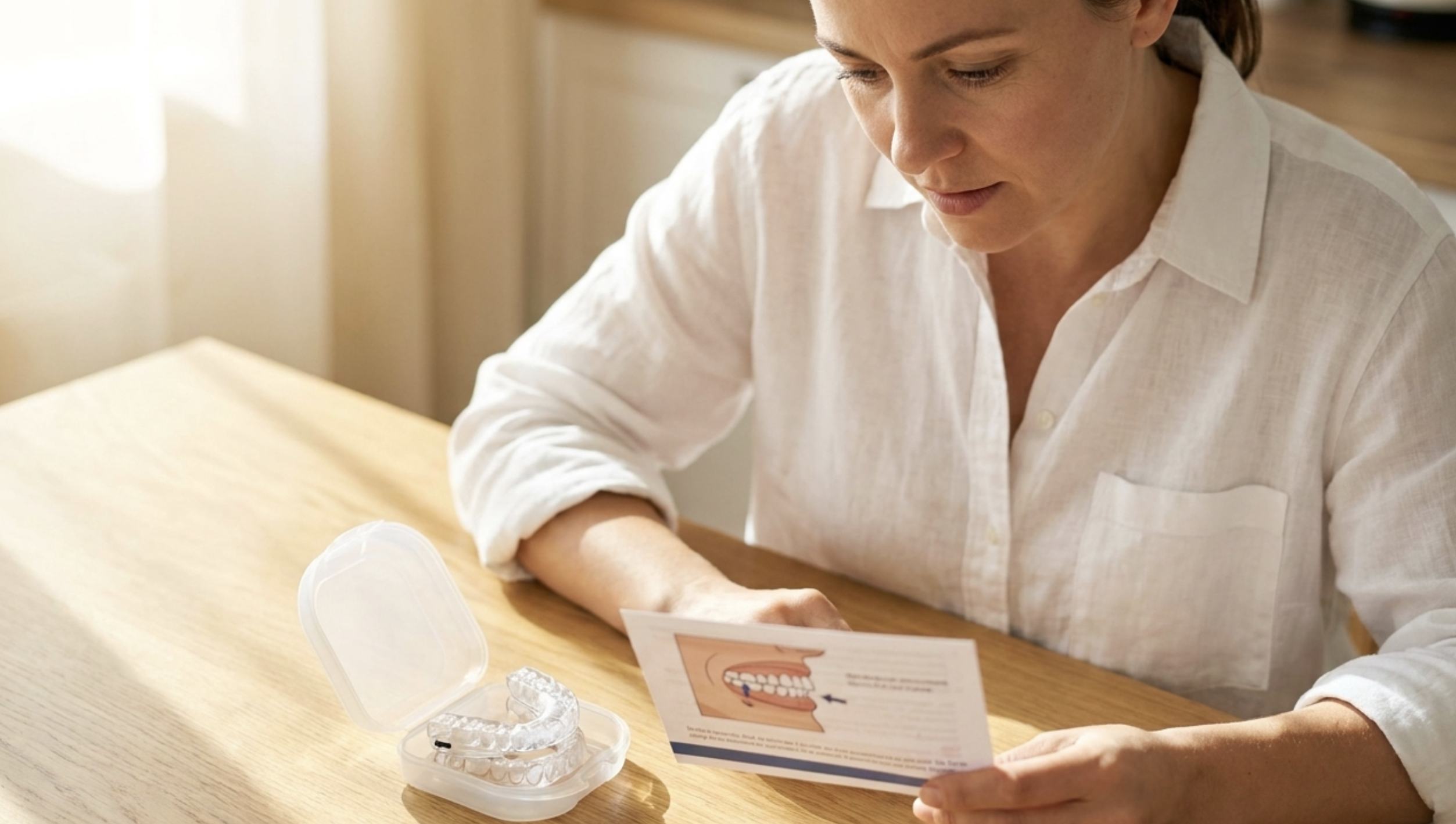
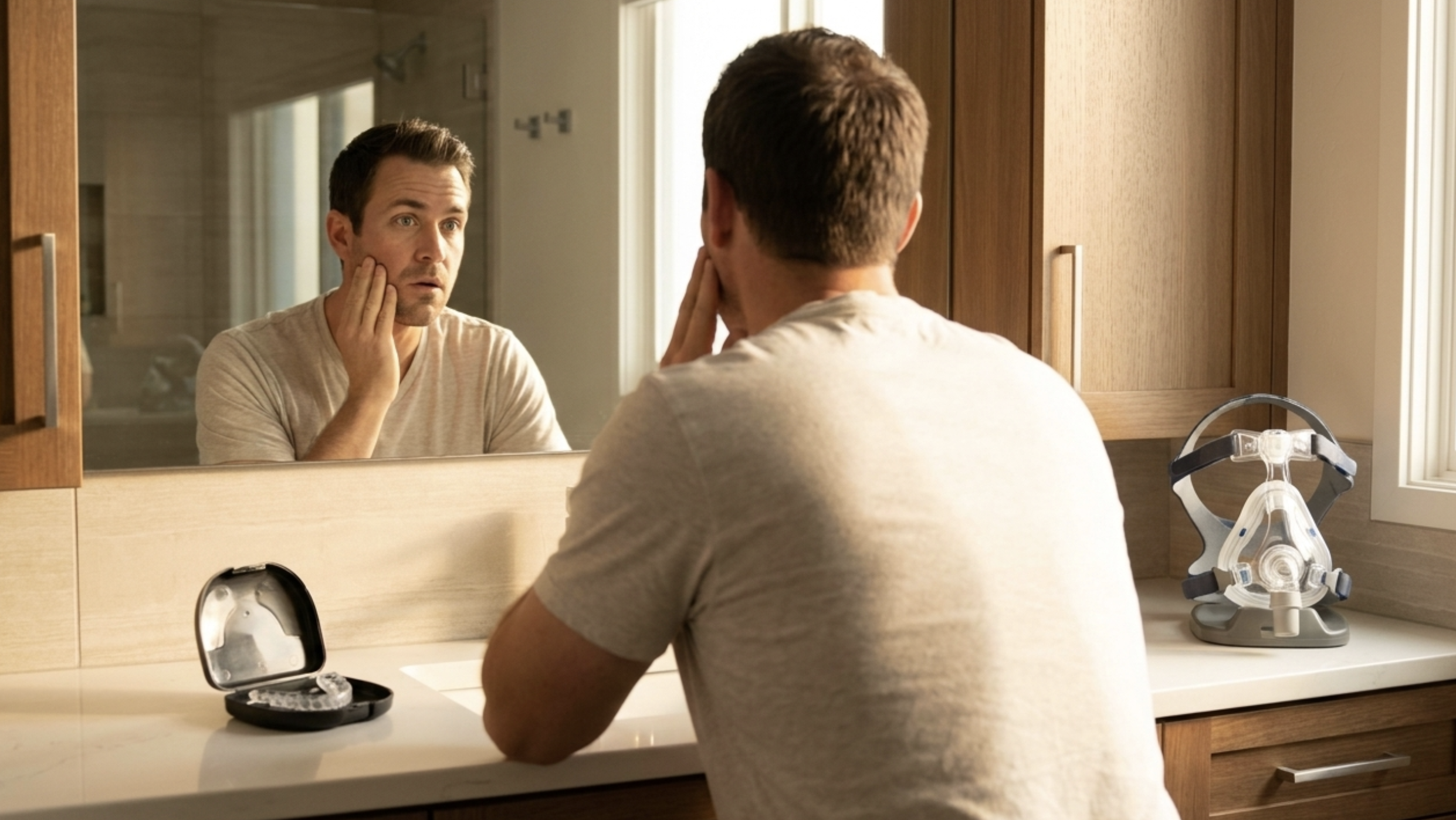
For millions of people diagnosed with sleep apnea, CPAP is the gold standard. It works. But it’s also a machine that straps a mask to your face, generates continuous airflow, and requires nightly setup, cleaning, and a power source. Compliance rates for CPAP are notoriously low — studies estimate that between 30% and 50% of people prescribed it don’t use it consistently.
That gap — between what CPAP can do and what people will actually do — is where oral appliances enter the picture.
A mouthpiece for sleep apnea — clinically known as a mandibular advancement device, or MAD — is a custom-fitted oral appliance that repositions the lower jaw slightly forward during sleep. This forward positioning keeps the airway more open, reducing the collapse and obstruction that causes apnea events.
This article explains how oral appliances work, who they’re appropriate for, how they compare to CPAP, and what the important limitations are. It also explains the distinction between a sleep apnea device and a standard tooth-protection night guard — because these are different appliances with different regulatory clearances, and the difference matters.
What Is Sleep Apnea?
Sleep apnea is a condition in which breathing repeatedly stops and starts during sleep. The most common form — obstructive sleep apnea (OSA) — occurs when the throat muscles relax during sleep and the soft tissue partially or fully collapses, blocking the airway.
Each obstruction is an apnea event. Depending on severity, a person with OSA may experience dozens or hundreds of these per night. Each causes a partial arousal — often too brief to remember — as the brain detects low oxygen and triggers breathing to resume.
Sleep apnea severity is measured by the Apnea-Hypopnea Index (AHI) — the number of breathing events per hour:
| Severity | AHI | Description |
|---|---|---|
| Mild | 5–14 events/hour | Noticeable symptoms; first-line treatment options vary |
| Moderate | 15–29 events/hour | CPAP typically recommended |
| Severe | 30+ events/hour | CPAP strongly indicated; MAD less likely to be sufficient |
How CPAP Works
Continuous Positive Airway Pressure (CPAP) delivers a constant stream of pressurised air through a mask worn over the nose or mouth and nose. The air pressure acts as a pneumatic splint — it physically holds the airway open throughout the night, preventing collapse.
CPAP is highly effective when used correctly. For moderate to severe sleep apnea, it’s the benchmark against which other interventions are measured. The challenge is adherence: the mask, the noise, the required nightly setup, and the sensation of pressurised airflow cause many people to abandon it.
How Oral Appliances Work for Sleep Apnea
A mandibular advancement device (MAD) is a custom-fitted oral appliance that holds the lower jaw (mandible) in a slightly forward position during sleep. This forward positioning advances the tongue base away from the posterior airway, tightens the soft tissue around the throat and pharynx, increases the cross-sectional area of the upper airway, and reduces the likelihood of airway collapse during sleep.
The degree of advancement is adjustable in most clinical MADs — the dentist or sleep specialist titrates the device over several appointments, incrementally increasing the forward position until symptoms are adequately managed.
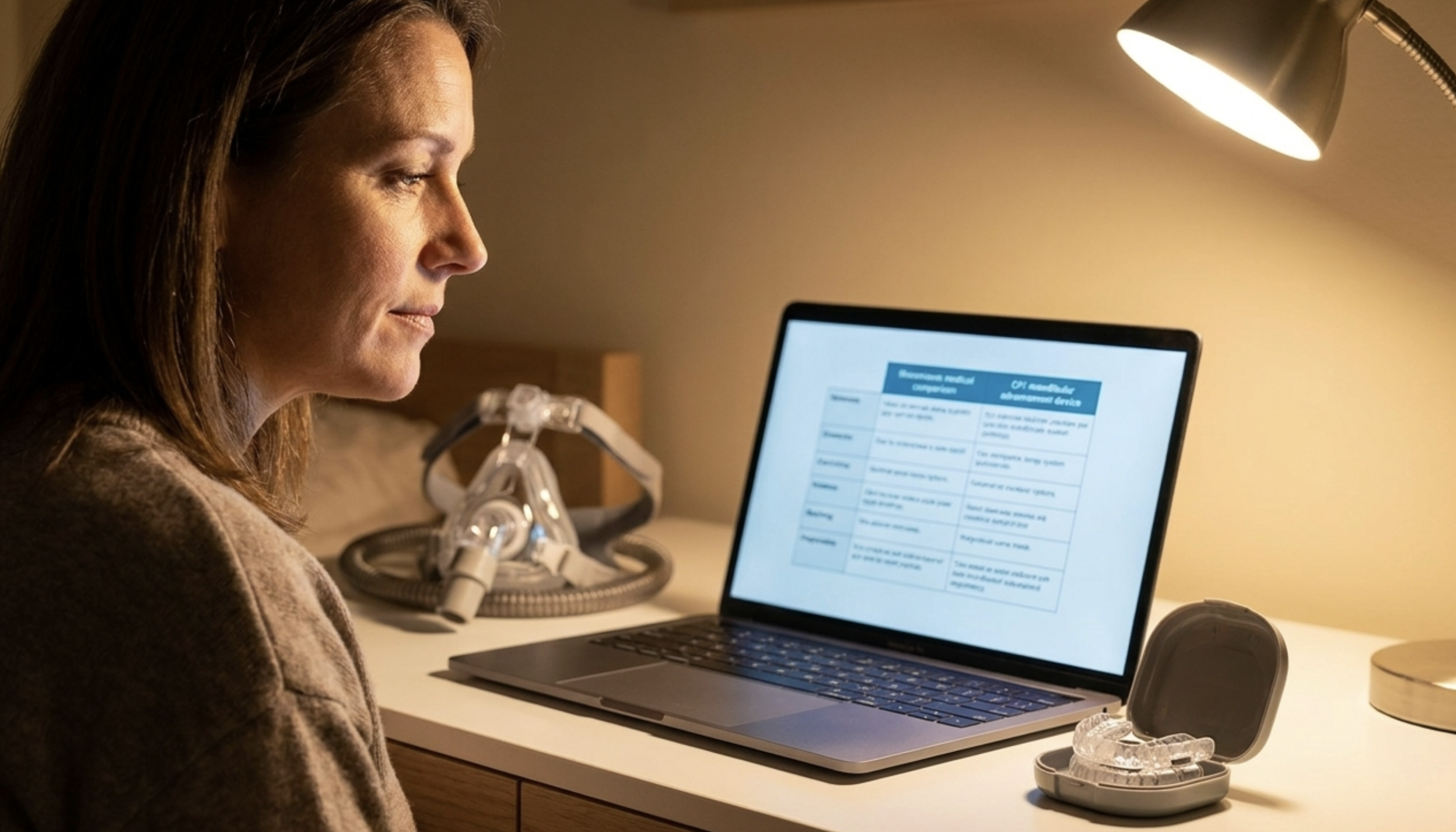
MAD vs CPAP: An Honest Comparison
| CPAP | Mandibular advancement device | |
|---|---|---|
| How it works | Pressurised air holds airway open | Jaw repositioning increases airway space |
| Effectiveness | High across all severity levels | Best for mild to moderate OSA |
| Compliance | Lower (mask, noise, setup) | Higher (small, silent, no power needed) |
| Side effects | Mask discomfort, dry mouth, aerophagia | Jaw soreness, tooth sensitivity during adjustment |
| Portability | Requires machine and power source | Compact, travel-friendly |
| Prescription required | Yes | Yes |
| Cost | $500–$3,000+ (machine + supplies) | $1,500–$2,500 (dentist-fitted) |
The evidence on MAD vs CPAP shows that CPAP is more effective at reducing AHI in objective terms — but MADs produce comparable health outcomes in mild-to-moderate patients because the higher compliance rate compensates for slightly lower per-night efficacy. A device worn every night at 80% efficacy outperforms a device worn three nights a week at 100% efficacy.
Who Is a MAD Appropriate For?
Oral appliance therapy for sleep apnea is most appropriate for:
- Mild to moderate OSA — patients with severe OSA typically require CPAP; MADs are less likely to adequately manage high AHI counts
- CPAP-intolerant patients — people who have genuinely tried CPAP and cannot tolerate it; MAD is a recognised alternative for this group
- Positional OSA — sleep apnea that is primarily or significantly worse in the supine position
- Patients without severe jaw joint issues — MADs require sustained jaw protrusion; people with significant TMJ disorder or limited jaw mobility may not be candidates
Who is not well-suited for a MAD:
- Severe OSA where AHI is unlikely to be managed by jaw repositioning alone
- Significant existing dental or jaw problems that the device would worsen
- Central sleep apnea — a different mechanism not caused by airway obstruction
- Patients who grind heavily and primarily need tooth protection rather than jaw repositioning
Critical Distinction: A MAD Is Not a Night Guard
This is important — and frequently misunderstood.
A mandibular advancement device for sleep apnea and a night guard for bruxism are fundamentally different appliances. They look similar. They both go in your mouth at night. But the distinction matters significantly.
A MAD repositions the jaw — it holds the mandible forward to open the airway. This is a therapeutic action with specific medical intent. MADs for sleep apnea must be FDA-cleared as Class II medical devices. They require a sleep apnea diagnosis, a prescription, and professional fitting and titration.
A night guard protects teeth — it sits over the teeth and absorbs grinding force. A standard custom night guard is an FDA-registered Class I device designed for tooth protection. It does not reposition the jaw and does not have any indication for sleep apnea.
Using a night guard as a sleep apnea treatment is not appropriate. If you have both sleep apnea and bruxism — a common combination — you may need to discuss with your clinician which appliance takes priority, or whether a combination device is appropriate for your specific situation.
The Bruxism and Sleep Apnea Connection
Bruxism and sleep apnea co-occur at a notably high rate. Research indicates that people with obstructive sleep apnea have significantly elevated rates of sleep bruxism compared to the general population. The proposed mechanism involves micro-arousals — as the airway obstructs and oxygen drops, the brain triggers brief arousal events that can manifest as grinding episodes.
The practical implications:
- If you’ve been diagnosed with sleep apnea, tooth protection during sleep is worth discussing with your dentist — you may be grinding without knowing it
- If you have confirmed bruxism, sleep apnea screening is worth discussing with your doctor
- If you’re being fitted for a sleep apnea device, the question of tooth protection during sleep is worth raising separately
The two conditions often need to be managed in parallel, with input from both dental and medical professionals.
Getting Diagnosed and Getting the Right Device
If you think you may have sleep apnea, the path is straightforward:
- See your doctor — describe your symptoms: snoring, witnessed apnea, daytime fatigue, unrefreshing sleep
- Sleep study — either in-lab polysomnography or a home sleep apnea test measures your AHI and confirms diagnosis
- Treatment discussion — based on severity and your preferences, your clinician recommends CPAP, MAD, positional therapy, or other interventions
- If MAD is recommended — typically referred to a dentist with sleep medicine training for fitting and titration over multiple appointments
- Discuss bruxism — if you also grind your teeth, raise it with both your doctor and dentist so both needs can be addressed
Frequently Asked Questions
Can a mouthpiece treat sleep apnea?
Yes — a mandibular advancement device (MAD), prescribed and fitted by a clinician, is an FDA-cleared treatment for mild to moderate obstructive sleep apnea. It repositions the lower jaw forward to keep the airway open during sleep. It is not appropriate for severe OSA, and it is not the same as a standard night guard for teeth grinding.
What is the difference between a sleep apnea mouthpiece and a night guard?
A MAD for sleep apnea repositions the lower jaw forward to open the airway — Class II FDA-cleared, requires prescription and clinical fitting. A night guard for bruxism protects teeth from grinding pressure — Class I FDA-registered. They look similar but serve different purposes and carry different regulatory clearances. Do not use one as a substitute for the other.
Is CPAP better than an oral appliance for sleep apnea?
CPAP is more effective at reducing AHI in objective terms. But oral appliances produce comparable health outcomes in mild-to-moderate OSA patients because compliance rates are significantly higher — a device worn every night at 80% efficacy typically outperforms a device worn inconsistently at 100% efficacy.
Who is a good candidate for a sleep apnea oral appliance?
Mild to moderate OSA, CPAP-intolerant patients, positional OSA, and patients without significant jaw joint issues or limited jaw mobility. Not appropriate for severe OSA, central sleep apnea, or patients with significant TMJ disorder.
Can I have both sleep apnea and teeth grinding?
Yes — bruxism and obstructive sleep apnea co-occur at an elevated rate. The proposed mechanism involves micro-arousals from apnea events that can manifest as grinding episodes. If you have confirmed bruxism, sleep apnea screening is worth discussing with your doctor. If you have sleep apnea, tooth protection during sleep is worth discussing with your dentist.
The Bottom Line
A mouthpiece for sleep apnea — a mandibular advancement device — is a legitimate, evidence-supported alternative to CPAP for mild to moderate obstructive sleep apnea. It works by repositioning the lower jaw to maintain airway space during sleep. It offers higher compliance compared to CPAP, is portable, and produces comparable health outcomes for appropriate patients.
It is not a standard night guard. The two appliances serve different purposes, work by different mechanisms, and carry different regulatory requirements. If you need tooth protection from grinding, you need a night guard. If you need sleep apnea treatment, you need a clinician-prescribed MAD. If you need both — which is common — both need to be addressed with coordinated input from dental and medical professionals.
For anyone whose primary concern is protecting their teeth from grinding pressure during sleep, the Reviv how-to-choose guide is the right starting point — or browse the full range of FDA-registered Class I appliances designed for tooth protection. For sleep apnea, please speak with your doctor.