

Best mouth guard for jaw clenching?
Clenching guard vs grinding guard — different?
Can I wear a guard during the day?
How do I know if I clench or grind?
Do soft guards work for clenching?


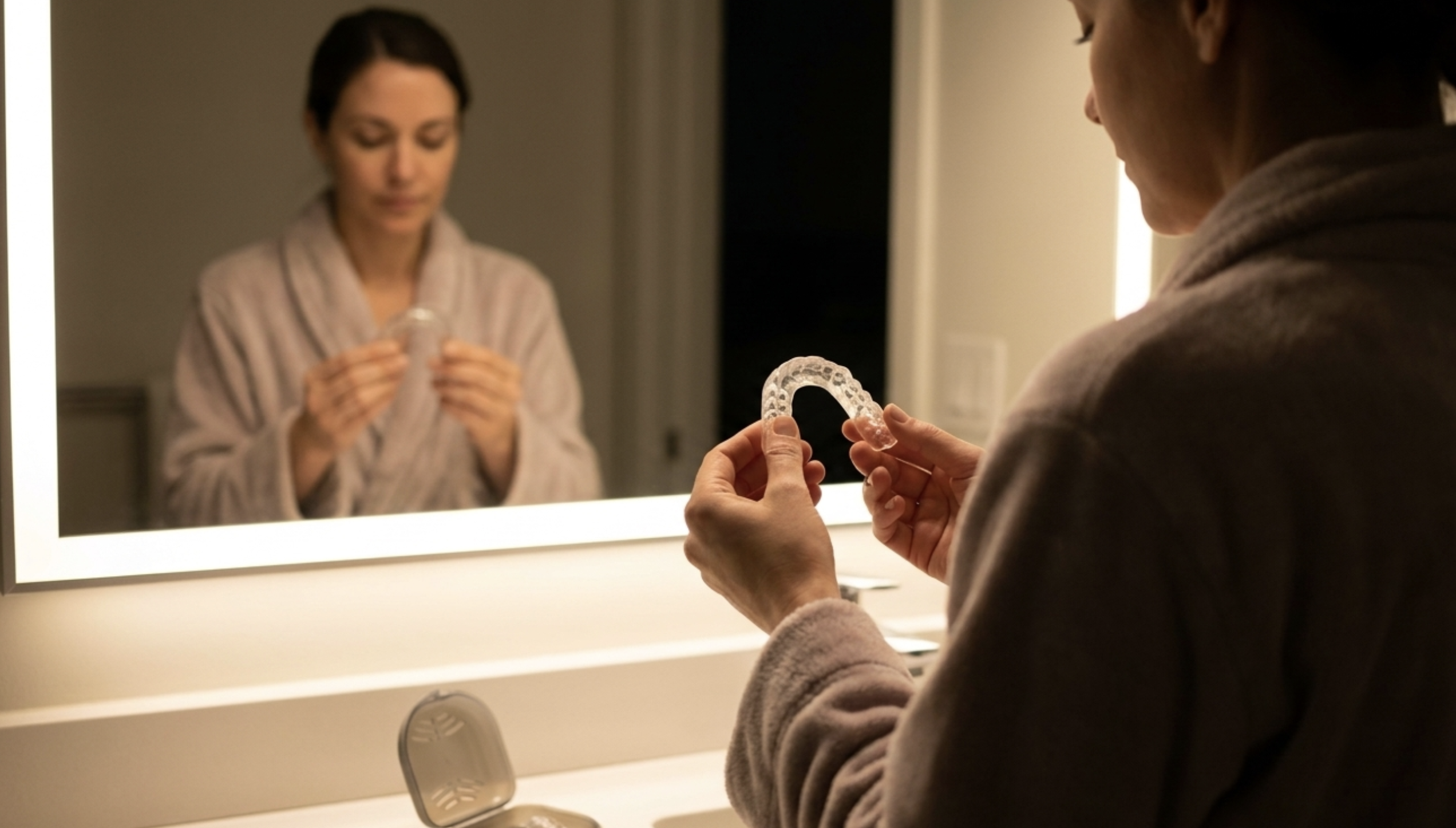
Most mouth guard articles treat clenching and grinding as the same problem and prescribe the same solution. They’re not the same problem — and the guard that works for one can actively make the other worse.
Clenching is vertical compression: your jaw muscles loading sustained force onto specific teeth, primarily molars. Grinding is lateral movement: your jaw sliding side to side, abrading enamel across the biting surface. Many people do both, but the force patterns are different, the symptoms are different, and the ideal guard specification is different.
This guide covers the full picture — clenching vs grinding, the daytime and nighttime split, which guard types are appropriate for each, and what to do if you clench at both. It’s structured as a diagnostic: by the end you should know which category you’re in and what to buy.
Clenching vs Grinding: What’s Actually Different
Understanding the distinction changes your guard selection. Here’s the practical difference:
Clenching (bruxism — static)
You hold your teeth together and tighten the jaw muscles — no movement, just sustained pressure. The force generated by clenching can be 2–3x higher than normal biting force. Peak loads concentrate on specific teeth, typically the molars, rather than distributing evenly across the arch. The wear pattern is different: less obvious surface abrasion, more risk of tooth fracture, cracked cusps, and restoration failure from the compressive overload.
Symptoms: Morning jaw soreness and muscle fatigue (especially the masseter — the thick muscle at the sides of the jaw), tension headaches, earache that isn’t from the ear, tender teeth without visible wear. Worth noting: static clenching causes damage without any grinding sound — a partner won’t always hear it. Reviv covers this in more detail here: Why Everyone Can Benefit from a Mouthguard at Night →
Grinding (bruxism — dynamic)
The jaw moves side to side or forward and back while the teeth are in contact. The abrasive movement wears enamel progressively — the characteristic flat, shiny wear surfaces your dentist identifies. Lower-force per contact than clenching, but sustained over thousands of cycles per night produces cumulative damage.
Symptoms: Flattened or worn tooth surfaces visible on inspection, enamel erosion at the biting edges, noise audible to a partner, morning tooth sensitivity.
Combined pattern (most common)
Most people who present with bruxism do both — clenching under stress, grinding during lighter sleep stages. A dentist can usually identify the dominant pattern from the wear signature, but the combined pattern is what most “best night guard” articles should be addressing rather than either in isolation.
Quick Diagnostic: Day, Night, or Both?
Before choosing a guard, you need to know when your clenching occurs. The timing determines the guard specification entirely — a nighttime guard is too thick for day, and a daytime guard doesn’t provide sufficient nighttime protection.
You likely clench primarily at night if:
- You wake with jaw soreness that improves through the morning
- You have no awareness of clenching during the day
- A partner has heard grinding or jaw sounds during sleep
- Morning headaches are common but afternoon headaches are not
You likely clench primarily during the day if:
- You notice jaw tension building during work, driving, or screen time
- You catch yourself with teeth touching when they shouldn’t be (rest position should be lips together, teeth apart)
- Jaw fatigue worsens through the day rather than first thing in the morning
- Stress events directly correlate with jaw tension episodes
- You take stimulant medication (Adderall, Vyvanse, Ritalin) — stimulant-driven jaw clenching is primarily a daytime pattern
You likely clench both day and night if:
- Jaw soreness is present both morning and evening
- You notice daytime clenching consciously but also have morning soreness beyond what you’d explain by daytime habits
- Your dentist has noted wear patterns consistent with sustained bruxism rather than occasional stress clenching
Nighttime Clenching: Guard Requirements and Options
For nighttime clenching, the guard needs to do two things: intercept the compressive force before it reaches your teeth, and do so without giving your jaw muscles additional resistance to bear down against.
This second requirement is why soft guards are generally wrong for clenchers. A soft, compressible material under the teeth gives the masseter and temporalis muscles something to load against — the same principle as biting down on a pen cap triggers more jaw muscle activation, not less. Hard or dual-laminate guards with a flat, even contact surface allow the jaw to rest without a compressible target.
Hard acrylic custom guard
The clinical standard for clenching. Hard acrylic doesn’t compress, so it doesn’t stimulate additional force. The flat occlusal surface distributes clenching load evenly across the arch rather than allowing it to concentrate on specific teeth. Lab-custom fit means it seats accurately on your arch and stays in place through the night.
Takes 1–3 weeks to adjust to initially. After that, most people find it unremarkable. Best for: moderate to heavy clenchers, combined clenching and grinding, people who have noticed their soft guards compressing or wearing quickly.
Dual-laminate guard
Hard outer surface, softer inner layer against the teeth. For people who couldn’t tolerate a fully hard guard — the inner softness provides comfort during seating without introducing the compressibility issue on the contact surface. Good for moderate clenchers or combined patterns. Less durable than pure hard acrylic under maximum clenching force.
Biomechanical guard (Reviv R2, R3)
Designed specifically for the clenching-and-grinding combined pattern. The occlusal surface geometry is engineered to influence jaw closing angle under force — distributing compressive load away from the molar concentration points that take disproportionate clenching force. R2 for moderate combined pattern, R3 for heavy.
Daytime Clenching: A Completely Different Problem
Daytime clenching has a different driver than nighttime bruxism. Where nighttime grinding is largely neurological — happening during sleep without conscious awareness — daytime clenching is usually triggered by stress, concentration, or medication. The jaw tightens in response to a cognitive or emotional state, often while the person is completely unaware it’s happening.
The guard requirement is completely different from nighttime:
- Ultra-thin — 1mm or less, to allow normal speech, swallowing, and eating around the guard
- Discrete — clear, slim enough to not be visible in normal conversation
- Removable without a ritual — needs to be easy to pop in and out as needed, not something requiring a settling-in period
- Hard material — the same reasoning as nighttime: soft material invites loading
Standard nighttime guards are typically 2–4mm thick and designed for static wearing through sleep. They are not suitable for daytime use — too bulky for speech, too obvious for professional settings, and not designed for the on/off use pattern of daytime wear.
DTC options for daytime clenching
The daytime guard category is smaller than the nighttime market — most people don’t know it exists. Key options:
- Reviv RD1 — ultra-thin daytime design, custom-fit, engineered for discrete wear. The primary DTC daytime option with a biomechanical surface. Browse Reviv →
- Pro Teeth Guard daytime option — ultra-thin custom lab guard, thinner than their nighttime range, designed for daytime wear
- Dental Duty daytime guard — thinner boil-and-bite option, more affordable entry point for testing if daytime guard wearing suits you before committing to custom
If you’ve never worn a daytime guard before, it’s worth trying an inexpensive OTC thin guard first — not for the protection quality, but to confirm you can tolerate wearing something during the day before investing in a custom lab guard.
If You Clench Both Day and Night
This is the most common underserved situation. People who clench both day and night often buy one nighttime guard and wonder why their daytime symptoms persist. The answer is that nighttime protection doesn’t carry over to daytime, and vice versa — they’re protecting against different episodes.
The practical solution is two separate guards:
- A custom nighttime guard in hard acrylic or dual-laminate for sleep protection
- An ultra-thin custom daytime guard for conscious clenching during the day
Ordering both from the same DTC lab means one impression kit — most labs can fabricate multiple guard types from a single set of impressions. The combined cost is typically $150–$250, which is still well below a single dentist-made guard.
For the combined grinding-and-clenching pattern specifically, Reviv R2 (nighttime) and RD1 (daytime) are designed as paired solutions — the biomechanical surface approach applied to both use cases. If you’re unsure which model fits your jaw size and pattern, Reviv’s sizing guide walks through the selection: Sizing Guide: Choosing the Right Reviv for Your Mouth →
Why Soft Guards Don’t Work for Clenching: The Mechanism
This is important enough to address directly because most affordable OTC guards are soft, and most people’s first guard purchase is soft.
When a soft, compressible material is placed between the teeth, the jaw’s proprioceptive system detects the give in the material and responds by increasing muscle activation — the same way your hand grips harder when holding something soft and compliant than when gripping something rigid. For a grinder, this isn’t a major issue — the lateral movement is what matters, and soft material absorbs the sliding friction adequately.
For a clencher, the compressibility is a problem. The sustained vertical loading that characterises clenching is amplified, not reduced, by a soft target. Some people find their morning jaw soreness increases after starting with a soft guard — this is the mechanism. The guard is making the muscles work harder, not less.
The counter-intuitive finding is consistent enough to be a clinical rule: clenchers need hard guards. The comfort comes from the even contact surface and precise fit, not from soft material. For a deeper look at the nighttime clenching pattern specifically, the Reviv blog has a useful guide: How to Identify and Fix Jaw Clenching at Night →
Jaw Clenching vs Teeth Clenching: Is There a Difference?
“Jaw clenching” and “teeth clenching” are often used interchangeably, but they describe slightly different things anatomically. Teeth clenching is when the upper and lower teeth are in contact and the jaw muscles are loading force through that contact. Jaw clenching can also refer to the muscles tightening even when the teeth aren’t in contact — a pattern of jaw muscle hypertonicity without dental loading.
For guard purposes, the relevant scenario is teeth clenching — where the teeth are in contact and force is transmitted through them. A guard protects the teeth from that transmitted force. Pure jaw muscle tension without tooth contact doesn’t cause direct dental damage, though it causes the same muscle soreness and headache symptoms.
If you have jaw muscle pain and tension without clear tooth contact patterns, it’s worth mentioning to your dentist — the differential matters for what intervention is most appropriate.
Frequently Asked Questions
What is the best mouth guard for jaw clenching?
For nighttime clenching: a hard or dual-laminate custom guard. Soft guards compress under clenching force and can stimulate more muscle activity — not appropriate for clenchers. For daytime clenching: an ultra-thin custom guard (1mm or less) designed for discrete wear and normal speech. Reviv R2 is designed for the combined nighttime clenching-and-grinding pattern; Reviv RD1 is the daytime option.
Is a mouth guard for clenching different from a grinding guard?
Yes — clenching is vertical compression and grinding is lateral movement. The ideal guard for a pure clencher is hard material with even occlusal contact that doesn’t stimulate additional loading. Soft guards are more appropriate for grinding; hard or dual-laminate for clenching. Most people do both, making a guard that handles both patterns (dual-laminate or biomechanical) the most practical choice.
Can I wear a mouth guard during the day for clenching?
Yes — daytime guards exist specifically for this. They need to be significantly thinner than nighttime guards (1mm or less) to allow normal speech and swallowing. Standard nighttime guards are too thick for discrete daytime wear. DTC labs including Reviv offer ultra-thin daytime guards designed for this use case. If you’ve never worn a daytime guard, try an inexpensive thin OTC guard first to confirm you can tolerate it before investing in custom.
How do I know if I clench or grind my teeth?
Clenching typically causes jaw muscle soreness and fatigue, tension headaches, and earache — with less visible tooth wear. Grinding typically causes flattened tooth surfaces, enamel erosion, and noise a partner can hear. Many people do both. A dentist can identify the dominant pattern from the wear signature on your teeth — ask specifically at your next check-up.
Do soft guards work for clenching?
Generally no. Soft material gives jaw muscles something to bear down against, which can stimulate more clenching force rather than less. Hard or dual-laminate guards with a flat, even contact surface are more appropriate for clenchers. This is counter-intuitive — the guard that feels softer and more comfortable during fitting often makes nighttime muscle symptoms worse, not better.
The Bottom Line
The right mouth guard for clenching depends on when you clench and whether you also grind. Nighttime clenchers need hard or dual-laminate custom guards — not soft OTC guards, which can worsen the problem. Daytime clenchers need an ultra-thin custom guard designed for discrete wear — not a nighttime guard, which is too thick for daytime use. If you clench both day and night, you need both: one guard for each pattern, ideally from a single DTC lab using one set of impressions.
For the combined grinding-and-clenching pattern — the most common presentation — Reviv’s model selector matches your specific pattern to R1, R2, R3, or RD1. Or browse the full range of FDA-registered Class I guards.



Pingback: Ultra-Thin Daytime Mouth Guard: How Thin Is Thin Enough? - TMJ Mouthguard