

Can breathing problems cause teeth grinding?
Why do I grind more sleeping on my back?
Mouth breathing and jaw clenching — connected?
Should I get a sleep study if I grind my teeth?
Does a night guard help with sleep apnea?
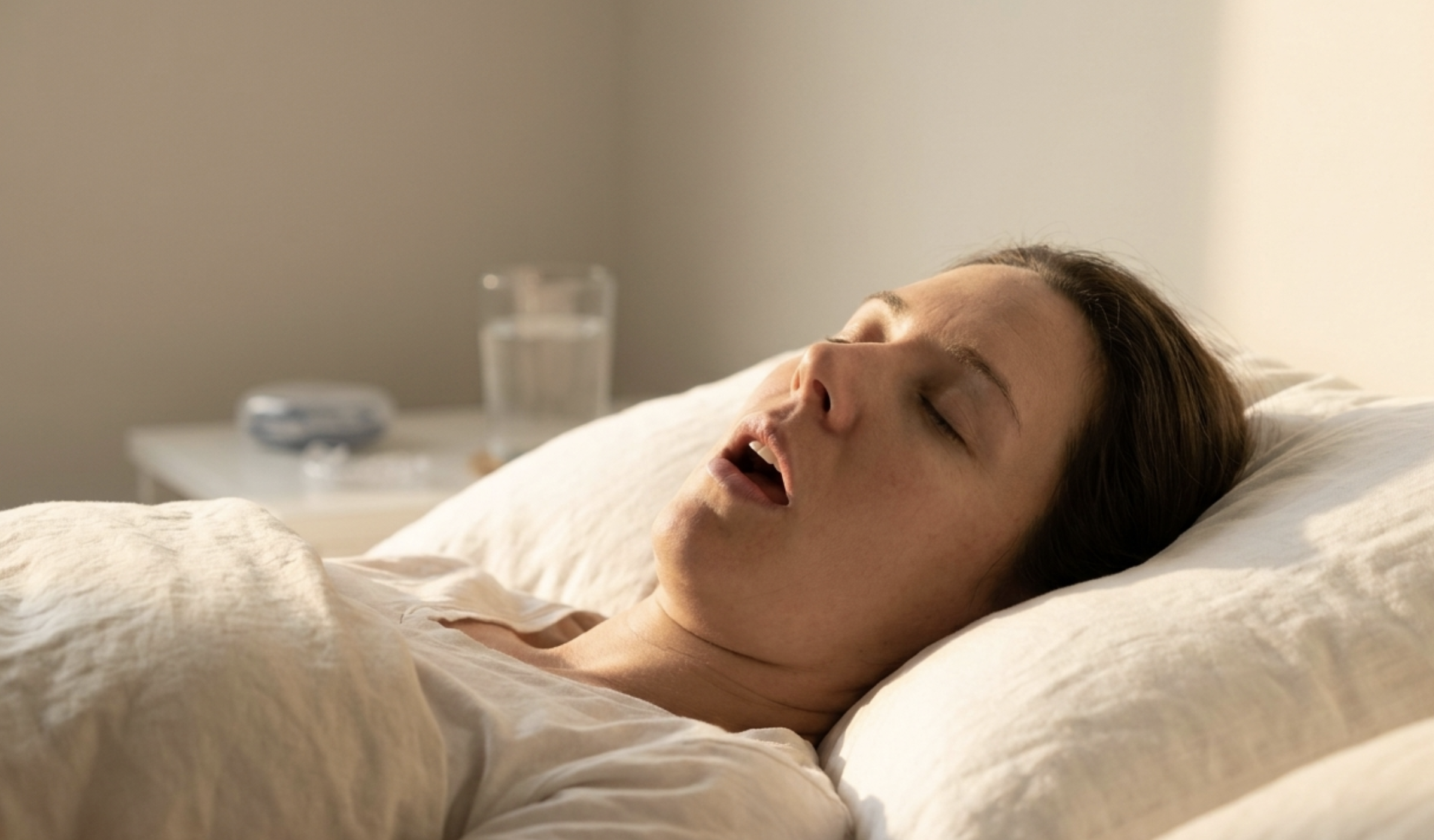
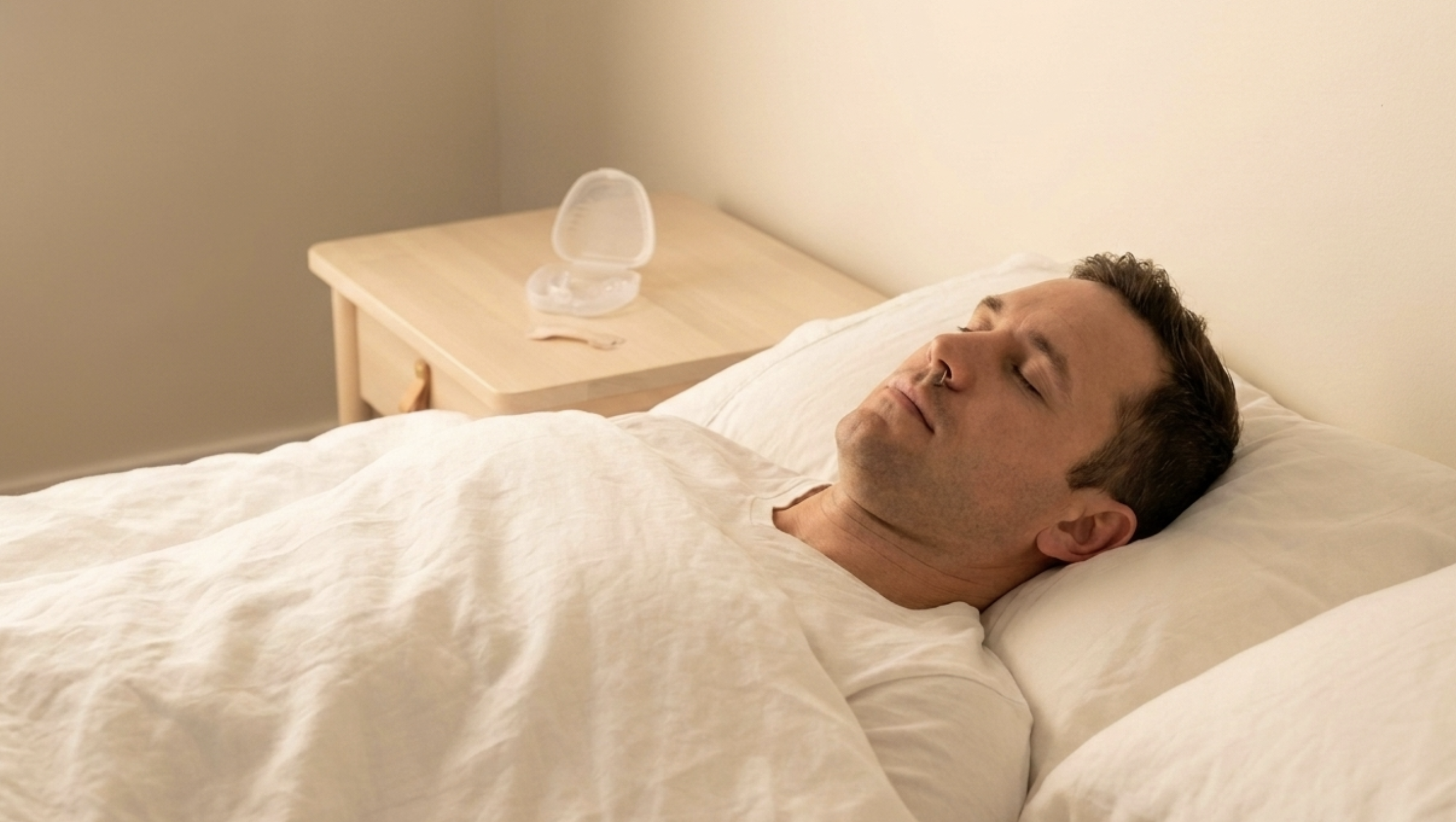
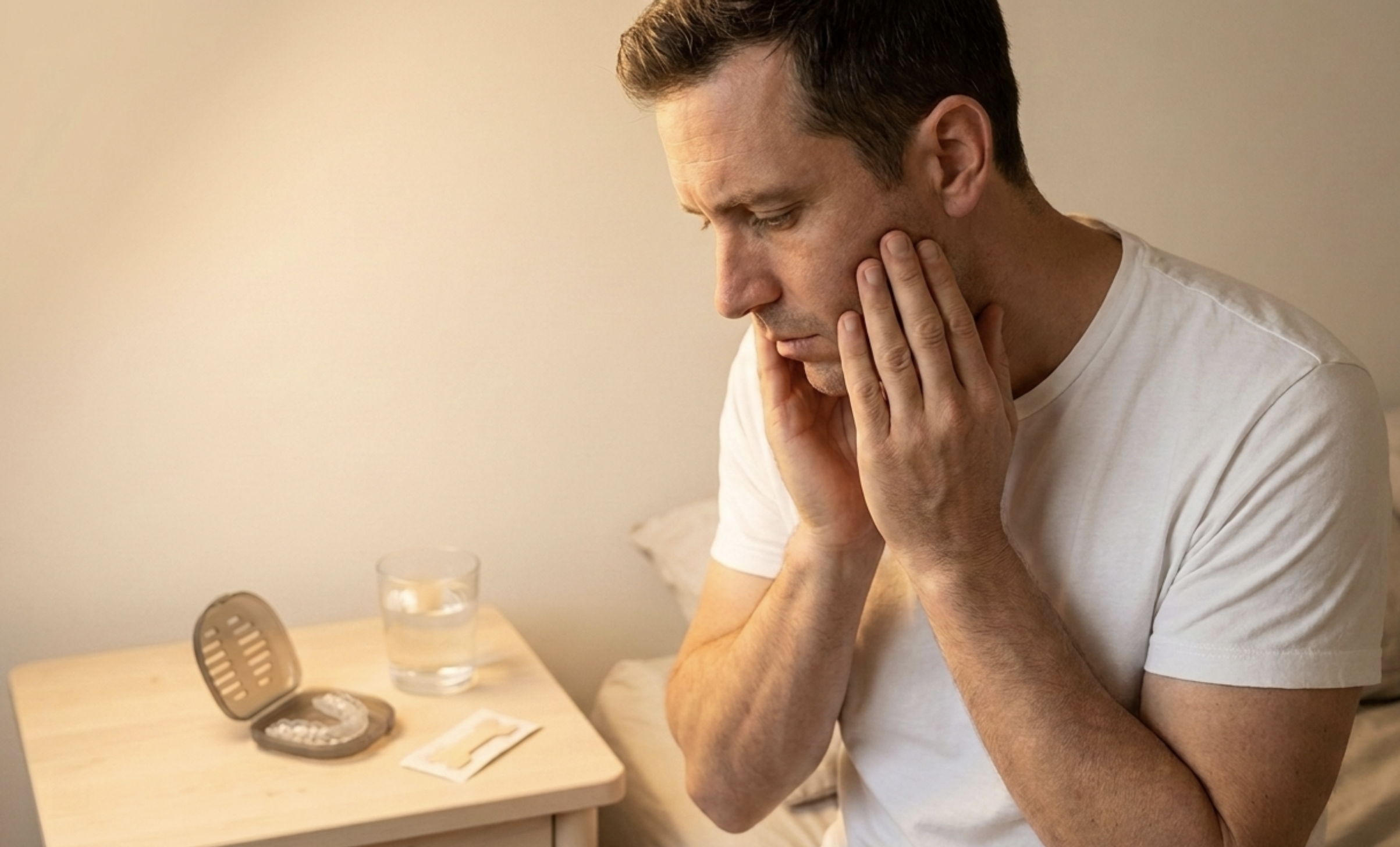
You wake up with a sore jaw. You wear a night guard. You don’t feel particularly stressed. And the grinding continues anyway.
For a subset of people with bruxism, the driver isn’t primarily stress, posture, or dental alignment — it’s breathing. Research consistently shows that sleep-disordered breathing and teeth grinding co-occur at rates far above chance, and the proposed mechanisms are specific enough to have practical implications for what you do about it.
This article covers what the research actually shows — including where the evidence is strong, where it’s uncertain, and what the three proposed mechanisms are — followed by a self-diagnostic framework and the practical interventions that address each mechanism.
What the Research Actually Shows
The association between sleep-disordered breathing (SDB) and bruxism is well-established in the literature. Studies show that 33–54% of people with obstructive sleep apnea also grind their teeth during sleep — a prevalence significantly higher than in the general population. Conversely, research on people with diagnosed bruxism finds elevated rates of sleep-disordered breathing.
What is less established is the causal direction. Three hypotheses exist:
- SDB causes bruxism — breathing interruptions trigger micro-arousals that manifest as grinding
- Bruxism causes SDB — jaw muscle signals from grinding increase nasal congestion and airway resistance
- Shared underlying factors — stress, neurological arousal, and anatomy contribute to both independently
The strongest evidence supports the first hypothesis — that breathing problems drive grinding in a subset of patients. This is supported by studies showing that treating OSA with CPAP often reduces bruxism episodes significantly, and that the timing of grinding episodes correlates with apnea events in patients who have both conditions.
The honest caveat: not all grinding is airway-driven. Bruxism has multiple drivers including stress, stimulant medication, sleep architecture, and neurological factors. The airway connection matters specifically for people whose grinding coexists with the specific symptom cluster described later in this article.
The Three Proposed Mechanisms
Understanding which mechanism is most relevant to your situation matters because the interventions are different for each.
Mechanism 1: The Micro-Arousal Response
This is the most extensively researched mechanism and the one with the strongest evidence base.
During sleep, if the upper airway narrows enough to reduce oxygen flow — whether from a full apnea event or a partial obstruction — the brain detects the oxygen drop and triggers an arousal response. This arousal is often sub-cortical: you don’t wake up consciously, but your nervous system activates enough to restart breathing. These brief activations are called micro-arousals.
Micro-arousals involve widespread sympathetic nervous system activation — increased heart rate, muscle tension, and motor activity throughout the body. The jaw muscles are part of this motor activation. In people who are already prone to bruxism, this sympathetic activation can manifest as a clenching or grinding episode. The grinding may physically reposition the jaw forward slightly, which shifts the tongue base and can help reopen a partially collapsed airway — a reflex that may have adaptive value even if its dental consequences are damaging.
The practical implication: if your grinding is primarily driven by this mechanism, reducing the frequency and severity of airway obstruction — through sleep position, nasal breathing interventions, or OSA treatment — will reduce the triggering events. The night guard protects your teeth from the force of whatever grinding still occurs; it doesn’t reduce the triggers.
Mechanism 2: Mouth Breathing and Airway Anatomy
Nasal breathing and mouth breathing produce different airway dynamics during sleep, and the difference matters for bruxism.
When you breathe through your nose, the nasal airway provides resistance that maintains positive pressure in the airway and supports the tone of the upper airway muscles. The tongue tends to rest in a higher position — against the palate — when nasal breathing is functional.
Mouth breathing bypasses this resistance. It allows the jaw to drop open and the tongue to rest lower and further back. During sleep, this posterior tongue position increases the likelihood of the tongue base partially obstructing the airway during the muscle relaxation of sleep stages. The result is more partial obstructions, more micro-arousals, and — in people prone to bruxism — more grinding episodes.
Anything that forces mouth breathing — chronic nasal congestion, a deviated septum, enlarged turbinates, allergic rhinitis — can amplify the airway-bruxism connection. This is why some people find their grinding is significantly worse during periods of nasal congestion from illness or seasonal allergies, and better when nasal breathing is clear.
Mouth taping during sleep — a practice of placing a small strip of tape across the lips to encourage nasal breathing — is used by some as an intervention for this mechanism. See the full evidence and safety guide for mouth taping before trying it, particularly if you have any suspicion of undiagnosed sleep apnea — mouth taping is contraindicated in OSA.
Mechanism 3: Sleep Position and Postural Airway Narrowing
Sleeping on your back places the tongue, soft palate, and uvula under gravitational pull toward the posterior pharyngeal wall — the back of the throat. This narrows the airway cross-section. For people with anatomical factors that already reduce airway space (a recessed lower jaw, a high body mass index, enlarged tonsils, or a naturally small upper airway), this postural narrowing can be enough to produce partial obstruction and the micro-arousal sequence described above.
Many people notice their grinding is significantly worse on nights when they sleep primarily on their back versus on their side. This is consistent with the postural airway mechanism — the supine position produces more obstruction events, more micro-arousals, and more grinding episodes. Side sleeping keeps the tongue from falling posteriorly and maintains a larger functional airway cross-section.
This is also why alcohol and sedatives — which reduce upper airway muscle tone — tend to worsen grinding in people with the airway-bruxism connection. Both substances increase the likelihood of airway collapse during sleep, increasing micro-arousal frequency and, in susceptible people, grinding activity.
Self-Diagnostic Signals: Is the Airway Connection Relevant to You?
Not everyone who grinds has an airway component. These are the signals that suggest breathing may be a significant driver in your specific case.
Strong signals — worth discussing with a doctor
- A bed partner has reported loud snoring or witnessed pauses in your breathing during sleep
- You consistently wake feeling unrefreshed despite sleeping 7–9 hours
- You experience significant daytime fatigue or sleepiness that isn’t explained by sleep quantity
- Morning headaches — particularly at the back of the head — that improve through the day
- You wake with a very dry mouth or sore throat despite not sleeping with your mouth visibly open
Supporting signals — suggestive but not diagnostic
- Your grinding is noticeably worse on nights when you sleep on your back
- Grinding worsens significantly when you have nasal congestion
- Grinding worsened after alcohol use the previous evening
- You breathe primarily through your mouth during the day as well as sleep
- You have chronic nasal congestion, a known deviated septum, or seasonal allergy that affects breathing
Signals that suggest other drivers are primary
- Grinding correlates tightly with high-stress periods but is absent or mild during low-stress periods
- Grinding began or significantly worsened after starting a stimulant medication
- Sleep quality feels good — restorative, uninterrupted — despite the grinding
- No snoring, no dry mouth on waking, no daytime fatigue
What You Can Do
The interventions are organised by mechanism. The most appropriate starting points depend on which signals are most prominent for you.
For the micro-arousal mechanism: address OSA directly
If you have multiple strong signals — witnessed apnea, loud snoring, chronic unrefreshing sleep, daytime fatigue — the correct intervention is a sleep study, not a night guard upgrade. A sleep study will measure your Apnea-Hypopnea Index (AHI) and determine whether you have OSA and at what severity. Treatment options range from lifestyle changes and positional therapy through CPAP, mandibular advancement devices (MADs), and surgical intervention depending on severity.
A night guard protects your teeth from grinding force regardless of cause. It does not reduce OSA-triggered micro-arousals or the grinding they produce. Both may be appropriate simultaneously — the night guard for dental protection while the breathing condition is assessed and managed.
For the mouth breathing mechanism: improve nasal airflow
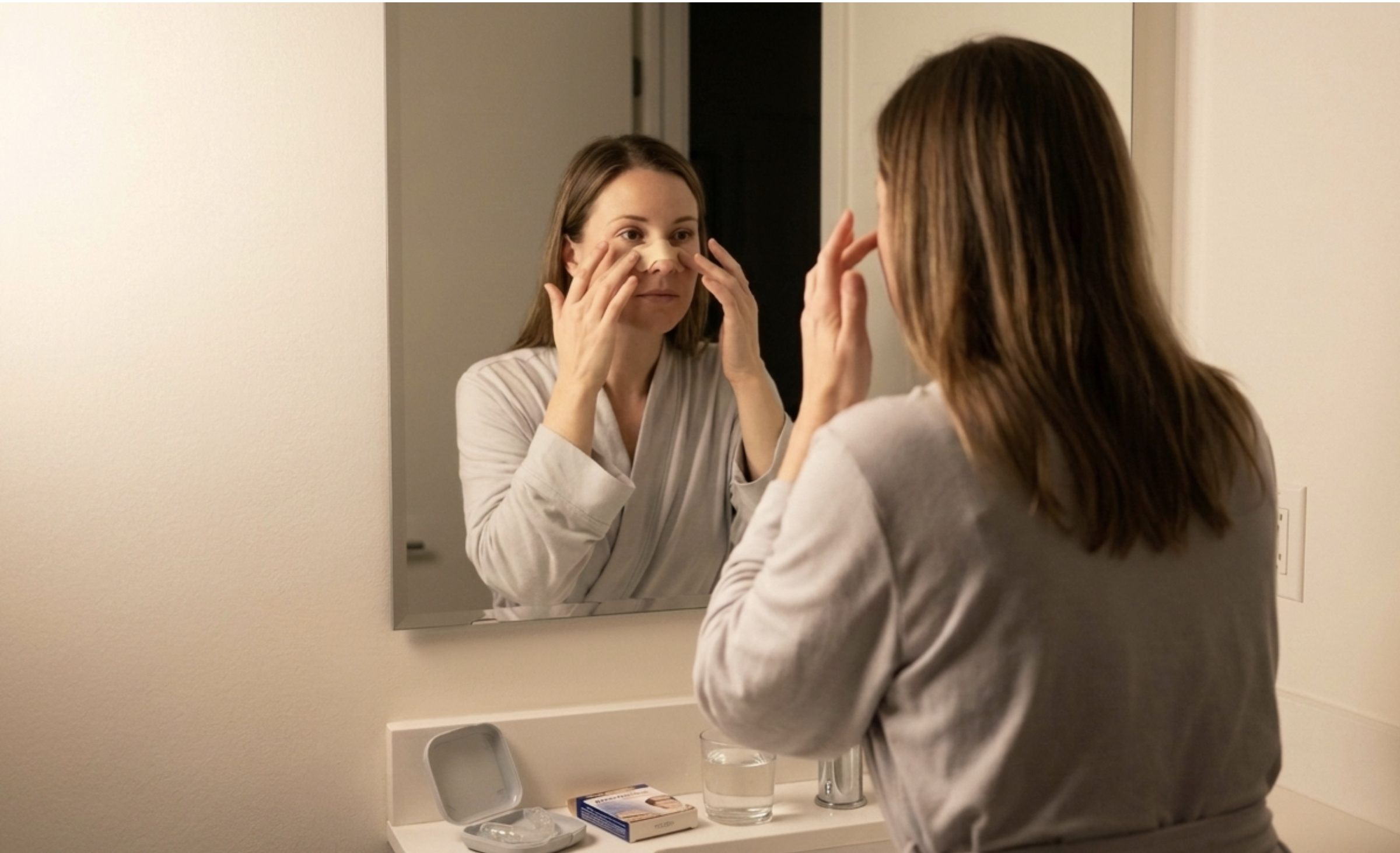
- Nasal strips — OTC external nasal dilator strips (Breathe Right or equivalent) mechanically open the nasal valve and can meaningfully improve nasal airflow during sleep. A practical low-cost first trial. If nasal strips help reduce morning grinding symptoms, it’s a useful signal that the mouth-breathing mechanism is a primary driver of your nocturnal jaw activity.
- Saline nasal rinse — before bed, clears mucus and reduces congestion that forces mouth breathing
- Address allergic rhinitis — if seasonal or year-round nasal congestion drives mouth breathing, treating the allergy (antihistamines, nasal corticosteroids) reduces the airway-bruxism trigger
- Humidifier — dry air dries nasal passages, worsening congestion-driven mouth breathing
- Septal issues — if chronic nasal obstruction is structural (deviated septum, enlarged turbinates), this warrants an ENT assessment
For the positional mechanism: side sleeping
Side sleeping is the most accessible and most immediately testable intervention for the postural airway mechanism. It requires no product and no clinical assessment. If your grinding is primarily driven by supine airway narrowing, side sleeping will produce a noticeable reduction within a few nights.
Practical methods to maintain side sleeping: a body pillow behind you that prevents rolling supine, a positional shirt or device that makes back sleeping uncomfortable, or simply starting every night deliberately on your side. Some people find that elevating the head of the bed slightly (4–6 inches) helps maintain airway patency even in positions that aren’t fully lateral.
Night Guard vs Mandibular Advancement Device: The Distinction That Matters
This is the most important practical distinction this article can establish, because it is frequently confused — particularly by people who discover the airway-bruxism connection and assume their night guard is addressing both problems.
A standard night guard (FDA Class I device, tooth protection) sits over your teeth and absorbs grinding force. It does not reposition your jaw, does not open your airway, and has no indicated use for sleep apnea or snoring. It protects your teeth from whatever grinding occurs. This is Reviv’s product category.
A mandibular advancement device (MAD) (FDA Class II device, cleared for sleep apnea and snoring) holds the lower jaw in a slightly forward position during sleep. This forward positioning advances the tongue base away from the posterior airway, increasing airway cross-sectional area. It requires a prescription, clinical fitting, and titration. It is a clinical sleep apnea treatment — a fundamentally different device to a night guard, despite superficial physical similarity.
If the airway connection is relevant to you, the path is: sleep study → diagnosis → appropriate clinical treatment (which may include a MAD) → night guard for dental protection alongside the clinical treatment. The two appliances address different problems and are not substitutes for each other. Full detail on oral appliances for sleep apnea is covered in the sleep apnea mouthpiece comparison.
Frequently Asked Questions
Can breathing problems cause teeth grinding?
Research shows a strong association — 33–54% of people with OSA also grind their teeth. The proposed mechanism involves micro-arousals triggered by breathing interruptions: the nervous system activates to restart breathing, which can manifest as jaw muscle activation and grinding. Treating the breathing disorder often reduces grinding frequency. The causal direction isn’t fully established for all cases, but the clinical correlation is consistent.
Why do I grind my teeth when I sleep on my back?
Gravity pulls the tongue and soft palate posteriorly in the supine position, narrowing the upper airway cross-section. This increases the likelihood of partial obstruction and the micro-arousal response, which in susceptible people manifests as grinding. Side sleeping reduces this postural airway narrowing and is consistently associated with reduced bruxism severity in people whose grinding is position-dependent.
What is the connection between mouth breathing and jaw clenching?
Mouth breathing alters the resting position of the tongue and jaw, bypasses the nasal airway’s pressure-maintaining function, and increases the likelihood of posterior tongue displacement during sleep — all of which raise the risk of partial airway obstruction and the micro-arousal bruxism response. Nasal congestion that forces mouth breathing is a commonly identified trigger for worsening nighttime grinding.
Should I get a sleep study if I grind my teeth?
If grinding coexists with loud snoring, witnessed breathing pauses, chronic morning headaches, or daytime fatigue despite adequate sleep hours — yes, a sleep study is worth discussing with your doctor. These symptoms together suggest possible sleep-disordered breathing that may be driving the grinding. A night guard protects your teeth from the grinding force but does not diagnose or address a breathing disorder.
Does a night guard help with sleep apnea?
No — a standard night guard (Class I tooth-protection device) and a mandibular advancement device (Class II sleep apnea treatment) look similar but serve completely different clinical purposes with different regulatory clearances. A night guard does not reposition the jaw or open the airway. If sleep apnea is present, it requires clinical diagnosis and appropriate treatment — which may include a MAD prescribed and fitted by a clinician, separately from any tooth-protection guard.
The Bottom Line
For a significant subset of people with bruxism — particularly those who also snore, wake feeling unrefreshed, experience morning headaches, or notice their grinding is worse when sleeping on their back or during nasal congestion — breathing is a meaningful driver of the grinding pattern. Addressing the airway component, through positional changes, nasal breathing interventions, or clinical OSA treatment, can reduce the frequency and intensity of grinding in a way that dental interventions alone cannot.
A night guard remains appropriate alongside any breathing intervention — it protects your teeth from the force of whatever grinding still occurs during the transition or as a complement to breathing treatment. But for people with the airway-bruxism connection, a guard alone is managing the consequence rather than the cause. The cause deserves its own investigation.
If the signals in this article apply to you, the starting point is a conversation with your doctor — not a guard upgrade. If you need tooth protection in the meantime, the Reviv model selector matches your pattern to the right FDA-registered Class I appliance.