

What is Ozempic teeth?
Does Ozempic cause tooth decay?
Is Ozempic teeth real?
Can Ozempic cause jaw clenching?
What is the Ozempic teeth study?



If you’re on Ozempic, Wegovy, Mounjaro, or another GLP-1 receptor agonist and you’ve noticed changes in your teeth — new sensitivity, unexpected cavities, a persistently dry mouth, or jaw tension — you’re not alone, and you’re not imagining it.
“Ozempic teeth” is a term that originated on Reddit and spread through TikTok and health media to describe a cluster of dental complaints reported by GLP-1 medication users. It is not a clinical diagnosis. But the underlying dental problems are real, the mechanisms are understood well enough to take seriously, and the protective steps are straightforward — which is what this article covers.
The honest version of this topic requires distinguishing between what is well-supported by evidence, what is plausible but unproven, and what is overclaimed. That distinction matters because it changes what you should actually do about it.
What Is Ozempic Teeth?
“Ozempic teeth” refers to a collection of dental and oral health issues reported by people taking GLP-1 receptor agonist medications — a class that includes semaglutide (Ozempic, Wegovy), tirzepatide (Mounjaro, Zepbound), liraglutide (Victoza, Saxenda), and similar drugs. The term was coined on Reddit and gained traction on TikTok before entering mainstream health media.
The reported complaints fall into four main categories:
- Dry mouth (xerostomia) and its downstream consequences — rapid decay, bad breath, difficulty swallowing
- Acid erosion from GLP-1-associated vomiting and acid reflux
- Accelerated tooth decay from the combined effect of reduced saliva, acid exposure, and reduced remineralisation
- Jaw clenching and bruxism — the least clinically established of the four, but reported consistently enough in online communities to warrant addressing
The critical point that most coverage gets wrong: Ozempic does not directly damage teeth. As of early 2026, there is no published clinical trial confirming that GLP-1 medications directly damage tooth enamel or gum tissue. The mechanism is indirect — the medication’s side effects create an oral environment that is significantly more hostile to dental health than normal.
The Evidence Picture: What We Know and What We Don’t
The honest evidence picture as of 2026:
Well-established: GLP-1 medications cause nausea, vomiting, and acid reflux in a significant proportion of users. FDA clinical data shows nausea occurs in 16–20% of Ozempic patients and vomiting in 5–9%. These are confirmed pharmacological effects. Vomiting introduces stomach acid into the mouth, and stomach acid erodes enamel — this causal chain is not disputed.
Well-established: GLP-1 medications suppress appetite and thirst. Reduced fluid intake causes dry mouth. The American Dental Association attributes the dental issues mainly to dry mouth and dehydration caused by appetite and thirst suppression from the drugs, along with altered saliva production. Reduced saliva means reduced acid neutralisation, reduced enamel remineralisation, and reduced mechanical cleaning of tooth surfaces — all of which increase decay risk.
Reported but unconfirmed by clinical trials: Direct reduction of salivary gland function by GLP-1 receptor agonism. Some dentists report this based on clinical observation; it has not been established in controlled trials as of 2026.
Implicated but not established: GLP-1 medications and bruxism. Reports appear in online communities; clinical evidence is absent.
Overclaimed: “Ozempic makes your teeth fall out.” Tooth loss reported in some cases is an extreme downstream consequence of untreated rapid decay and gum disease — not a direct pharmacological effect.
Issue 1: Dry Mouth and Reduced Saliva
This is the most significant and best-supported issue in the Ozempic teeth cluster. Saliva is not passive moisture — it is the oral cavity’s primary defence system.
Saliva neutralises the acids produced by bacteria after meals. It supplies minerals — calcium and phosphate — that remineralise enamel after acid exposure (a process that happens continuously in a healthy mouth). It mechanically rinses food particles from tooth surfaces. It contains antimicrobial proteins that suppress the bacterial populations that cause decay and gum disease. When saliva production is reduced, all of these protective functions weaken simultaneously.
GLP-1 medications reduce saliva in two ways. First, by suppressing thirst — the primary driver of fluid intake — they reduce the systemic hydration that saliva production depends on. Second, they slow gastric emptying, which affects fluid processing throughout the GI system. Some dentists also report that GLP-1 receptor activity in salivary glands may directly reduce secretion, though this is not yet confirmed by clinical research.
The result: a mouth that is persistently drier than it should be, with acid neutralisation and remineralisation both compromised, creating an environment where decay accelerates significantly even in patients with previously excellent oral hygiene.
Issue 2: Acid Erosion from Vomiting and Reflux
GLP-1 medications slow gastric emptying as part of their mechanism of action — food stays in the stomach longer, which contributes to the appetite suppression they produce. For a significant proportion of users, this slowed emptying also increases the likelihood of nausea, vomiting, and acid reflux.
Stomach acid has a pH of approximately 1.5–3.5 — highly acidic. Enamel begins to dissolve at a pH below 5.5. Vomiting brings stomach acid into direct contact with tooth surfaces. Acid reflux, which may be less dramatic but more frequent, produces sustained acid exposure to the back teeth and throat.
The enamel damage from acid exposure is irreversible — enamel does not regenerate. Once erosion has occurred, the affected area is permanently more vulnerable, and continued acid exposure accelerates the damage. For GLP-1 users experiencing regular nausea or vomiting, this is the most urgent dental concern.
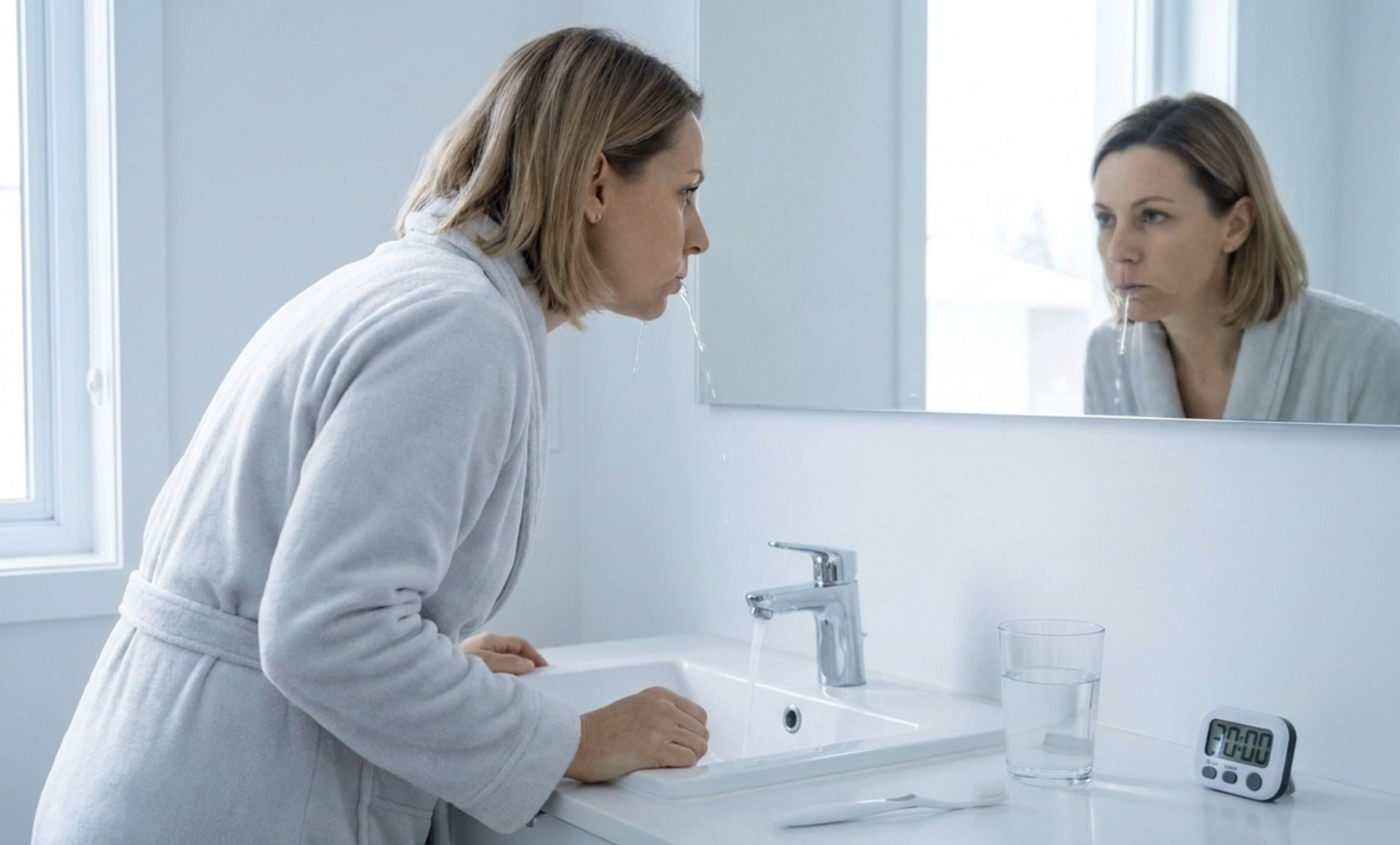
The critical protective instruction — and the one most people don’t know — is that brushing immediately after vomiting makes the damage worse, not better. Brushing spreads the stomach acid across more tooth surfaces and physically abrades the temporarily softened enamel. The correct response is to rinse the mouth with water immediately, wait 30 minutes for saliva to neutralise the acid and begin to reharden the enamel surface, then brush normally. This single protocol change meaningfully reduces enamel damage in patients with frequent vomiting.
Issue 3: Accelerated Tooth Decay
Tooth decay (dental caries) results from the combined action of acid-producing bacteria, fermentable carbohydrates, and a susceptible tooth surface over time. In a mouth with healthy saliva production and normal acid neutralisation, decay progresses slowly enough that regular dental care catches and addresses it. In a mouth with reduced saliva, elevated acidity, and enamel compromised by acid erosion, decay progresses significantly faster.
What distinguishes GLP-1-associated decay from normal decay is the speed and pattern. Patients with previously excellent oral hygiene — no significant decay history — are presenting with multiple new cavities across several teeth simultaneously. The characteristic pattern is decay appearing at the gumline and in areas normally protected by adequate saliva, progressing within months rather than the years that normal caries progression takes.
This rapid-onset presentation is what has driven the Ozempic teeth conversation in dental practices. Dentists who have not been informed that a patient is on GLP-1 medication are encountering decay patterns inconsistent with the patient’s prior dental history and hygiene behaviour — and the explanation is the changed oral environment the medication has created.
This is why informing your dentist that you are on a GLP-1 medication is the single most important thing you can do. It changes how your dentist monitors, how frequently they recommend cleanings, and what protective measures — prescription fluoride, saliva substitutes, remineralisation treatments — they recommend proactively. For more on why proactive oral protection matters across different conditions, the principle applies directly here.
Issue 4: Jaw Clenching and Bruxism
This is the least clinically established of the four reported issues and warrants the most careful framing — because it is the one most relevant to the readers of this site and the one most likely to be either overclaimed or dismissed.
Reports of jaw tension, bruxism, and new or worsened teeth grinding on GLP-1 medications appear consistently in online communities — Reddit threads, patient forums, and anecdotal reports to dentists. There is currently no published clinical research establishing a causal link between GLP-1 receptor agonists and bruxism. The reports are plausible but unconfirmed.
The plausibility rests on two proposed mechanisms:
Dopaminergic pathway involvement. GLP-1 receptors are present in the central nervous system, including in dopaminergic circuits. Bruxism is associated with alterations in dopaminergic signalling — the same pathway implicated in stimulant-medication-induced jaw clenching (Adderall, Vyvanse). Whether GLP-1 agonism produces sufficient dopaminergic activation to drive jaw clenching is not established, but the pathway is present.
Sympathetic activation and appetite suppression. The physiological arousal of appetite suppression — the sustained mild sympathetic activation that GLP-1 medications produce — may elevate baseline jaw muscle tone in susceptible individuals, in the same way that stress-related sympathetic activation drives bruxism.
The practical position: if you are on a GLP-1 medication and have developed new jaw tension, morning jaw soreness, or been told by a partner that you are grinding your teeth — mention it to your dentist. In the context of already-compromised dental health from the other three mechanisms, the additional force of unprotected bruxism is more damaging than it would be in a normal oral environment. A night guard protects teeth that are already more vulnerable.
What Is the Ozempic Teeth Study?
“What study?” is one of the most-searched follow-up queries on this topic, and the honest answer is that there is no single definitive Ozempic teeth study.
The evidence base as of 2026 consists of:
- Pharmacovigilance data — a 2024 analysis of FDA adverse event reports found elevated reporting of dental adverse events among GLP-1 medication users compared to matched controls. Adverse event report data cannot establish causation — it reflects what is reported, not what is caused — but elevated signals in pharmacovigilance are used to justify further investigation
- Case reports and dental practice observations — individual dentists and dental practices documenting rapid-onset decay and gum disease in GLP-1 users, as reported in dental journals and professional publications
- Mechanistic research — established research on GLP-1 receptor distribution (including in salivary glands), gastric emptying effects, and vomiting incidence that supports the plausibility of the indirect mechanisms
- The ADA position — the American Dental Association has acknowledged the phenomenon and called for dedicated prospective research
Dedicated prospective clinical trials examining GLP-1 medications and oral health were underway but had not reported results as of early 2026. The scientific picture will clarify over the next two to three years as those trials report. In the meantime, the precautionary protective steps — increased hydration, more frequent dental care, post-vomit rinsing protocol, fluoride — are justified by the indirect mechanisms even in the absence of definitive trial data.
How to Protect Your Teeth on GLP-1 Medications
These are the six evidence-referenced protective steps, in order of importance:
1. Tell your dentist you are on a GLP-1 medication
This is the single highest-impact action. Before starting the medication if possible; at your next appointment otherwise. Your GLP-1 status changes what your dentist monitors, how frequently they recommend cleanings (every 3–4 months rather than twice yearly while on the medication), and what protective treatments they may recommend proactively. Dry mouth from GLP-1 medications also accelerates biofilm formation on any oral appliances — your dentist needs to know this context.
2. Hydrate intentionally, not when thirsty
Thirst suppression means the normal signal to drink is absent. Set reminders. Drink water consistently throughout the day regardless of whether you feel thirsty. Water directly increases saliva production, dilutes oral acid concentration, and mechanically rinses tooth surfaces. This is the most accessible and most cost-free protective step.
3. The post-vomit protocol
If you vomit: rinse the mouth with water immediately. Do not brush. Wait 30 minutes. Then brush with fluoride toothpaste. Brushing within 30 minutes of vomiting physically abrades the temporarily acid-softened enamel and spreads the stomach acid to additional tooth surfaces. The 30-minute wait allows saliva to neutralise the acid and the enamel to begin rehardening. This protocol is simple, costs nothing, and meaningfully reduces enamel damage in patients with frequent GLP-1-associated nausea.
4. Use fluoride toothpaste — and consider prescription strength
Standard OTC fluoride toothpaste (1000–1450 ppm) provides adequate fluoride for normal decay risk. GLP-1 users with elevated decay risk — which is most users with persistent dry mouth — may benefit from prescription-strength fluoride (5000 ppm) under dentist supervision. Ask specifically at your dental appointment. Remineralisation products (products containing hydroxyapatite, casein phosphopeptide-amorphous calcium phosphate, or similar) are also worth discussing.
5. Address dry mouth directly
Sugar-free gum or lozenges containing xylitol stimulate saliva production and provide some antimicrobial benefit from the xylitol. Saliva substitute products (mouth sprays, gels, rinses) are available OTC and provide temporary lubrication and some of saliva’s protective functions. Avoid mouthwashes containing alcohol, which further dry the oral mucosa. Avoid sugar-containing beverages, which fuel the acid-producing bacteria in an already-susceptible oral environment.
6. Wear a night guard if you are experiencing bruxism
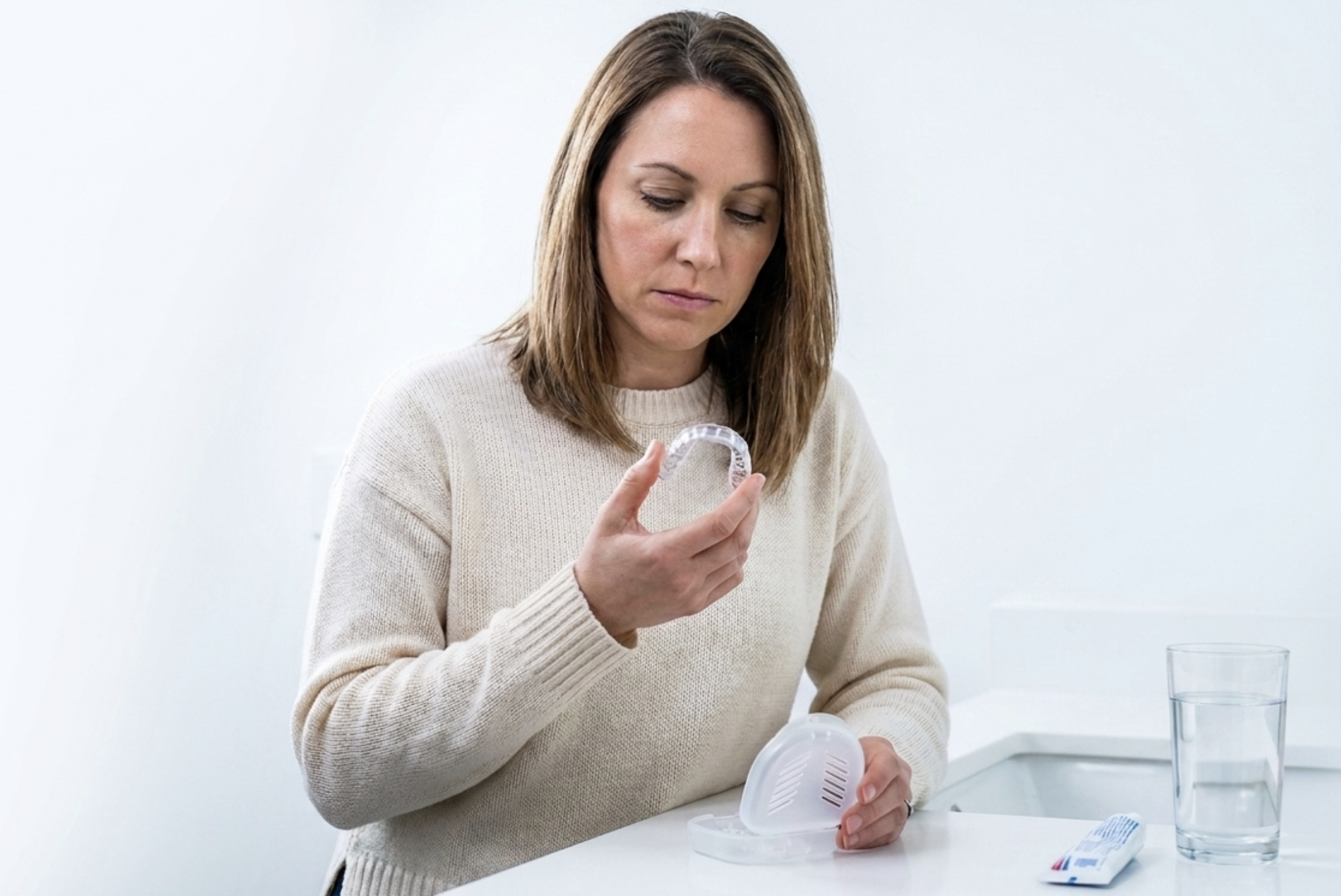
In a mouth already compromised by dry mouth and acid erosion, the additional mechanical force of unprotected bruxism is more damaging than in a normal oral environment. Enamel that has already been thinned by acid erosion fractures more easily under clenching force. If you are grinding, a night guard absorbs that force before it reaches already-vulnerable tooth surfaces.
Telling Your Dentist: What to Say
Many GLP-1 users don’t mention their medication at dental appointments — either because they don’t think it’s relevant, or because they haven’t made the connection to their dental changes. This is the gap that produces the worst outcomes.
At your next dental appointment, tell your dentist:
- Which GLP-1 medication you are on and the dose
- How long you have been taking it
- Whether you are experiencing nausea, vomiting, or acid reflux — and how frequently
- Whether you have noticed dry mouth
- Whether you have noticed any new jaw tension, morning soreness, or grinding
This information changes the clinical picture and the appropriate management. A dentist who doesn’t know you’re on a GLP-1 medication may attribute new decay to hygiene lapses or dietary changes — missing the medication context that explains both the pattern and the appropriate response.
The Bottom Line
Ozempic teeth is real — but the mechanism is indirect, not pharmacological. GLP-1 medications do not directly eat away at enamel or directly damage gum tissue. They create an oral environment that is significantly more vulnerable to decay, erosion, and gum disease through three well-supported indirect mechanisms: reduced saliva from thirst suppression, enamel acid erosion from vomiting and reflux, and the cascade effects of reduced salivary protection. A fourth possible mechanism — medication-associated jaw clenching — is reported but clinically unestablished.
The protective steps are straightforward, low-cost, and proportionate to the evidence: tell your dentist, hydrate intentionally, follow the post-vomit rinsing protocol, increase dental cleaning frequency, and address dry mouth directly. If bruxism is also present, a night guard adds mechanical protection to teeth that are already more vulnerable than normal. The Reviv model selector helps identify the right FDA-registered Class I appliance for your specific grinding pattern — or browse the full range.
The research will clarify over the next few years as prospective trials report. In the meantime, the indirect mechanisms are understood well enough to justify precaution — and precaution in this case costs very little compared to the dental treatment that follows from not taking it.