
- To Every Nurse Reading This
- The Elevated Bruxism Rates
- Mechanism 1: Sympathetic Overdrive
- Mechanism 2: Cortisol and Shift Work
- Mechanism 3: Short Sleep Cycles
- Mechanism 4: The Mask-Talking Habit
- Mechanism 5: Dehydration on Shift
- Protection Strategies
- The Night Guard for Shift Workers
- The Bottom Line
Do nurses grind their teeth more?
Why do nurses clench their jaw?
What is the mask-talking habit?
How does shift work affect bruxism?
What can nurses do to protect their teeth?

To Every Nurse Reading This
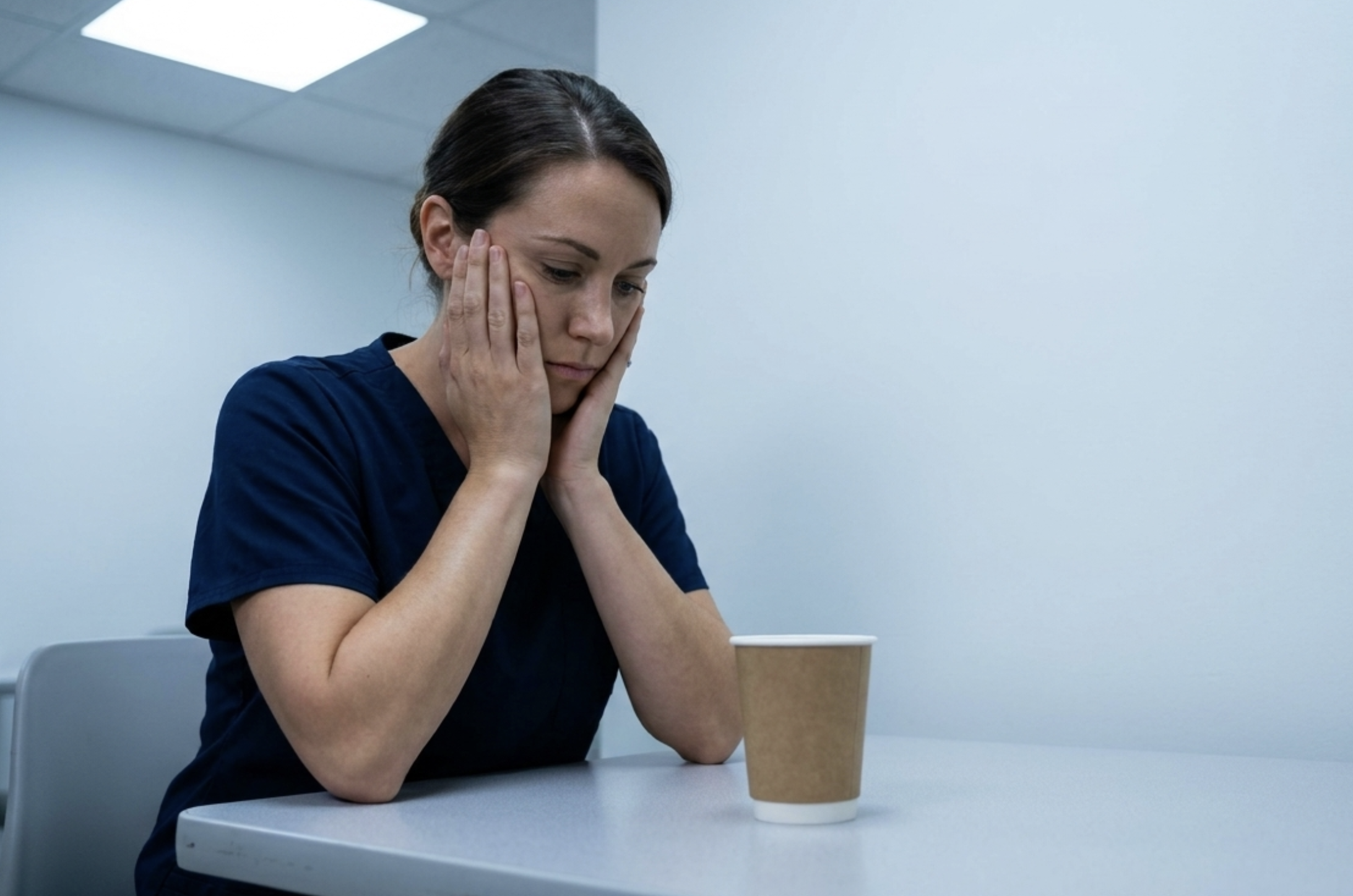
You spend 12 hours absorbing other people’s worst moments. You make decisions under pressure that most people will never face. You walk an average of five kilometres per shift. You skip breaks, skip meals, and still find something kind to say to a patient at hour eleven.
What almost nobody mentions on National Nurses Day is what this does to your jaw.
Bruxism — teeth grinding and clenching — is elevated among healthcare workers, and for reasons that are specific and explainable. This is not generic “stress causes grinding.” The nursing work environment activates jaw clenching through five distinct physiological pathways, and understanding them changes what you can actually do about it.
This article is the jaw health content nobody thought to write for nurses. It explains the mechanisms, maps practical protections to each one, and ends with the honest acknowledgment that you deserve at least one thing that takes care of you the way you take care of everyone else.
The Elevated Bruxism Rates Among Healthcare Workers
Research on occupational stress and bruxism consistently places healthcare workers — and nurses specifically — among the professional groups with the highest bruxism prevalence. Studies examining shift workers, ICU staff, and emergency department nurses find grinding and clenching rates significantly above general population norms.
The explanation is not simply “nurses are stressed.” Stress is a component, but the specific physiological conditions of nursing — shift rotation, sustained sympathetic activation, PPE communication habits, short inter-shift sleep windows — each independently elevate bruxism risk through separate mechanisms. In nursing, multiple mechanisms operate simultaneously, which is why the bruxism rates are so much higher than can be explained by stress alone.
Mechanism 1: Sympathetic Nervous System Overdrive
The sympathetic nervous system — the “fight or flight” system — is designed for acute activation and recovery. A brief threat, a sympathetic surge, then parasympathetic recovery. In a nursing environment, this cycle doesn’t complete. The activation is sustained for 12 hours at a time: a deteriorating patient, a code, a family crisis, a medication error caught at the last moment, a patient in pain who needs immediate assessment. The sympathetic system stays activated because the environment demands it.
Sustained sympathetic activation has a direct effect on jaw muscle tone. The masseter and temporalis — the primary jaw-closing muscles — elevate their baseline tension as part of the body’s sustained-arousal state. The jaw sets as part of the full-body alertness response. This is the same mechanism that drives bruxism in people on stimulant medications and in people under chronic stress — the nursing environment produces it through sustained activation rather than through chemical means.
At the end of a 12-hour shift, the nervous system doesn’t immediately return to parasympathetic baseline. Cortisol, adrenaline, and the arousal state can persist for hours after leaving the hospital. This is why many nurses report that their worst grinding occurs not during the shift but in the first sleep period after a long shift — the sympathetic activation that couldn’t resolve during waking hours manifests as nocturnal jaw muscle activity during sleep.
Mechanism 2: Cortisol Elevation from Shift Rotation
Cortisol — the primary stress hormone — follows a normal daily rhythm tied to the circadian clock: high in the early morning to promote waking and alertness, declining through the day, lowest during the first half of the night. Shift work disrupts this rhythm fundamentally.
Night shift nurses have elevated cortisol during the periods when it should be lowest. Rotating shift workers — who cycle through day, evening, and night shifts — never fully adapt to any single cortisol rhythm, maintaining a chronically dysregulated hormonal pattern. Chronically elevated cortisol has two specific effects relevant to jaw health: it maintains higher baseline sympathetic tone (compounding Mechanism 1), and it increases overall muscle excitability, reducing the threshold at which muscles activate and making relaxation harder to sustain.
This is the cortisol-jaw connection that drives much of the “jaw feels tight all the time” experience that nurses describe. It is not imagined and it is not simply stress — it is a specific hormonal consequence of shift rotation that changes the baseline muscle tone of the jaw independently of any acute stressor.
Mechanism 3: Short Sleep Cycles and Sleep Architecture
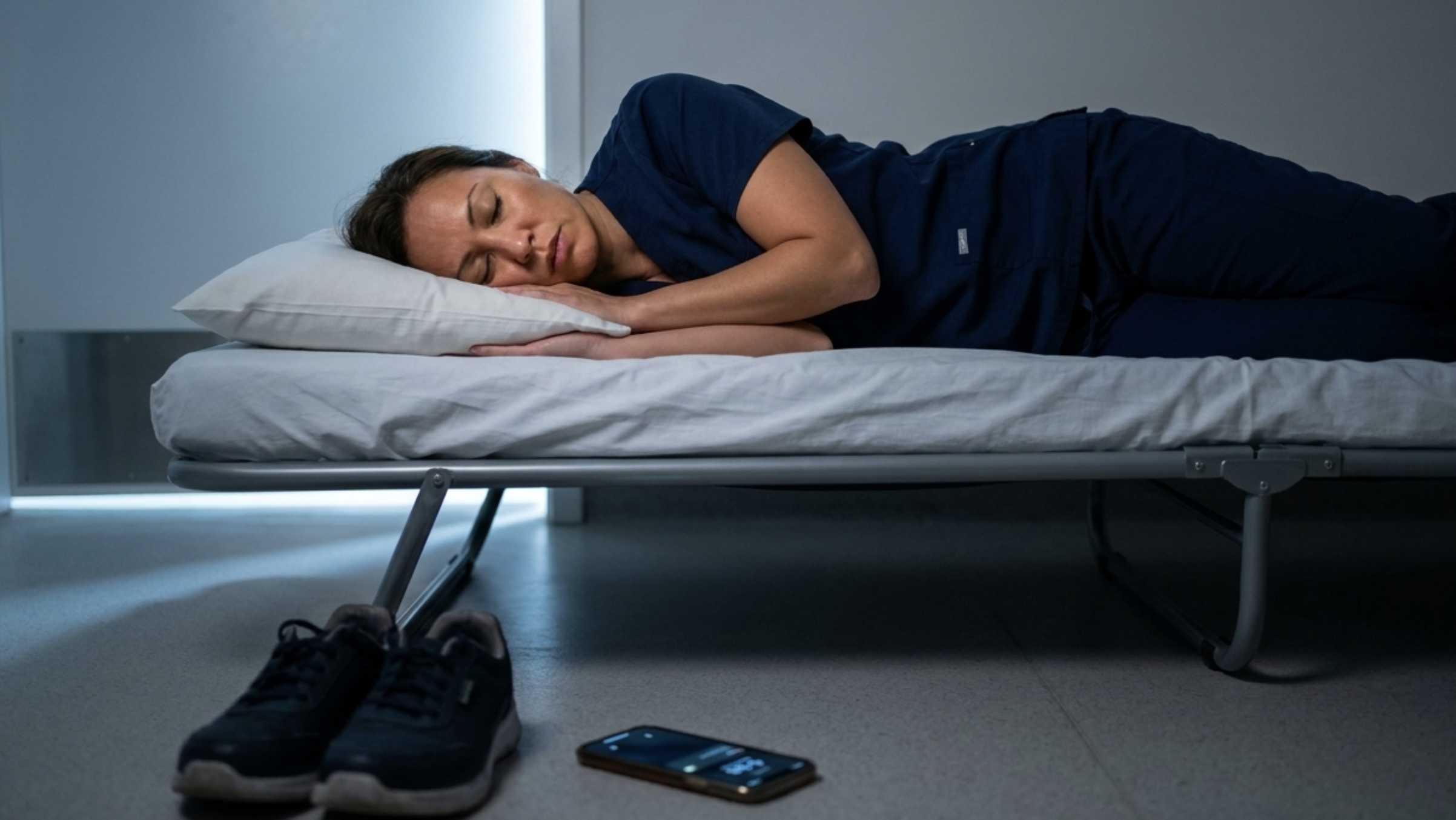
Most nurses working 12-hour shifts have 10–14 hours between shift end and the next shift start. After commuting, eating, and decompressing, the available sleep window may be 6–8 hours — less if childcare, household responsibilities, or the sympathetic activation from the shift makes sleep onset difficult.
Bruxism occurs predominantly in lighter sleep stages — N1 and N2 non-REM sleep. In a full, uninterrupted 8–9 hour sleep period, the body cycles through deep sleep (N3) multiple times, and the proportion of time in lighter stages is relatively small. In a 6-hour sleep window, the body prioritises sleep architecture differently — often spending more proportionate time in lighter stages because the total sleep opportunity is insufficient for complete deep sleep cycling.
The result: a shorter sleep window means more time in the stages where bruxism occurs, relative to total sleep time. This is why nurses who grind often find their bruxism is significantly worse during work weeks versus days off — the inter-shift sleep window is structurally different from a rest-day sleep in ways that directly increase bruxism exposure time.
Rotating shifts compound this by preventing adaptation to any single sleep pattern. A nurse cycling through day, evening, and night shifts is continuously resetting their body clock — there is no stable sleep window to which the body can adapt and in which deep sleep can be reliably achieved. Sleep architecture disruption also activates the airway-bruxism connection, producing more micro-arousals during lighter sleep that can manifest as grinding episodes.
Mechanism 4: The Mask-Talking Habit
This is the mechanism unique to post-pandemic healthcare workers, and it is the one most likely to go unrecognised as a bruxism driver.
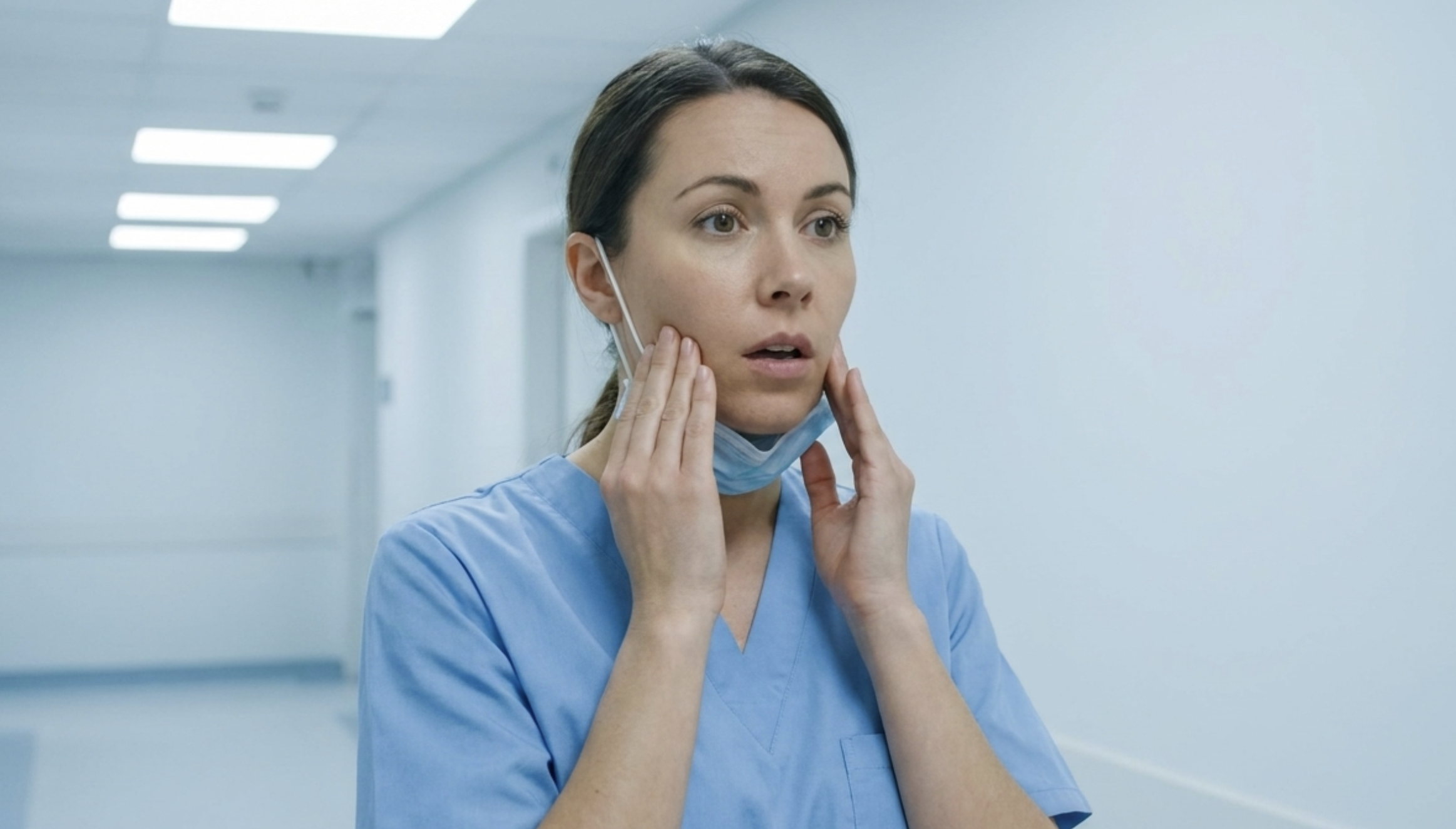
During the pandemic, nurses and frontline healthcare workers learned to communicate through N95 and surgical masks for extended periods. Speaking through a mask requires projecting the voice, speaking more deliberately, and — for many people — involves a specific jaw tension as a compensatory mechanism: the jaw sets slightly as the muscles work harder to produce clear, projectable speech through the muffling barrier.
For nurses who spent two or more years communicating through masks for 12 hours a day, this jaw-tension-while-communicating pattern became habitual — a learned neuromuscular pattern that the body maintained even when the mask came off. Many nurses now clench their jaw during any demanding communication: during handoffs, during difficult patient conversations, during phone calls with physicians. The mask is gone; the jaw pattern it reinforced is not.
This daytime clenching pattern — which occurs during waking hours, during the periods of highest cognitive and communicative demand — adds to whatever nighttime grinding the sleep mechanisms produce. For nurses who clench during shift and grind during their short inter-shift sleep, both patterns need to be addressed.
Mechanism 5: Dehydration and Electrolyte Gaps on Shift
Twelve-hour shifts in busy clinical environments regularly produce skipped breaks, skipped meals, and inadequate fluid intake. Many nurses report not drinking enough water for the first 6–8 hours of a shift because the pace doesn’t allow it, and not eating until the end of the shift or after.
Dehydration reduces saliva production, worsening the oral environment. But it also affects muscle function directly: dehydrated muscles are less efficient at the contraction-relaxation cycle, producing more residual tension after activation. For jaw muscles already elevated by sympathetic activation and cortisol, the additional load of dehydration-related muscle inefficiency compounds the clenching tendency.
Magnesium depletion from inadequate eating during shifts has a specific jaw effect. Magnesium is the mineral that allows muscles to release contraction — it acts as a natural calcium antagonist, enabling the relaxation phase of the muscle cycle. When intake is inadequate during long shifts, jaw muscles lose a key relaxation mechanism, amplifying whatever clenching the other four mechanisms are already driving. The evidence and specific form recommendations for maintaining a protective oral routine despite shift work constraints extends to guard care during short inter-shift windows.
Protection Strategies — Designed for Shift Workers
The standard bruxism advice — manage stress, get better sleep, practise relaxation — is reasonable for the general population and largely useless for nurses, who cannot manage away a code or restructure their shift schedule. The interventions here are designed for a 12-hour rotating shift reality.
The jaw awareness habit during documentation
The highest-leverage daytime intervention for nurses is a jaw position check during documentation time — the moments at computer stations when concentration-induced clenching peaks. A sticky note on the monitor or a phone reminder set to every hour: are your teeth touching? They shouldn’t be at rest. The correct resting position is lips gently closed, teeth slightly apart. This single habit, consistently maintained during the highest-clenching documentation periods, meaningfully reduces the daytime clenching load.
Hydration as a clinical priority, not a personal one
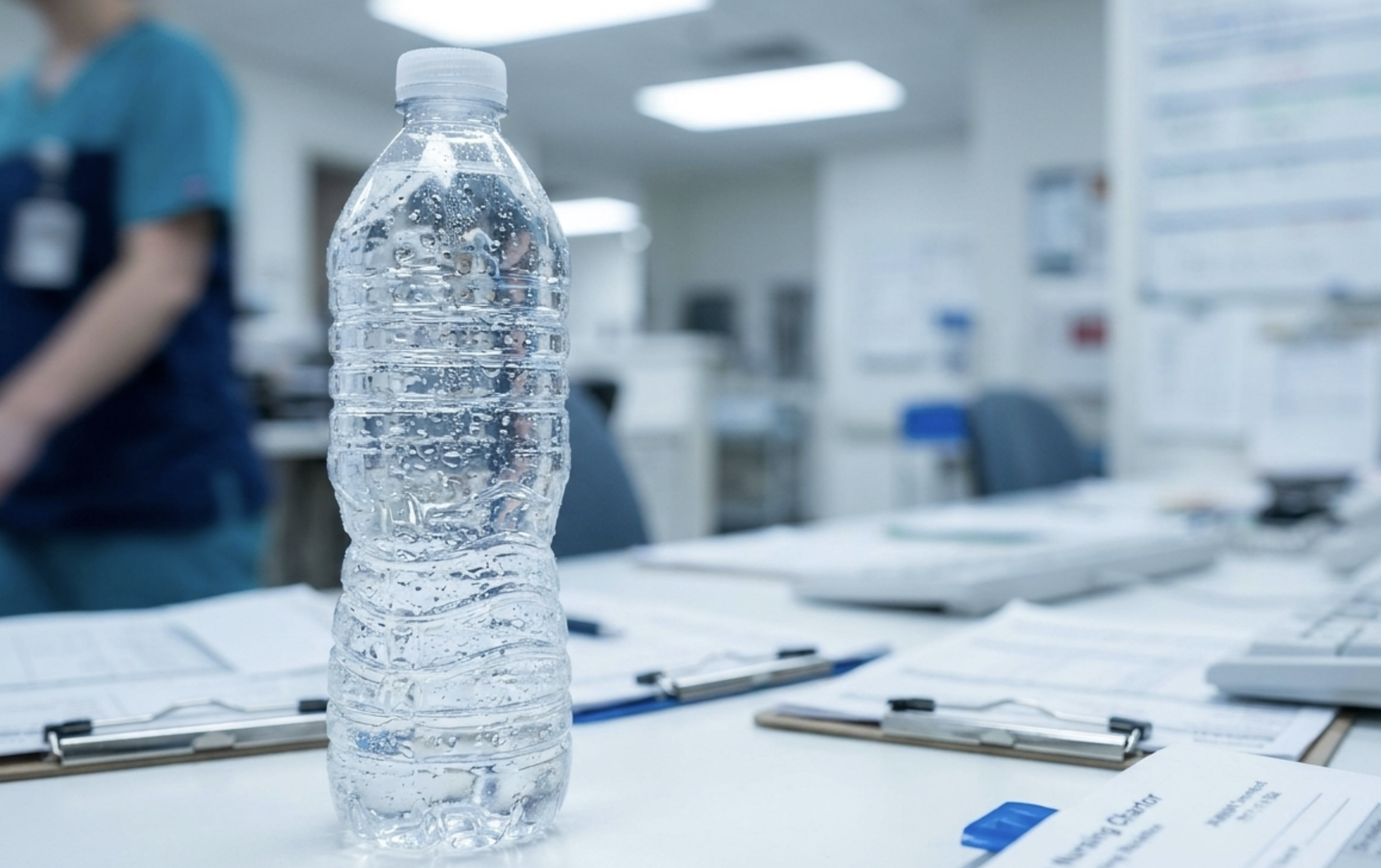
Keeping a water bottle accessible during shift — and treating drinking from it the same way you’d treat any other clinical task — addresses Mechanism 5 directly. The bottle needs to be visible and within reach during documentation, not locked in a break room you won’t visit for six hours. For nurses in environments where patient-side water bottles aren’t possible, prioritising drinking during any transition between tasks — room exits, handoffs, medication preparation — builds the habit around the structure that actually exists.
Magnesium glycinate before every sleep session, regardless of when it falls
The standard advice is to take magnesium glycinate in the evening. For nurses, the relevant guidance is: take it 30–60 minutes before your intended sleep session, regardless of what time of day that sleep session falls. The muscle-relaxing effect and its sleep-quality support are needed equally for a 2pm daytime sleep after a night shift and for a 10pm sleep before an early day shift. The timing to sleep onset is what matters, not the clock.
The Night Guard for Shift Workers: Specific Considerations
A night guard is the mechanical foundation of bruxism protection — it absorbs whatever force your jaw generates during sleep before it reaches your enamel. For nurses, three considerations that don’t apply to standard guard advice:
Wear it for every sleep session, not just at night
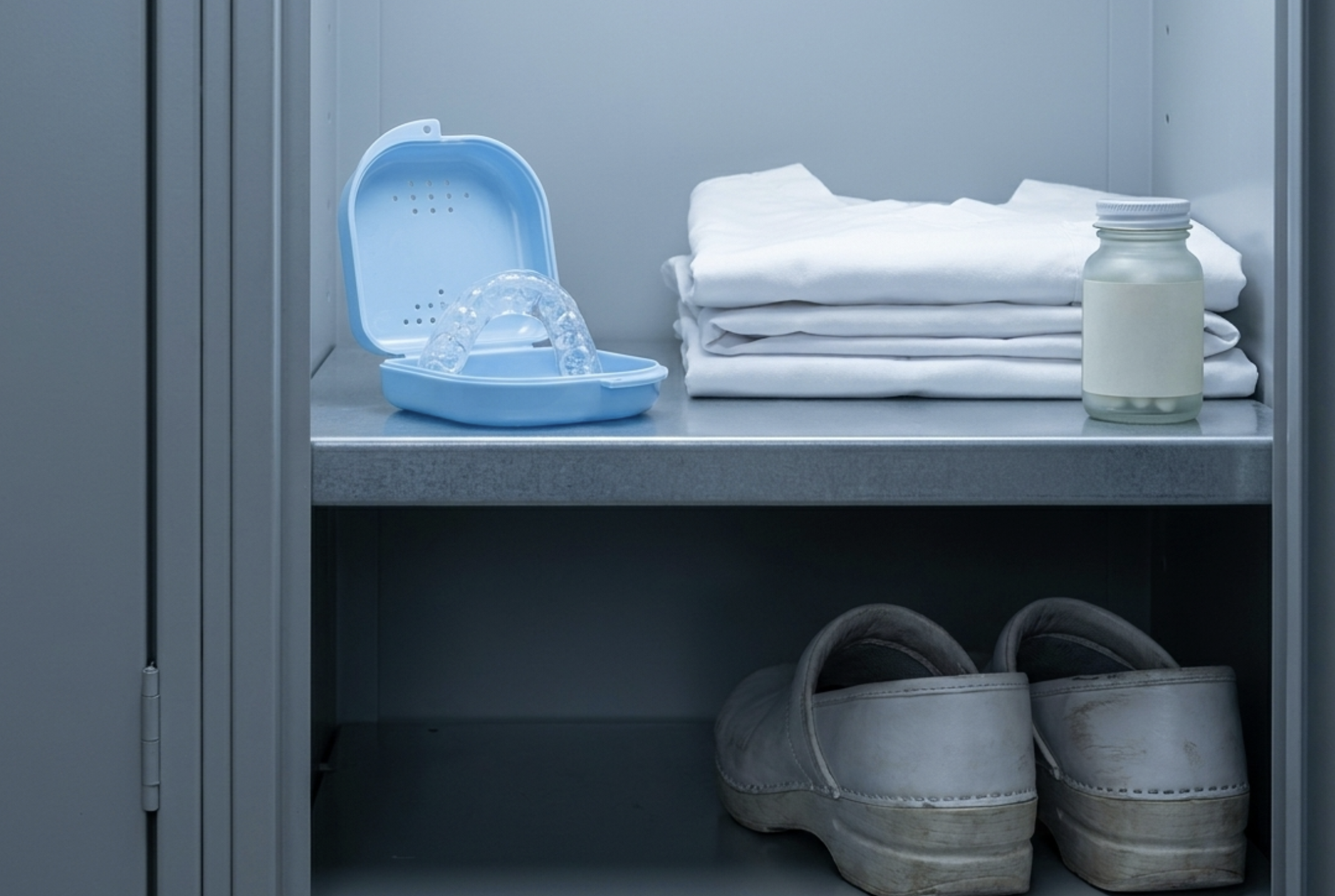
The guard doesn’t know what time it is. If you grind during a 6-hour daytime sleep between night shifts, that session needs guard protection the same way a conventional night sleep does. This means having the guard accessible wherever you sleep — not just on a nightstand that you only use during standard sleeping hours.
Hard acrylic only — not soft OTC
Nursing bruxism is driven predominantly by clenching (sympathetic activation, mask-talking habit) rather than lateral grinding. Soft OTC guards compress under clenching force and can stimulate more muscle loading, not less. Hard acrylic custom guards provide a non-compressible surface that distributes force without giving the jaw muscles a compressible target. This distinction matters more for clenching-dominant bruxism than for grinding-dominant bruxism, which is why it specifically matters for nurses.
Guard cleaning within the short inter-shift window
The standard cleaning routine assumes you wake up with time to clean the guard properly before starting your day. For nurses with 10-hour windows between shifts, this routine needs to fit into a compressed morning. The minimum effective cleaning takes 90 seconds: rinse immediately on removal, brush with mild soap and a soft toothbrush, leave to air dry. This can happen while the kettle boils or the shower runs. Do not skip it — the alternative is a biofilm-covered guard going back in for the next sleep session.
The Bottom Line — And a Genuine Thank You
The bruxism that many nurses experience is not a personal failing or a sign that they need to manage stress better. It is the physiological consequence of a work environment that demands sustained sympathetic activation, disrupts sleep architecture through shift rotation, created the mask-talking habit through years of PPE necessity, and consistently deprioritises the hydration and nutrition that maintain muscle health.
The five mechanisms are specific, explainable, and each has a specific intervention. They don’t require restructuring the work environment or eliminating shift work. They require a hard custom night guard worn consistently, magnesium timed to sleep onset, a jaw awareness habit during documentation, intentional hydration on shift, and dental monitoring that accounts for a rotating shift schedule.
That’s a manageable list. And it’s one that nurses deserve to have — because the same thoroughness that nurses apply to their patients’ health rarely gets applied to their own.
To every nurse reading this: thank you. The ANA theme this year is “The Power of Nurses.” Part of that power is protecting yourself so you can keep doing what you do. Your jaw has been absorbing the weight of your work for years. It deserves some protection back.
The Reviv model selector identifies the right FDA-registered Class I guard for your clenching and grinding pattern — or browse the full range.