
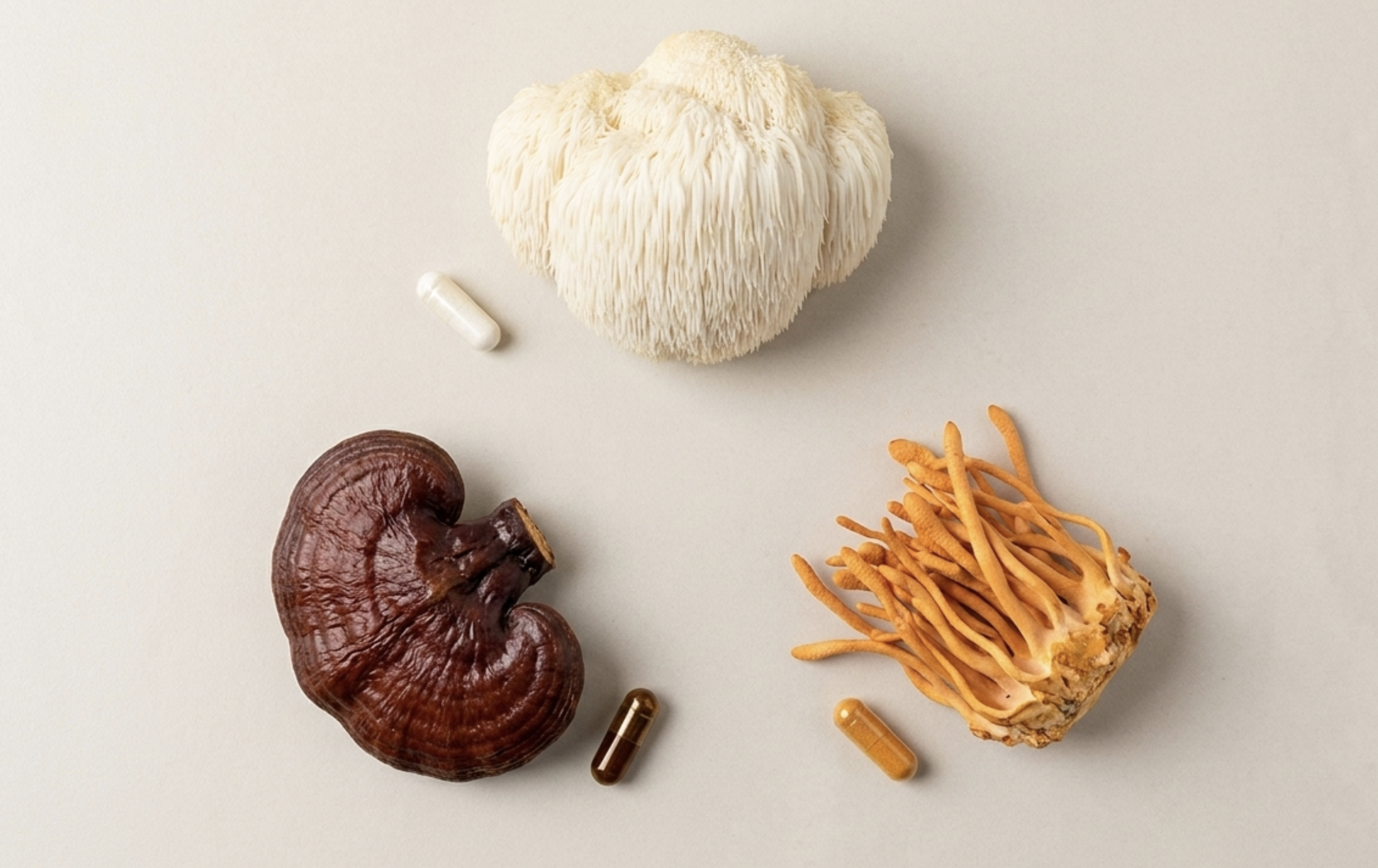

Can mushrooms help with teeth grinding?
Which mushroom is best for jaw clenching?
Does Lion’s Mane help with jaw tension?
When should I take Reishi for bruxism?
Do mushroom supplements replace a night guard?



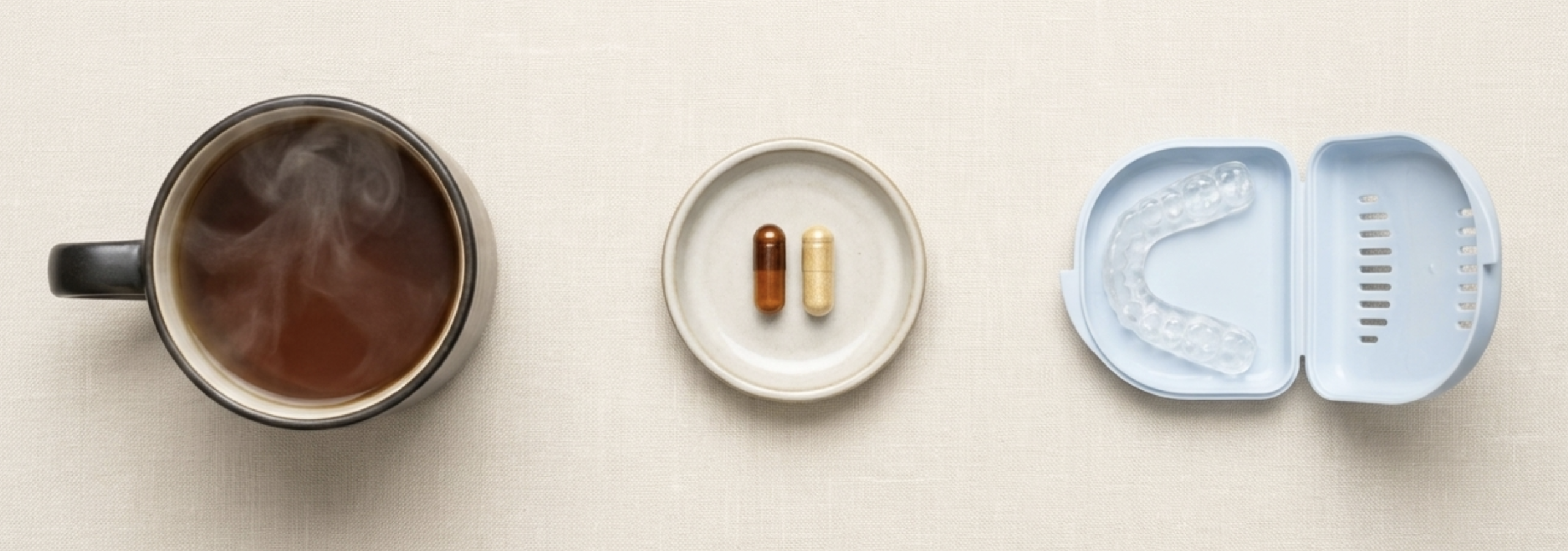
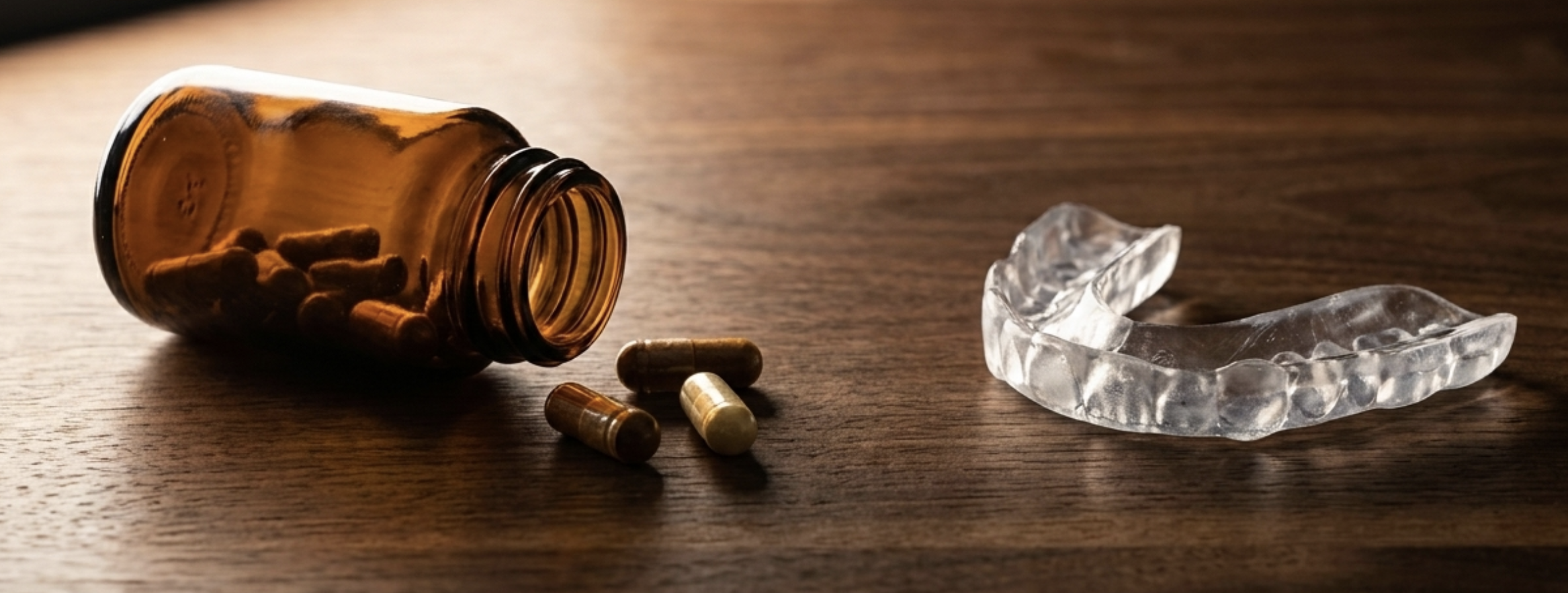
Adaptogenic mushrooms have become one of the fastest-growing supplement categories, and they show up regularly in bruxism conversations — in wellness communities, Reddit threads, and functional medicine practices. Lion’s Mane for anxiety. Reishi for sleep. Cordyceps for cortisol. The claims range from careful to extravagant.
This article gives you the mechanistic reality for each of the three mainstream adaptogenic mushrooms, mapped specifically to how bruxism works — which drivers they may address, which they don’t, and what the evidence actually supports versus what’s marketing. It also covers what none of these supplements can do, and why a night guard remains necessary regardless.
The Honest Starting Point
There is no clinical trial showing that any mushroom supplement reduces bruxism. The bruxism-specific research doesn’t exist. What does exist is research on the stress, cortisol, and sleep pathways that drive bruxism — and three mushrooms with varying levels of evidence for affecting those pathways.
Bruxism is driven, in most people, by some combination of sympathetic nervous system activation, cortisol elevation, and disrupted sleep architecture. It is not a single-mechanism condition — which is why no single supplement addresses it comprehensively. The mushrooms below each address one or two components of the bruxism picture, not the whole thing.
The honest framing: these are stress-pathway and sleep-architecture supports. If the primary drivers of your bruxism are stress-related and sleep-related — which they are for most people — reducing those drivers may indirectly reduce the frequency and intensity of nighttime clenching. The operative word is indirectly. And a night guard remains necessary because it addresses the dental consequences of whatever grinding still occurs after any supplement effect.
How Mushrooms Relate to Bruxism: The Connection
Bruxism is most commonly driven by elevated sympathetic tone (the nervous system state of alertness and readiness), elevated cortisol (particularly in shift workers, high-stress jobs, and people under chronic stress), and disrupted sleep architecture (too much time in lighter sleep stages where bruxism predominantly occurs).
Adaptogenic mushrooms — a functional category of fungi defined by their capacity to help the body maintain homeostasis under stress — work primarily on the HPA (hypothalamic-pituitary-adrenal) axis, which regulates cortisol and the stress response. Several also have direct effects on sleep neurotransmitters and neural growth factors that affect mood and anxiety.
The connection to bruxism is therefore indirect but mechanistically plausible: if adaptogenic mushrooms reduce sympathetic activation, moderate cortisol, and improve sleep depth, they address three of the primary drivers of nighttime jaw clenching — through the same pathways that stress management, sleep hygiene, and cortisol regulation address, but through pharmacological support rather than behavioural change alone.
Lion’s Mane: The Nootropic Anxiolytic
Lion’s Mane (Hericium erinaceus) is the most cognitively-focused of the three. Its primary mechanisms are nerve growth factor (NGF) stimulation and gut-brain axis modulation — which produce nootropic effects (improved focus, cognitive function) alongside what research describes as mild anxiolytic properties.
What the evidence shows
A randomised controlled trial published in Biomedical Research found that Lion’s Mane supplementation significantly reduced depression and anxiety scores compared to placebo in a group of adult women over four weeks. A separate study found improvements in sleep quality in a subset of participants alongside mood improvements. The mechanisms proposed include NGF-stimulated neuroplasticity and direct effects on the gut microbiome, which modulates the gut-brain axis that influences anxiety and mood.
The effects are modest by clinical standards — this is not an anxiolytic drug, and the evidence is emerging rather than established. But for people whose bruxism is significantly driven by anxiety and sustained daytime sympathetic activation, Lion’s Mane provides a low-risk adjunct that addresses the anxiety component through a pathway distinct from magnesium or Reishi.
Relevance to bruxism
Lion’s Mane is most relevant for people whose jaw clenching is primarily driven by anxiety and daytime sympathetic activation — the concentration-clenching pattern that occurs during focused work, stressful interactions, or chronic low-grade anxiety. By reducing the baseline anxiety load, it may reduce the sympathetic tone that elevates jaw muscle baseline tension. The effect is daytime — it does not directly improve sleep architecture the way Reishi does.
Timing and dosing
Morning or daytime — Lion’s Mane is a cognitive support taken during waking hours, not a bedtime supplement. 500–1000mg of a dual-extracted Lion’s Mane preparation is the typical research-adjacent dose. Look for products that specify fruiting body extraction (not mycelium on grain) and beta-glucan content.
Reishi: The Bedtime Mushroom
Reishi (Ganoderma lucidum) is the most relevant of the three mushrooms for bruxism, and the one most worth prioritising if you’re going to add one to an evening routine.
What the evidence shows
Reishi’s primary active compounds are triterpenes (ganoderic acids) and polysaccharides. The triterpenes are responsible for most of the stress and sleep effects. Research has shown Reishi triterpenes to have activity at GABA receptors — the same receptor system that sedatives and anti-anxiety medications work on, though at significantly lower potency. Clinical research on Reishi for anxiety shows modest but consistent anxiolytic effects. Research on sleep shows improvements in both time to sleep onset and time in deep sleep stages — directly relevant to bruxism.
A 2012 study in the Journal of Ethnopharmacology found that Reishi extract significantly increased total sleep time and non-REM sleep in animal models. Human research, while more limited, is consistent with the animal data in showing sleep-promoting effects. Reishi’s traditional designation as a “spirit tonic” and bedtime herb in East Asian medicine is consistent with its pharmacological profile.
Relevance to bruxism
Reishi addresses the two most directly relevant bruxism drivers simultaneously: it promotes parasympathetic shift (reducing the sympathetic activation that elevates jaw muscle tone), and it improves deep sleep architecture (reducing time in the lighter sleep stages where bruxism predominantly occurs). Of the three mushrooms, Reishi has the most mechanistically direct pathway to reduced nocturnal jaw clenching — through the same sleep-depth mechanism that makes deep, restful sleep associated with less grinding than fragmented, shallow sleep.
The evidence remains emerging rather than definitive, but the safety profile is well-established and the mechanisms are plausible. For people whose bruxism worsens during high-stress periods or with poor sleep quality, Reishi is the most appropriate mushroom adjunct. It pairs naturally with magnesium glycinate as part of an evening bruxism-reduction stack — the magnesium addresses muscle relaxation directly, and Reishi addresses the sleep architecture and parasympathetic pathways.
Timing and dosing
30–60 minutes before sleep. This is not a morning supplement — it is specifically indicated as an evening preparation. 1–2g of a dual-extracted Reishi preparation (hot water extract for polysaccharides, alcohol extract for triterpenes — a dual extraction is necessary to get both active compound classes). Look for products that specify triterpene content (minimum 2%) alongside beta-glucan content. Preparations that only specify “polysaccharides” without triterpene assay are often lower-quality products that won’t deliver the sleep and anxiety effects.
Cordyceps: Cortisol Regulation — With an Important Caveat
Cordyceps (Cordyceps militaris is the cultivated supplement form; Cordyceps sinensis the wild form) has the most complex relevance to bruxism — useful for one specific mechanism but counterproductive if timed incorrectly.
What the evidence shows
Cordyceps’ primary mechanisms are improved cellular energy production (ATP) via adenosine compounds, HPA axis modulation, and anti-inflammatory activity. Research consistently shows Cordyceps improves oxygen utilisation, physical performance, and markers of stress resilience — the capacity to handle stress without the cortisol spike being disproportionate to the stressor. It does not reduce cortisol acutely; it modulates the HPA axis response so that cortisol output is better calibrated to actual demand over time.
For bruxism, this matters because chronically elevated cortisol — particularly in shift workers, high-stress professions, and people under sustained occupational stress — is a consistent driver of elevated jaw muscle tone. Reducing the overall cortisol burden through HPA axis modulation may, over weeks of use, reduce the baseline sympathetic tone that keeps jaw muscles more activated than they should be.
The caveat: Cordyceps is stimulating
Despite its cortisol-regulating properties, Cordyceps is energising rather than calming. Its ATP-promoting effects increase cellular energy and alertness — which is why it’s used as a pre-exercise supplement and morning cognitive enhancer. Taken in the evening, Cordyceps will disrupt sleep onset and reduce sleep quality — the exact opposite of what a bruxism-reduction evening routine is trying to achieve.
This is the most important practical point about Cordyceps: it belongs in the morning, not the evening. People who take Cordyceps as part of a stress-management routine but take it in the evening may be improving their cortisol regulation during the day while simultaneously reducing their sleep quality at night — worsening the sleep architecture driver of bruxism in the attempt to address the cortisol driver.
Timing and dosing
Morning or pre-exercise — never within 6 hours of intended sleep. 1–2g of Cordyceps militaris extract (the cultivated form with consistent cordycepin content) is the typical dose. Look for products that specify cordycepin content (minimum 1%) — this is the active adenosine compound responsible for most of the ATP and energy effects.
Side-by-Side: What Each Mushroom Does and Doesn’t Do
| Lion’s Mane | Reishi | Cordyceps | |
|---|---|---|---|
| Primary mechanism | NGF pathway, gut-brain axis | GABA receptor activity, HPA modulation | ATP production, HPA axis modulation |
| Effect on anxiety | Mild anxiolytic — emerging evidence | Moderate anxiolytic — consistent evidence | Indirect via energy balance, not direct |
| Effect on sleep | Minor secondary benefit | Primary effect — improves deep sleep | Negative if taken evenings |
| Effect on cortisol | Indirect via stress reduction | HPA modulation | Direct HPA modulation |
| Bruxism relevance | Moderate — anxiety/daytime clenching | High — sleep depth, parasympathetic shift | Low-moderate — cortisol, but stimulating |
| Optimal timing | Morning | 30–60 min before sleep | Morning or pre-exercise only |
| Pairs with magnesium | Yes | Yes — core evening stack | Not in the same session |
| Evidence level | Emerging | Moderate — most established of the three | Moderate for energy; limited for stress |
Pairing With Magnesium: The Evening Stack
The most effective supplement approach for stress and sleep-driven bruxism is not any single mushroom but a specific combination that addresses multiple pathways simultaneously. The evening pairing that has the most mechanistic support:
- Reishi (1–2g dual extract) — parasympathetic shift, sleep architecture, GABA receptor activity
- Magnesium glycinate (200–400mg) — direct muscle relaxation via calcium antagonism, GABA receptor co-agonism, sleep quality improvement
These two supplements work through complementary mechanisms without overlap or interaction. Reishi addresses the nervous system and sleep architecture; magnesium addresses the muscle physiology and adds additional GABA system support. Both are taken 30–60 minutes before sleep. The combination is significantly more comprehensive than either alone.
Lion’s Mane in the morning addresses daytime anxiety and the sympathetic activation that accumulates through the day and carries into nighttime muscle tone. Cordyceps in the morning addresses the cortisol regulation that determines baseline jaw muscle activation over weeks of use. The full stack uses all four, timed correctly — morning (Lion’s Mane, Cordyceps) and evening (Reishi, magnesium).
What to Look for on the Label
Mushroom supplement quality varies enormously, and poor-quality products may contain little to none of the active compounds claimed. Three label indicators of a quality mushroom supplement:
Fruiting body, not mycelium on grain
Many lower-cost mushroom supplements are produced from mycelium grown on grain (typically oats or brown rice) rather than from the mushroom fruiting body. Mycelium-on-grain products contain significant starch content from the grain substrate and typically much lower concentrations of active compounds (beta-glucans, triterpenes, cordycepin) than fruiting body extracts. Look for “fruiting body” specified on the label. “Mycelium biomass” or no specification at all is a flag.
Dual extraction for Reishi
Reishi’s active compounds come in two classes: water-soluble polysaccharides (extracted by hot water) and alcohol-soluble triterpenes (extracted by ethanol). A hot-water-only extract will have polysaccharides but no triterpenes — missing the compounds responsible for the anxiety and sleep effects. A dual-extracted Reishi product specifies both polysaccharide and triterpene content. This is non-negotiable for anyone taking Reishi specifically for the sleep and stress effects.
Third-party testing and beta-glucan assay
Look for products that provide a certificate of analysis (COA) from a third-party lab showing beta-glucan content (not just “polysaccharides” — these are different measurements) and, for Reishi, triterpene content. For Cordyceps, cordycepin content. Products that only claim “polysaccharides” without beta-glucan assay are likely using a non-specific assay that includes starch — inflating the number.
The Night Guard Stays
This deserves a direct statement because the wellness supplement world has a consistent tendency to position natural interventions as alternatives to conventional ones rather than as adjuncts.
Mushroom supplements — even the most effective combination, timed correctly, from the highest-quality source — do not protect your teeth from grinding and clenching force. If you grind while sleeping, the force reaches your enamel and causes wear, regardless of what supplements you’ve taken. Enamel does not regenerate. The cumulative damage of years of unprotected grinding is irreversible.
A hard custom night guard absorbs the grinding and clenching force before it reaches enamel. Identifying whether your primary pattern is clenching, grinding, or both determines the right guard specification — hard acrylic for clenchers, dual-laminate for heavy grinders. But the guard is not optional if bruxism is confirmed or suspected.
The supplements reduce the drive. The guard protects the teeth from whatever drive remains. These are complementary functions, not competing choices.
The Bottom Line
Of the three mainstream adaptogenic mushrooms, Reishi has the most direct relevance to nighttime bruxism — through its parasympathetic-promoting effects and evidence for improving deep sleep architecture. Lion’s Mane has secondary relevance for anxiety-driven daytime clenching. Cordyceps has potential benefit through cortisol regulation but must be taken in the morning — evening use is counterproductive for anyone trying to improve sleep quality.
The most effective approach: Reishi and magnesium glycinate in the evening address sleep architecture and muscle relaxation simultaneously. Lion’s Mane and Cordyceps in the morning address daytime anxiety and cortisol regulation. A hard custom night guard every sleep session protects teeth from whatever grinding still occurs.
None of this is bruxism treatment. All of it is bruxism management — reducing the drivers where possible, protecting the dental consequences regardless. The Reviv model selector identifies the right FDA-registered Class I guard for your specific pattern, or browse the full range alongside whichever supplement approach you pursue.